
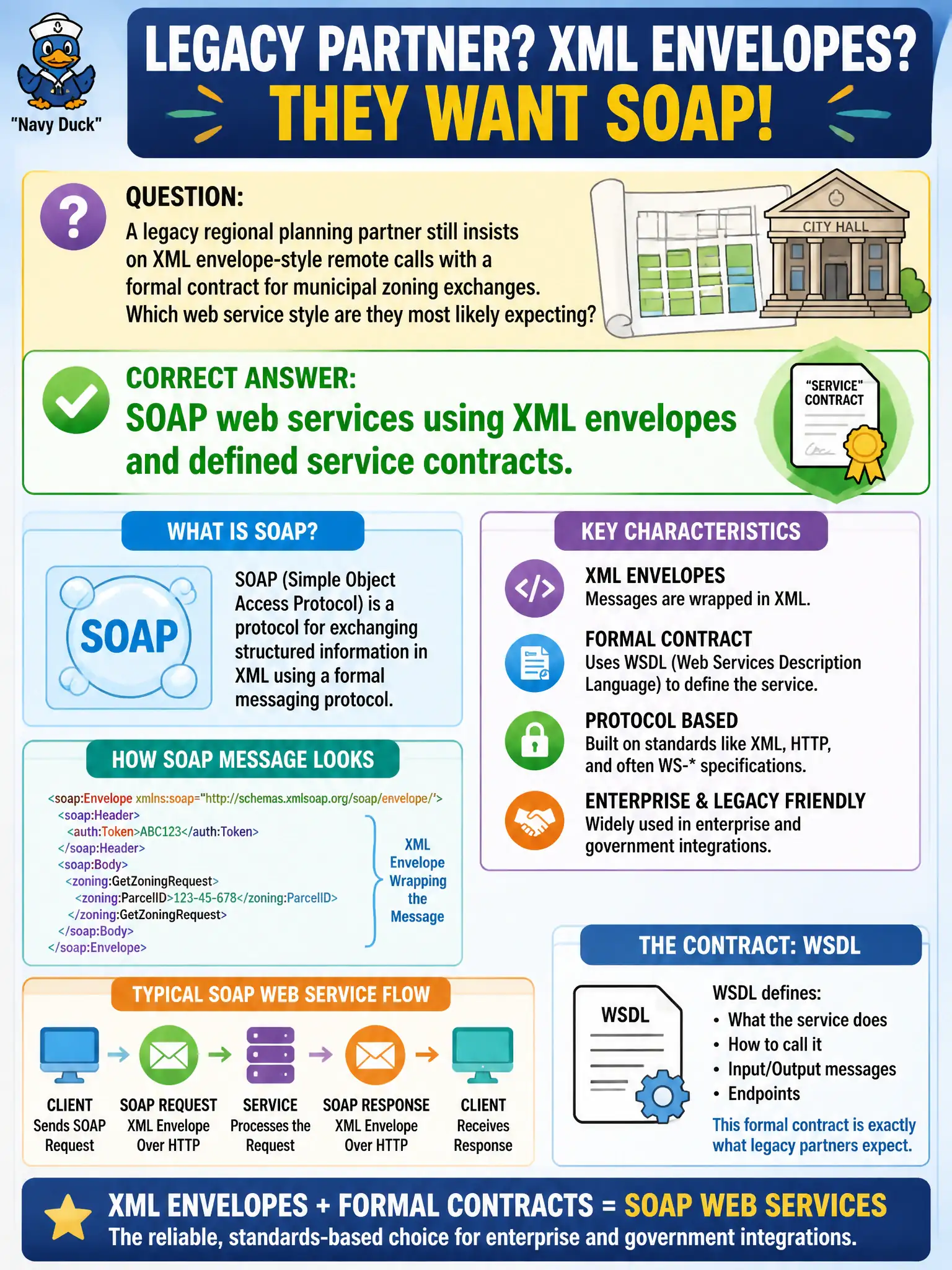
A legacy regional planning partner still insists on XML envelope-style remote calls with a formal contract for municipal zoning exchanges. Which web service style are they most likely expecting?
Select an answer to reveal the explanation.
Short Explanation
That partner still talks in formal XML envelopes—the SOAP world. Municipal integrations often keep SOAP around for legacy enterprise partners even when the city prefers REST elsewhere. Matching their contract beats forcing a trendy API they cannot consume.
Full Explanation
A legacy regional planning partner that still insists on XML envelope-style remote calls with a formal contract for municipal zoning exchanges is most likely expecting SOAP web services using XML envelopes and defined service contracts. SOAP and WSDL-style contracts remain common in inter-agency integrations even when city teams prefer REST internally. GraphQL queries that let the partner select nested JSON fields on demand do not satisfy XML envelope contract expectations. Ad hoc WebSocket streams without a published interface description lack the formal contract the partner requires. Unsigned MQTT telemetry packets from streetlight sensors address IoT telemetry, not zoning document exchange between planning systems. Exam caveat: prefer gateway or translation layers between SOAP partners and internal REST rather than forcing every civic system onto one style in a single cutover. Operational check: obtain the partner WSDL or contract, validate XML messages in a test environment, monitor SOAP faults, assign an interface owner, and document the zoning exchange in the municipal integration catalog. In municipal cloud operations, record the chosen control and the rejected alternatives in the change or incident ticket so future on-call staff understand which failure modes were avoided for city services. Re-validate after the next maintenance window that the same decision still holds under current provider limits, identity bindings, and application versions used by the civic platform team.