
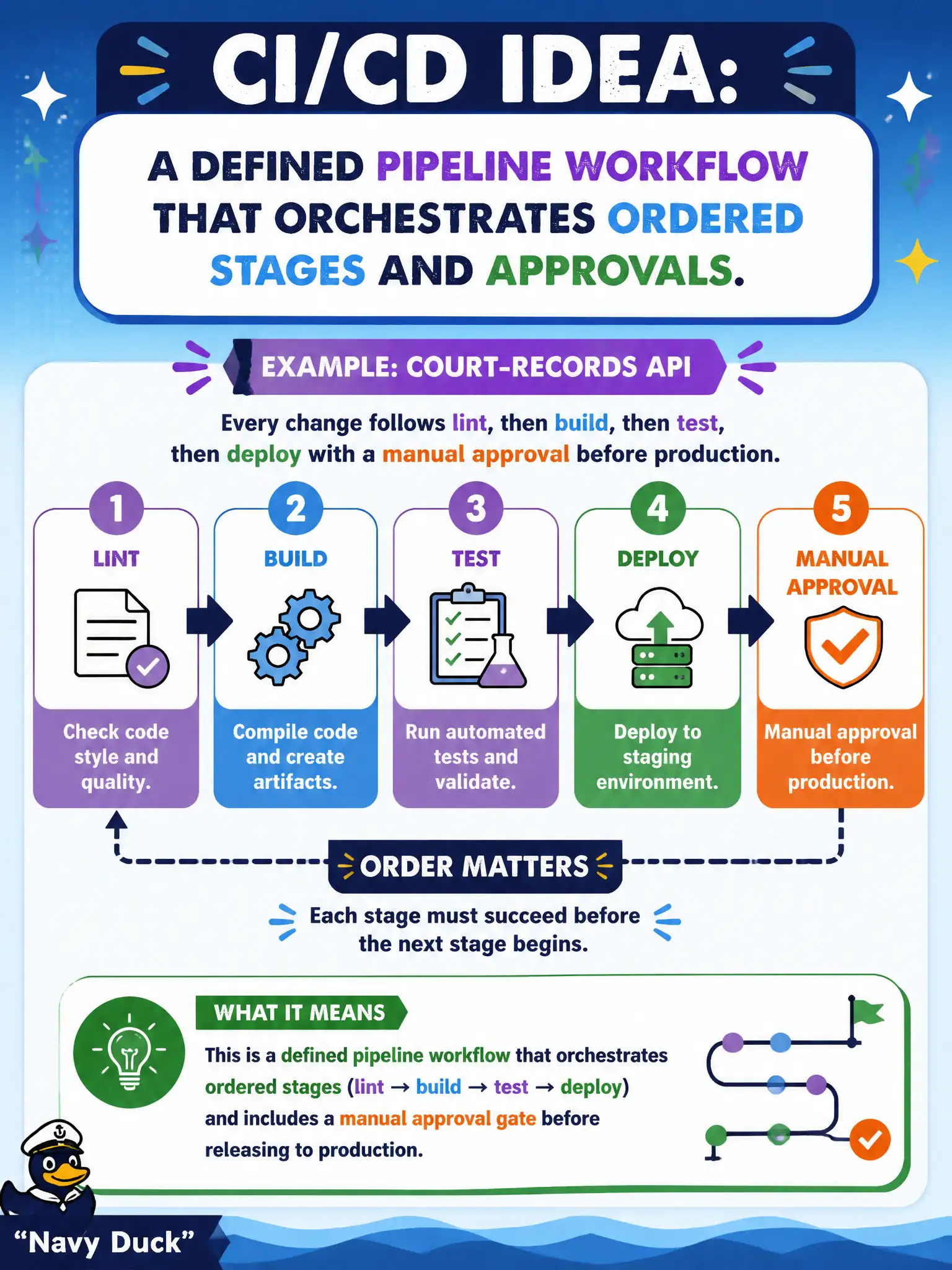
A DevOps lead documents that every change for the court-records API must follow lint, then build, then test, then deploy with a manual approval before production. What CI/CD idea is this?
Select an answer to reveal the explanation.
Short Explanation
A pipeline workflow is the recipe card: lint → build → test → deploy, with a human OK before production. Order matters—don’t serve dinner before you cook. Documented stages beat ‘whatever the runner felt like today.’
Full Explanation
A DevOps lead documenting that every change for the court-records API must follow lint, then build, then test, then deploy with a manual approval before production is describing a defined pipeline workflow that orchestrates ordered stages and approvals. Explicit sequencing makes municipal delivery repeatable, teachable, and auditable. Random job ordering so each run invents a new sequence destroys determinism and confuses incident reconstruction. Skipping lint whenever developers feel confident weakens the earliest static quality gate. Deploying first and running tests only after citizens report errors inverts the pipeline and exposes sensitive court-related workloads. Exam caveat: a manual production approval is compatible with CI/CD—it is a governance gate inside the workflow, not evidence that automation is absent or incorrect. Operational check: open the court-records pipeline definition, confirm lint→build→test→deploy order, verify production requires approval, run a change through staging, and capture stage timestamps and approver identity in the civic release record. In municipal cloud operations, record the chosen control and the rejected alternatives in the change or incident ticket so future on-call staff understand which failure modes were avoided for city services. Re-validate after the next maintenance window that the same decision still holds under current provider limits, identity bindings, and application versions used by the civic platform team.