
A county evaluates leaving a niche PaaS that stores case files in proprietary export formats. What migration risk should planners emphasize?
Select an answer to reveal the explanation.
Short Explanation
Leaving a quirky PaaS can feel like moving out of an apartment where the landlord built the closets in a shape only their hangers fit. Proprietary formats make the exit painful—that is vendor lock-in, not something AZ placement or reserved instances fix.
Full Explanation
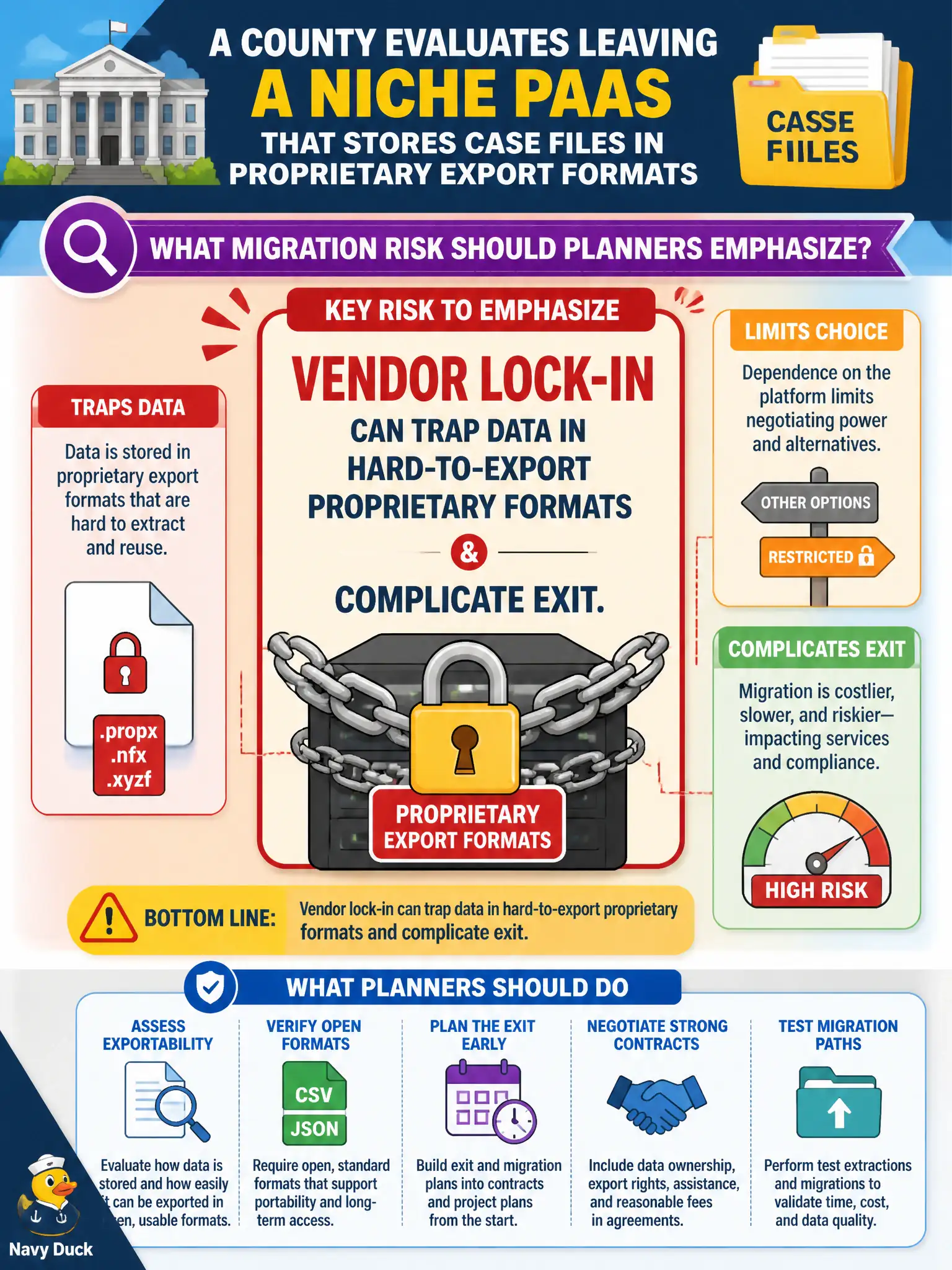
Vendor lock-in can trap data in hard-to-export proprietary formats and complicate exit from a niche PaaS that stores county case files. Planners must emphasize exportability, transformation cost, and contractual exit terms when evaluating departure. Autoscaling groups will reject any data that is not already in YAML fails as a nonsense constraint unrelated to format lock-in. Multi-AZ placement alone prevents proprietary format lock-in fails because availability design does not create portable exports. Reserved instances permanently encrypt municipal data against all exports fails; purchasing commitments are not an export control mechanism in that sense. Exam caveat: lock-in questions on Cloud+ often center on proprietary APIs, runtimes, and data formats—not on HA topology. Operational check: perform a sample export during the evaluation, measure transformation effort into open formats, store escrow copies per records policy, and write exit criteria into the municipal contract before more case files accumulate. In municipal platform operations, record the chosen control and the rejected alternatives in the change record so future on-call engineers understand the failure modes avoided for citizen services. Re-check the decision after the next provider feature change or compliance update to ensure the same answer still holds for the city's estate.