
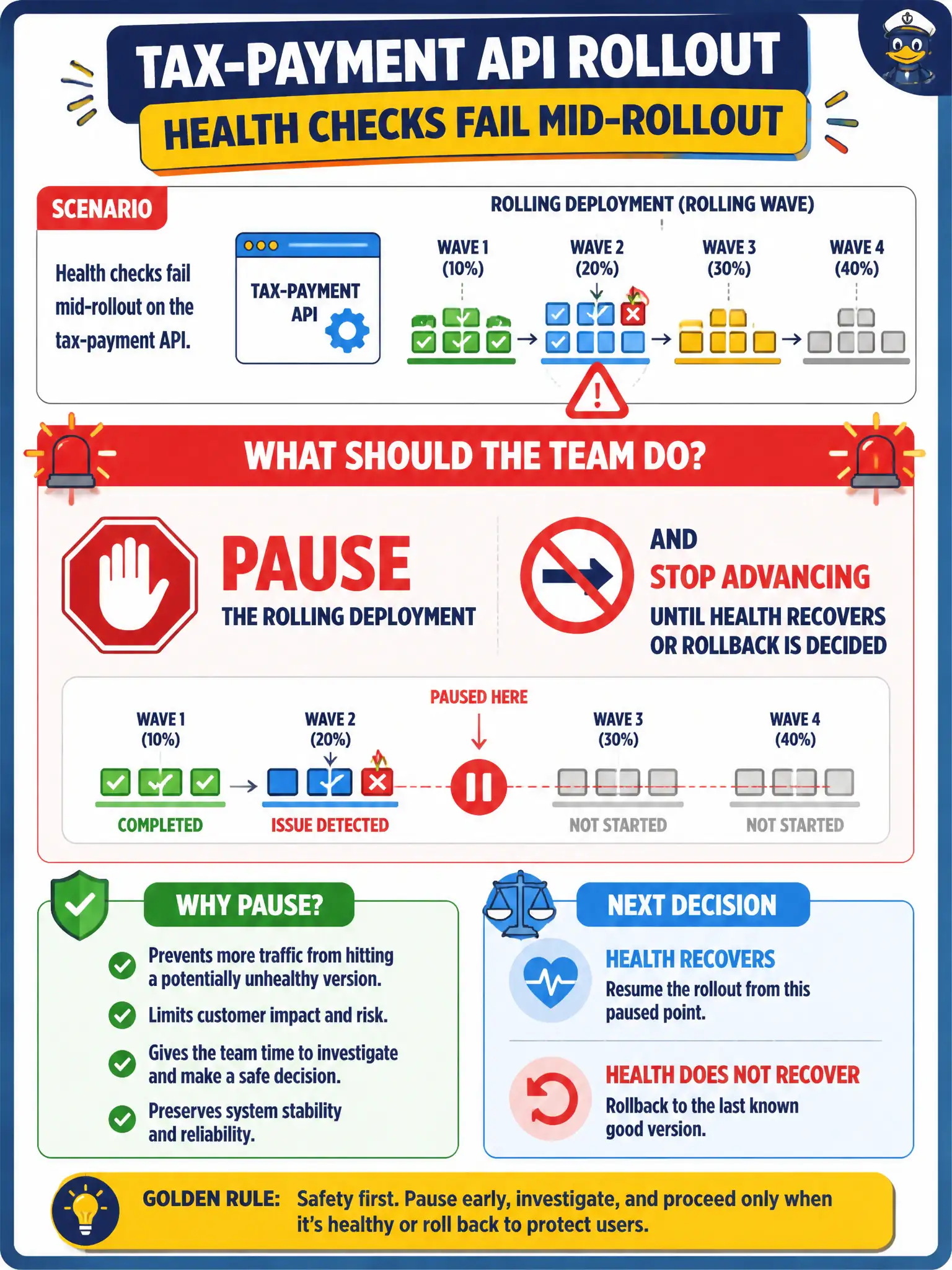
Health checks fail mid-rollout on the tax-payment API. What should the team do regarding the rolling wave?
Select an answer to reveal the explanation.
Short Explanation
If the first few cars on the new bridge shake, you do not send the whole convoy — you stop the wave. Rolling lives on incremental health: pause, diagnose, then continue or roll back. Pushing ahead while checks fail just widens the outage.
Full Explanation
When health checks fail mid-rollout, the correct operational response is to pause the rolling deployment and stop advancing until health recovers or an explicit rollback decision is made. That containment protects remaining healthy tax-payment capacity and prevents a bad batch from consuming the fleet. Ignoring failing checks and finishing every remaining instance as fast as possible fails because it maximizes blast radius against a known unhealthy signal. Immediately deleting all healthy instances still running the previous version fails because it removes the working capacity citizens still depend on. Switching 100% of traffic to an untested green environment with no validation fails because it abandons the rolling control loop for an unverified cutover. Exam caveat: rolling success depends on batch-gated progression; Cloud+ expects pause/rollback behavior on failed health, not “finish the wave anyway.” Operational check: automate halt-on-fail, page the on-call with batch identity and error signatures, compare payment success rates to baseline, and only resume after a documented municipal go/no-go. Preserve prior-version instances until rollback or forward-fix is decided so the civic payment path retains known-good capacity.