
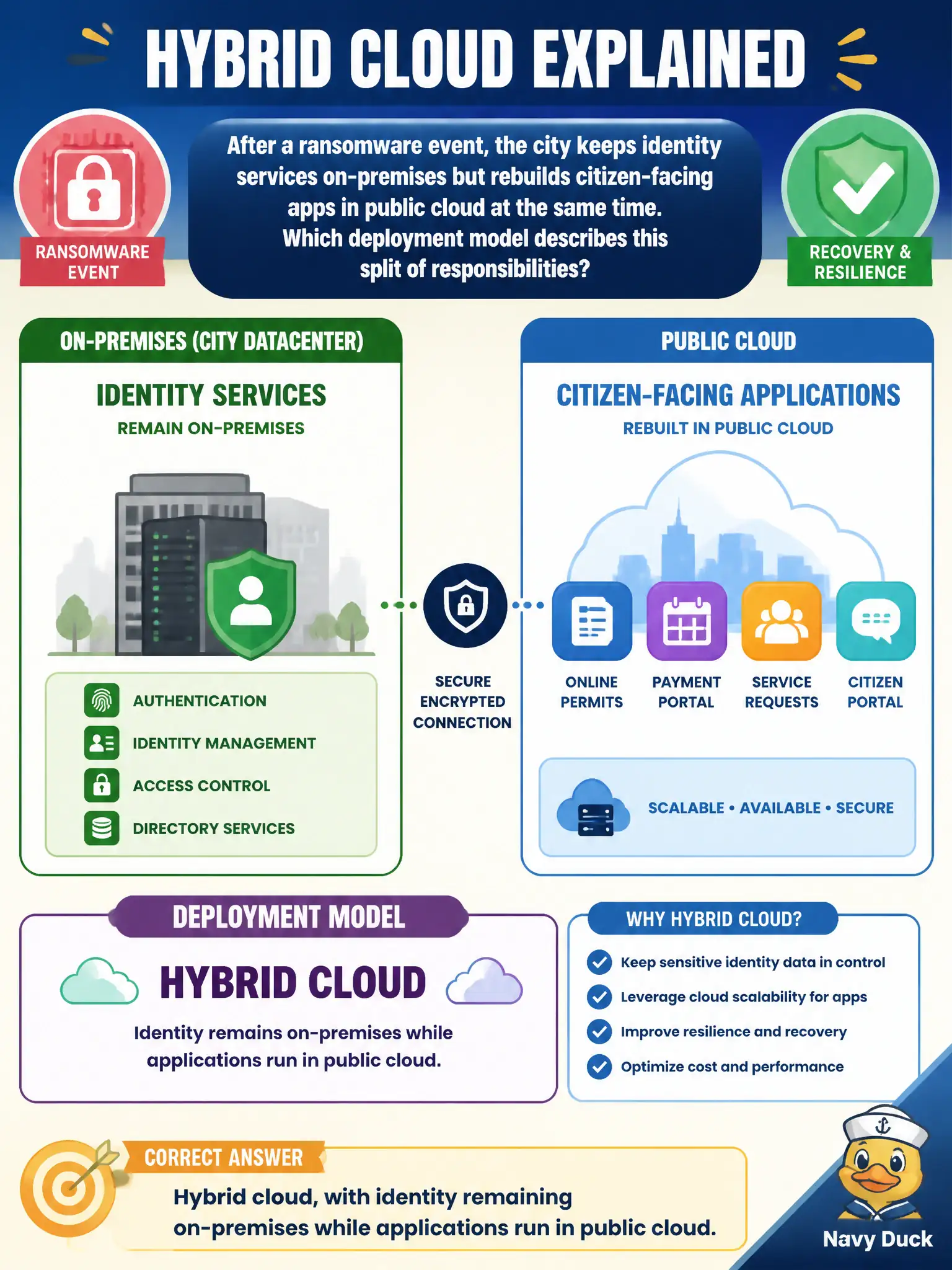
After a ransomware event, the city keeps identity services on-premises but rebuilds citizen-facing apps in public cloud at the same time. Which deployment model describes this split of responsibilities?
Select an answer to reveal the explanation.
Short Explanation
Hybrid is the "some here, some there" setup — like keeping the vault keys in city hall while the storefront moves to a safer mall. Identity stays on-premises; apps rebuild in public cloud. That intentional split across environments is hybrid, not "everything public" or "everything private."
Full Explanation
Hybrid cloud describes an intentional mix of on-premises or private capacity with public cloud so different layers of the stack can live in different places under coordinated operations. After ransomware, keeping identity services on-premises while rebuilding citizen-facing applications in public cloud is a classic hybrid split: authentication remains under city control while front-end workloads recover on elastic public infrastructure. Calling the design community cloud because two departments share one public SaaS mailbox fails the concept; community cloud is shared multi-organization infrastructure with common mission and governance, not mailbox sharing. Fully private cloud fails because application workloads are explicitly running in public cloud, so the estate is not private-only. Public cloud only fails because on-premises identity still exists and remains in the critical path. Exam caveat: Cloud+ items often tempt you to rename hybrid as private when any on-premises box remains, or as public when any internet-facing app appears; hybrid is the concurrent use of both. Operational check: verify federation or connectivity between on-premises identity and cloud apps, document the trust boundary, and exercise fail-closed behavior if the municipal identity plane is unreachable. Capture the recovery runbook so future civic incidents reuse the same hybrid pattern rather than improvising a full public-only rebuild that orphaned directory controls.