
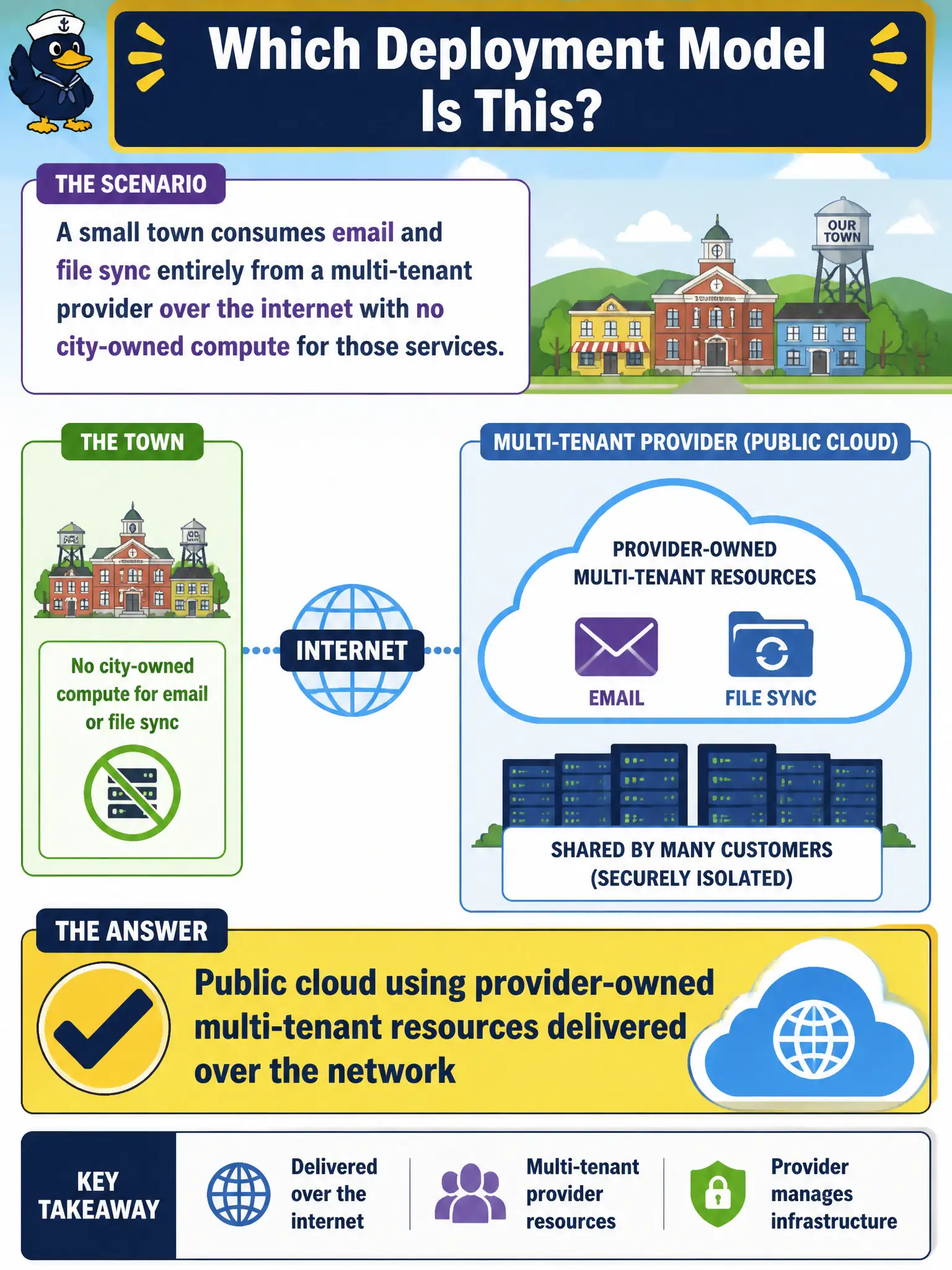
A small town consumes email and file sync entirely from a multi-tenant provider over the internet with no city-owned compute for those services. Which deployment model is this?
Select an answer to reveal the explanation.
Short Explanation
The town is renting seats on the big shared playground the provider owns — that is public cloud. Multi-tenant email and sync over the internet is the textbook picture. Private would mean the town's own dedicated stack.
Full Explanation
Public cloud delivers provider-owned, typically multi-tenant resources over the network to many customers. A small town that consumes email and file sync entirely from a multi-tenant provider over the internet with no city-owned compute for those services is using the public cloud deployment model—commonly experienced as SaaS running on public cloud infrastructure. Private cloud dedicated solely to one agency on city-controlled hardware is the opposite tenancy and ownership pattern. Community cloud shared only among allied counties with joint governance is a different multi-organization shared model with peer governance. An air-gapped lab with no external provider connectivity is not public cloud consumption at all. Exam caveat: deployment models (public, private, hybrid, community) describe ownership and sharing patterns—not merely whether users authenticate with passwords or multifactor authentication. Operational check: record the town’s email and file sync as public SaaS in the system inventory, implement strong identity federation and data-loss prevention, review the provider’s shared-responsibility and retention capabilities, test e-discovery exports, and ensure records schedules and legal holds still meet municipal policy.