
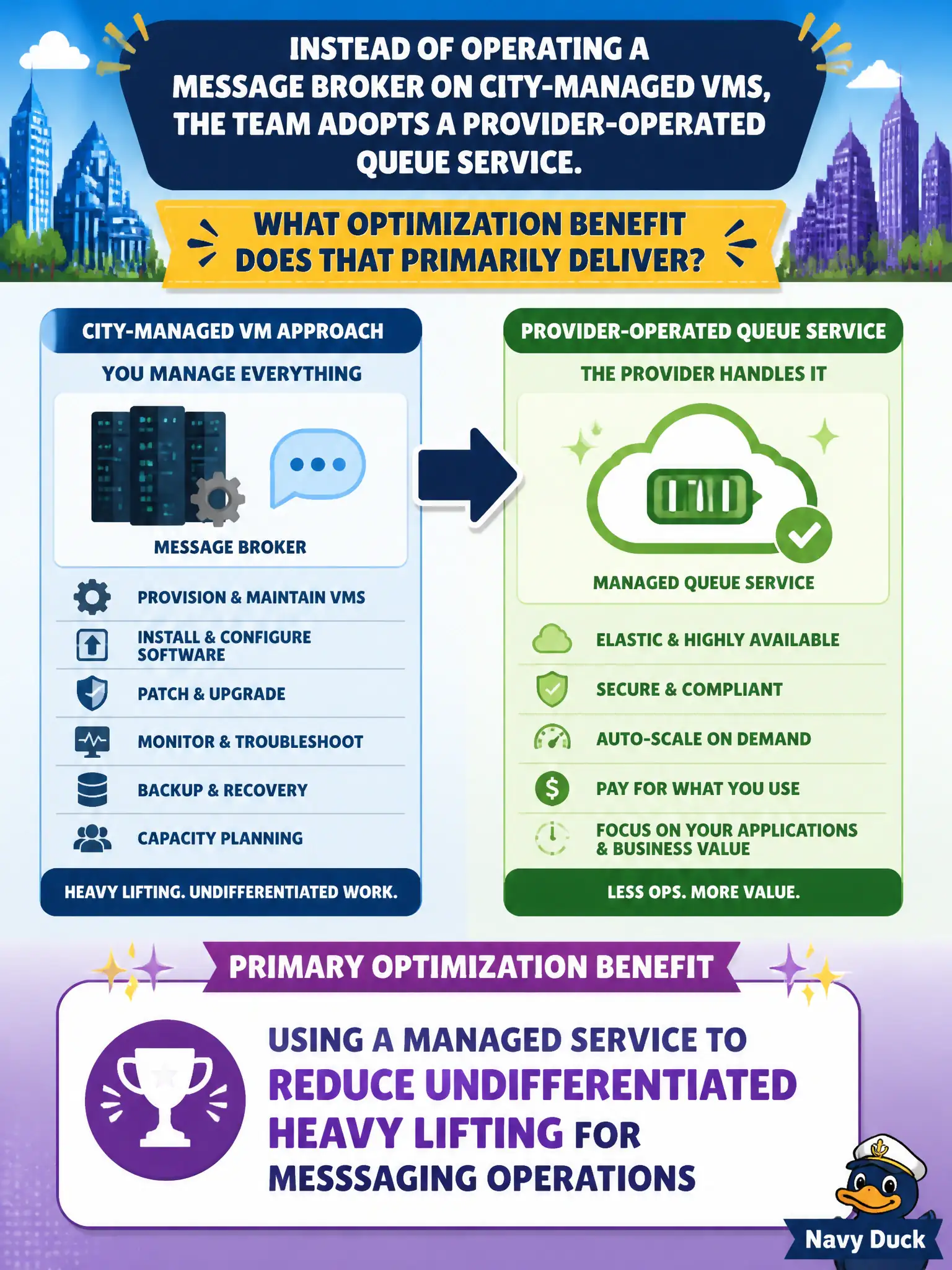
Instead of operating a message broker on city-managed VMs, the team adopts a provider-operated queue service. What optimization benefit does that primarily deliver?
Select an answer to reveal the explanation.
Short Explanation
Running your own message broker is like maintaining the city's mail trucks when you could use a postal service that already does sorting and upkeep. Managed queues hand that undifferentiated ops work to the provider. Your team focuses on the apps that put messages on the bus.
Full Explanation
Adopting a provider-operated queue or messaging service reduces undifferentiated heavy lifting—patching brokers, designing high-availability pairs, managing broker storage, and handling routine upgrades—so city teams can focus on producers, consumers, poison-message handling, and message contracts. That operational offload is the primary optimization benefit versus running a self-managed broker on municipal virtual machines. It does not eliminate the need for application authentication forever; clients still must authenticate and authorize to publish and subscribe. It does not guarantee zero network latency between every pair of services worldwide. It does not convert relational data automatically into handwritten paper forms for clerks. Exam caveat: managed messaging shifts platform operations, not application responsibility for idempotency, schema evolution, encryption, retention, and access policies on CompTIA Cloud+. Operational check: migrate topics and queues to the managed service with a dual-run period, configure IAM least privilege for each publisher and consumer, enable encryption and dead-letter queues, load-test peak 311 or permitting bursts, verify consumer lag dashboards, then decommission the old self-managed broker after stability and rollback criteria are met.