
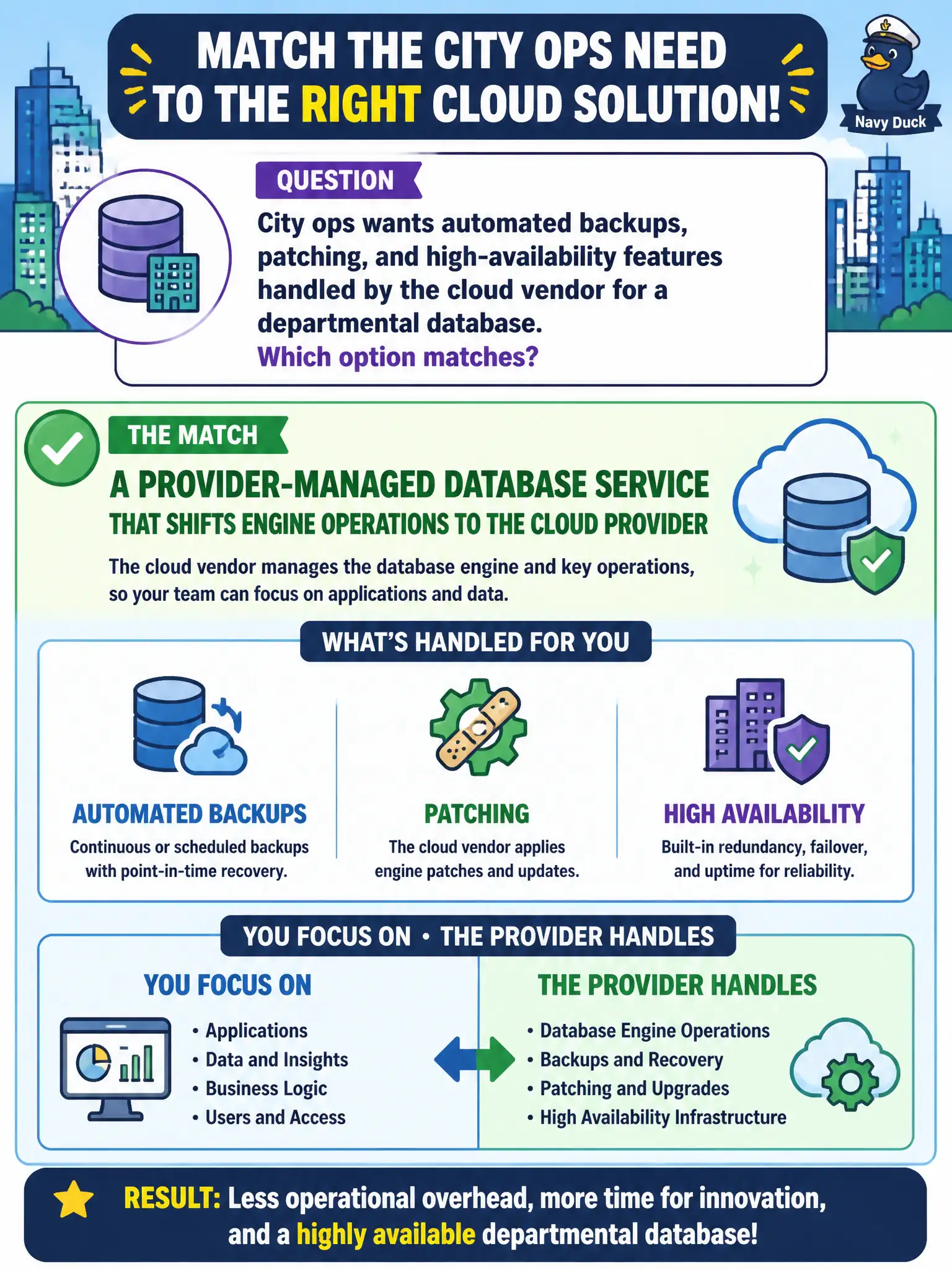
City ops wants automated backups, patching, and high-availability features handled by the cloud vendor for a departmental database. Which option matches?
Select an answer to reveal the explanation.
Short Explanation
Ops is saying, 'We will use the database, but you handle the oil changes.' Provider-managed database services do the backups, patches, and a lot of HA plumbing for you. That is the opposite of wrenching on every VM yourself.
Full Explanation
A provider-managed database service shifts undifferentiated engine operations—automated backups, patching, and many high-availability features—to the cloud vendor while the city retains data ownership, access control, schema design, and query responsibility. City ops that want those platform tasks handled by the vendor are selecting managed database services for the departmental workload. Installing the engine only on laptops so no cloud ops occur abandons departmental multi-user concurrency and durability needs. Self-managing every patch window manually on unmanaged VMs without vendor assistance is the opposite of the stated goal. Storing database files exclusively on removable USB drives at a clerk’s desk fails durability, concurrency, backup, and security expectations for municipal data. Exam caveat: managed does not mean unmanaged data—encryption, IAM, query safety, retention, and classification remain customer duties under Cloud+ shared-responsibility framing. Operational check: choose an engine and service tier that meet residency and HA needs, configure automated backups and maintenance windows around business freezes, test restore to a sandbox, enable audit logging, update runbooks so staff stop attempting guest-level engine patching, and verify application connection strings use least-privilege accounts.