
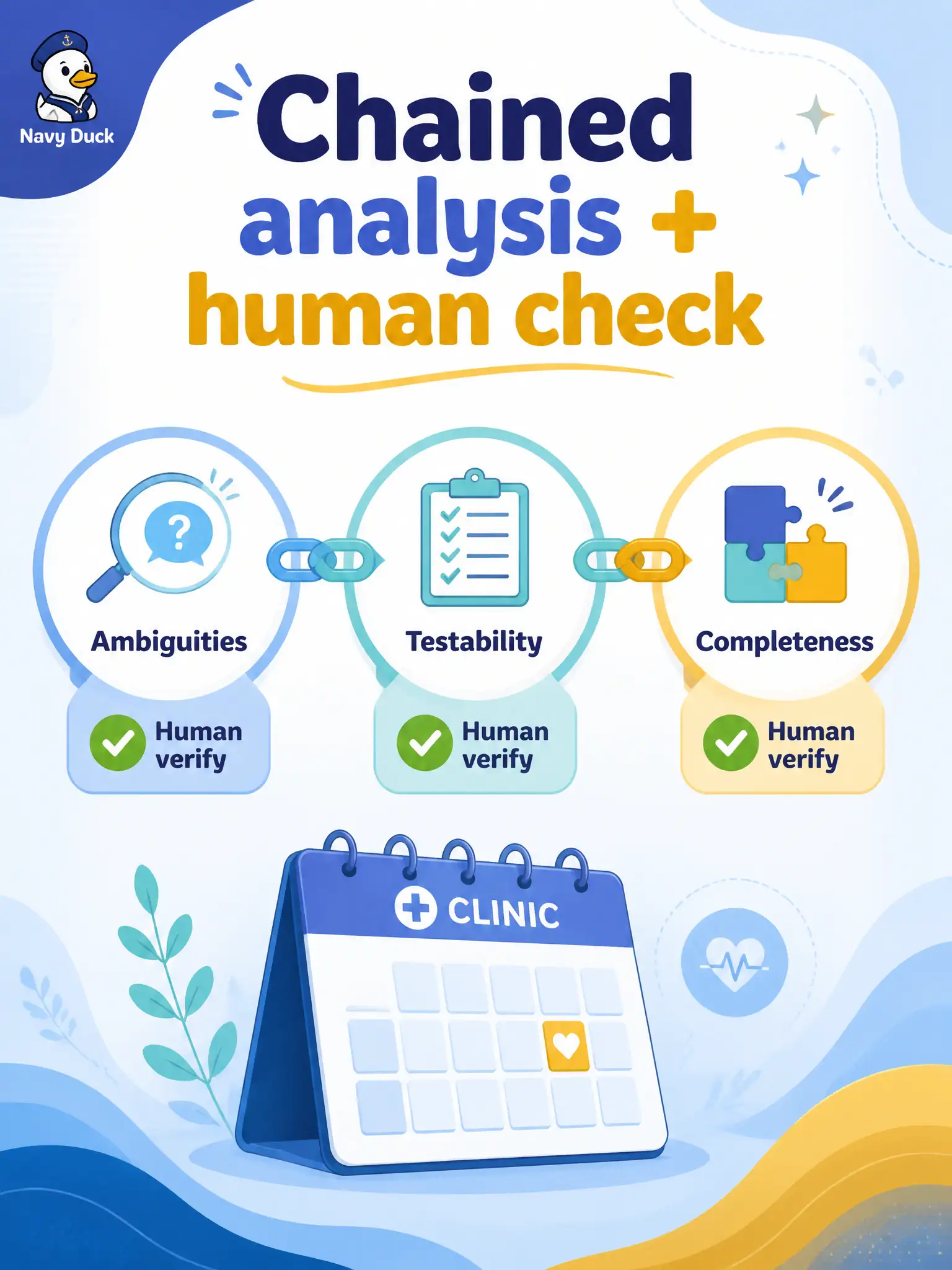
A community-clinic booking story will be refined across three GenAI asks—ambiguities, then testability, then completeness—with a tester correcting each reply. Which approach should the candidate select?
Select an answer to reveal the explanation.
Short Explanation
Refining AC is like seasoning soup in stages—taste after each pinch. Chain prompts for ambiguities, testability, and completeness, and have a human correct each reply. One giant unverified dump skips the tasting.
Full Explanation
Refining a community-clinic booking story across three GenAI asks—ambiguities, then testability, then completeness—with a tester correcting each reply is prompt chaining plus human verification after each step. Civic healthcare booking criteria affect access to care, so staged generation with human gates reduces the chance that fluent but flawed AC harden into policy. A single unverified dump that demands complete automation scripts fails because it collapses analysis stages, skips verification, and jumps to implementation assets too early. Skipping human review because fluent replies “always” yield complete AC fails as overtrust in fluency—a recurring GenAI risk in public services. Using only metamorphic testing of the LLM as the clinic’s system under test fails by concept: the scenario improves application acceptance criteria via chained prompts, not metamorphic evaluation of the model. Exam caveat: chaining is about sequenced prompts with checkpoints; human verification is part of responsible civic use, not optional polish. Operational check: run the three clinic prompts in order, require a tester sign-off after each reply against privacy and booking rules, merge corrections into the next prompt, and freeze AC only after the completeness checkpoint passes municipal clinical-operations review.