
A homestead-exemption desk must match four GenAI-in-testing needs: (1) manage AI systems for consistent practice; (2) ML lifecycle, data quality, and safety; (3) legal risk classes plus accountability and bias duties; (4) fairness, transparency, and security guidelines that help avoid biased test results. Which mapping is correct?
Select an answer to reveal the explanation.
Short Explanation
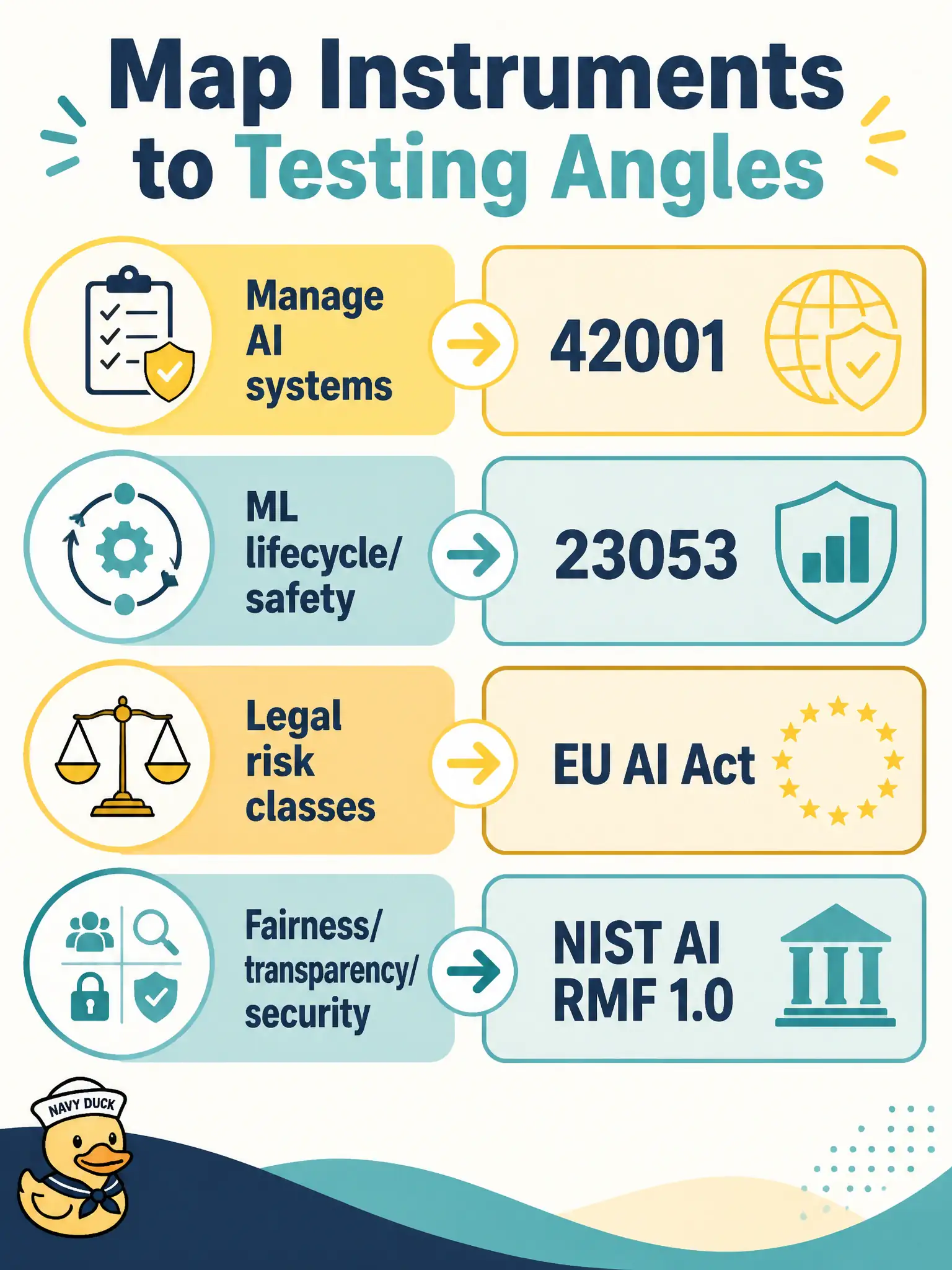
Line them up like tool drawers: manage AI systems → 42001; ML lifecycle and safety → 23053; legal risk classes → EU AI Act; fairness/transparency/security guidelines → NIST AI RMF 1.0. The syllabus one-liners lock that order.
Full Explanation
Homestead-exemption desks matching four GenAI-in-testing needs must map: (1) manage AI systems for consistent practice → ISO/IEC 42001:2023; (2) ML lifecycle, data quality, and safety → ISO/IEC 23053:2022; (3) legal risk classes plus accountability and bias duties → EU AI Act; (4) fairness, transparency, and security guidelines that help avoid biased test results → NIST AI RMF 1.0.
Other listed permutations scramble those syllabus one-liners. Wrong order is still wrong even if every name appears somewhere.
Exam caveat: lock the four one-liners; do not reshuffle under time pressure.
Operational check: keep a cheatsheet with the four need→instrument lines beside item-writing desks; validate new homestead GenAI governance docs against the same mapping before publication. Homestead exemption governance docs should paste the four need→instrument lines verbatim from the syllabus map and peer-check mappings before publication. Writers under time pressure should consult the cheatsheet rather than reshuffling familiar names into a plausible but wrong order. Before publishing homestead GenAI policy, have a second writer verify the four need→instrument lines against the syllabus map and reject any reshuffled permutation.