
A community-darkroom booking log with member IDs will travel to an LLM-powered test tool. Which mitigation best addresses protection of that data in motion and at rest?
Select an answer to reveal the explanation.
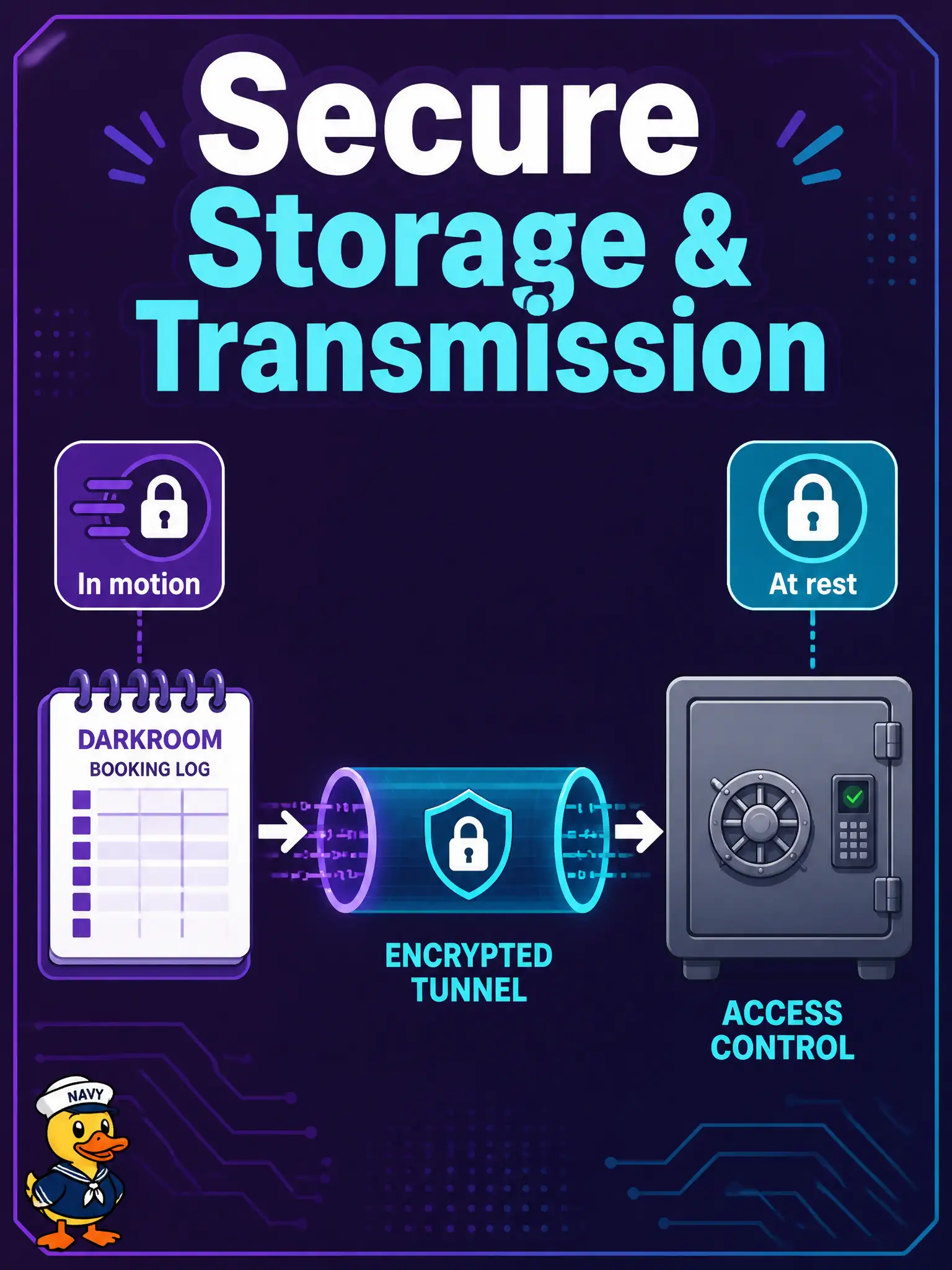
Short Explanation
Member IDs need a locked courier and a locked filing cabinet—not hopeful vendor slogans. Encryption plus access control protect the booking log while it moves and while it sits. Prompt tricks and hotter sampling are not storage or transport controls.
Full Explanation
Community-darkroom booking logs with member IDs need protection in motion and at rest: secure data storage and transmission using encryption and access controls. Locked courier and locked cabinet beat hopeful slogans.
Assuming vendor marketing makes further controls unnecessary fails by concept: claims are not controls. Relying solely on few-shot prompting to hide identifiers fails because prompt style is not encryption or access control. Increasing temperature so stored logs become statistically irreversible fails nonsensically—temperature does not secure storage.
Exam caveat: encryption and access control apply to GenAI test tooling pipelines the same way they apply to other civic systems holding member IDs.
Operational check: TLS in transit, encryption at rest, role-based access to the darkroom log store, no shared “test” passwords for the LLM tool, and key management reviewed with municipal IT security. Darkroom member-ID pipelines should require encryption in transit and at rest, rotate service credentials used by the LLM tool, and deny shared generic “testing” accounts that bypass least privilege. Keep custody evidence (who accessed which log export) so privacy reviews can reconstruct the path if a booking log later appears in an unexpected prompt.