
A community-orchard harvest kiosk security brief asks testers to name the four official GenAI security vectors in syllabus v1.1. Which set is correct?
Select an answer to reveal the explanation.
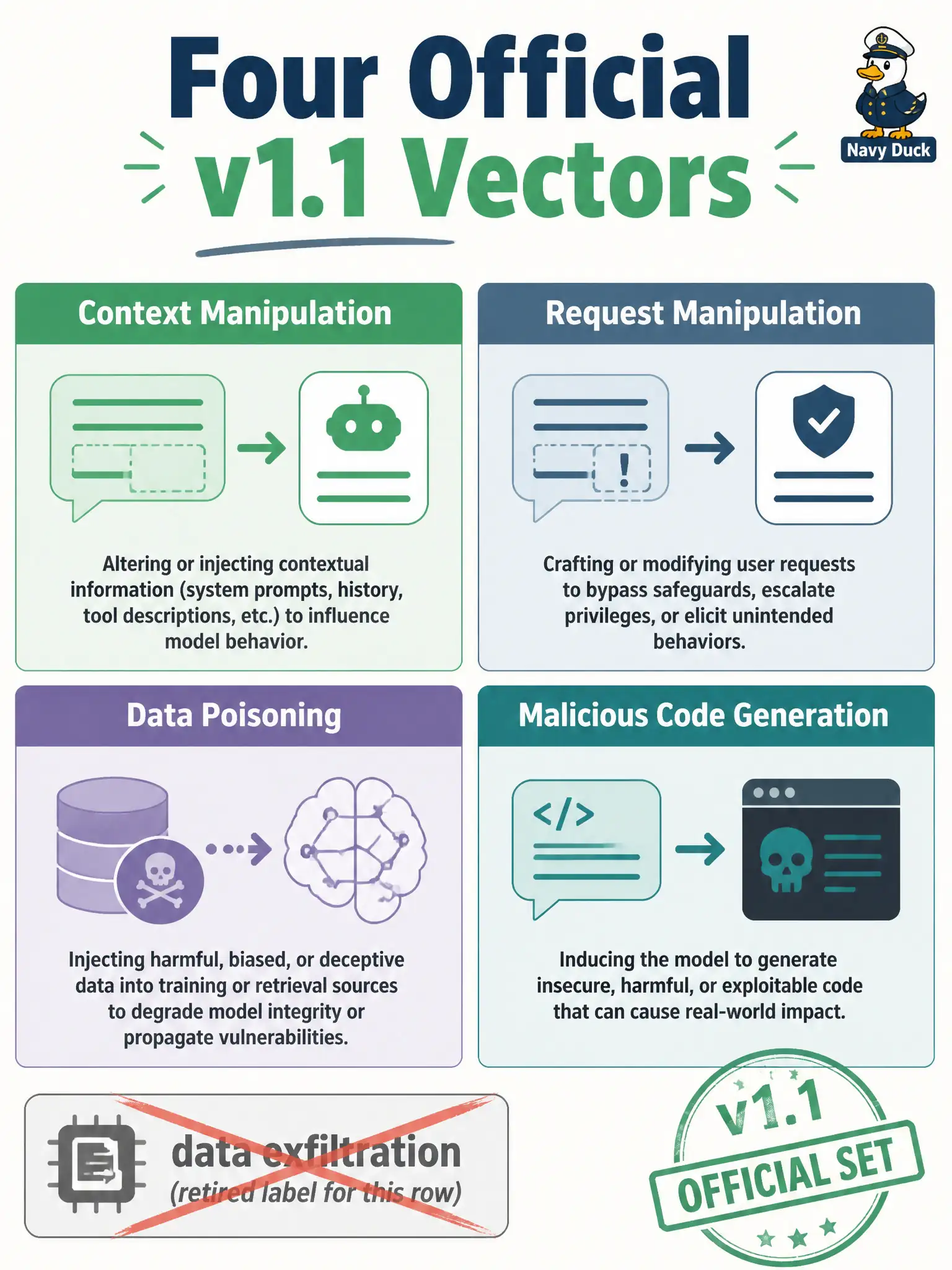
Short Explanation
The v1.1 roster is four named doors: context manipulation, request manipulation, data poisoning, and malicious code generation. Older “data exfiltration” labeling for this row is retired. Keep the official set straight for the exam.
Full Explanation
Orchard harvest kiosks under syllabus v1.1 must name the four official GenAI security vectors: context manipulation, request manipulation, data poisoning, and malicious code generation. That set is the examinable roster for this topic.
Lists that substitute data exfiltration, prompt lengthening, neuron coverage, and metamorphic oracles fail by mixing retired or off-syllabus labels. Jailbreak recipes, red-team payloads, vendor SKUs, and temperature floors fail as an unofficial grab bag. Hallucination scoring and NLP metrics fail because quality metrics are not the four security vectors.
Exam caveat: older study sheets may still say “data exfiltration” for a related idea; the exam follows v1.1 naming—context manipulation for that row’s official label.
Operational check: update internal security briefings and quizzes to the four v1.1 names; retire “data exfiltration” as the official vector label in training; map orchard-kiosk scenarios to the correct vector before prescribing controls. Refresh orchard security posters to the four v1.1 vector names and include one civic example each so staff stop using retired “data exfiltration” language on exams and in tickets. Keep the civic test basis authoritative over fluent model wording whenever the two disagree.