
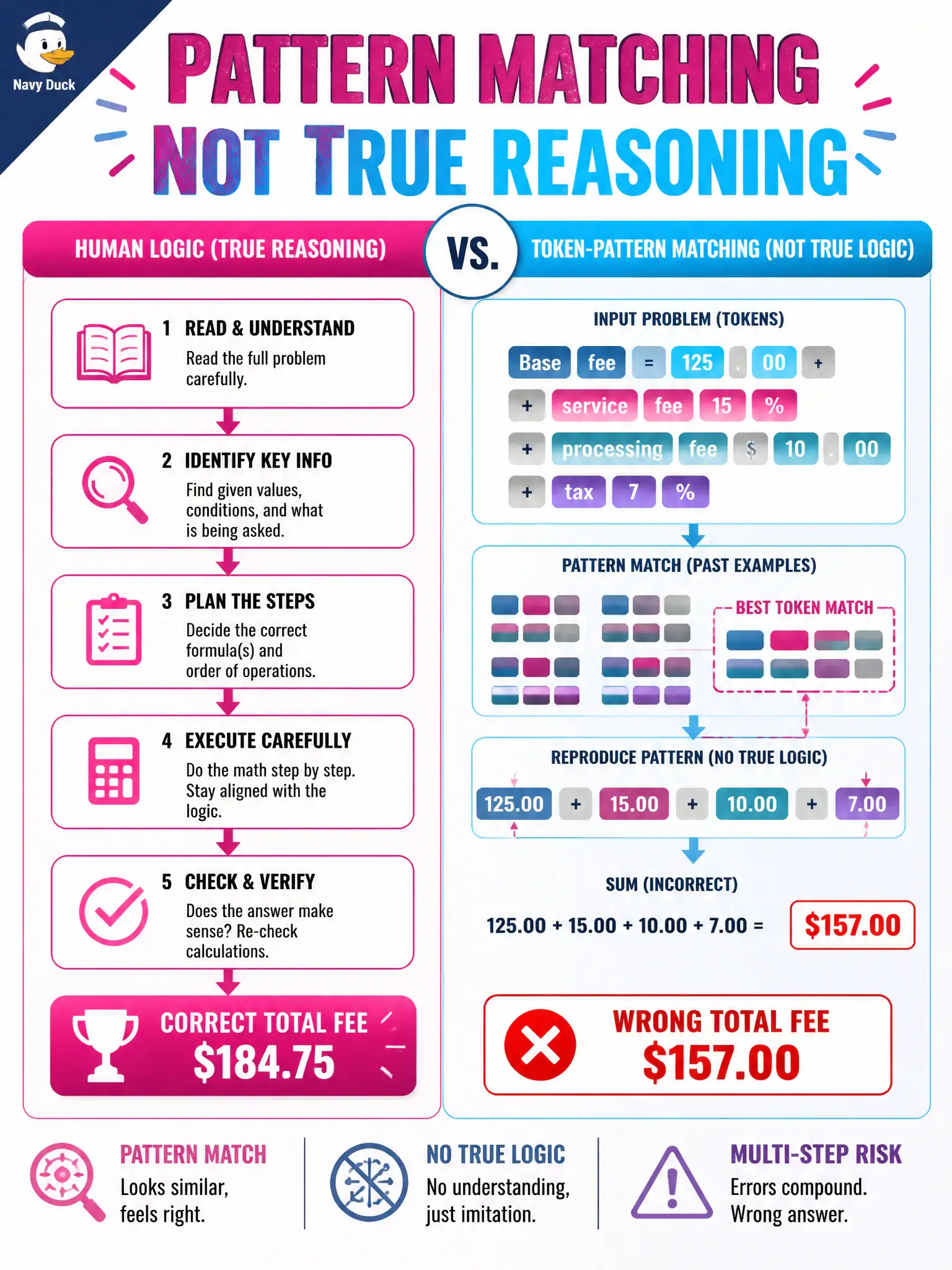
A municipal dog-license desk is told the LLM “thinks like a clerk” about late-fee ladders. Why do math-like and multi-step test tasks often go wrong?
Select an answer to reveal the explanation.
Short Explanation
An LLM is more like a gifted mimic than a careful clerk with a calculator. Pattern matching can look like reasoning until a multi-step fee ladder falls apart.
Full Explanation
A municipal dog-license desk told that the LLM “thinks like a clerk” about late-fee ladders should recognize that math-like and multi-step test tasks often go wrong because LLMs lack true logical reasoning and rely on pattern matching. Civic fee ladders need deterministic clerk logic; fluent mimicry is not a calculator. Claiming LLMs always raise temperature on numeric prompts fails as a false universal mechanism claim. Claiming they store every municipal fee table in parametric memory fails because cities’ tables are not reliably memorized ground truth. Claiming LLMs are themselves the SUT in this syllabus item fails because the stem explains application-side reasoning risk, not LLM-as-product evaluation. Exam caveat: treat multi-step numeric planning as high reasoning-error risk needing verification. Operational check: independently recompute late-fee ladders from the posted civic schedule, compare to GenAI steps, add tool-assisted calculation or human checks, and never file license fees from unverified model arithmetic. Retain the municipal audit note so later testers can see why the decision protects public service quality and fairness. Retain the municipal audit note so later testers can see why the decision protects public service quality and fairness.