
A community sauna-booking lead hears “once LLMOps is in, the model runs itself and we can skip review,” and separately that RAG or a house fine-tune cannot sit under the same operating plan. Which statement is accurate?
Select an answer to reveal the explanation.
Short Explanation
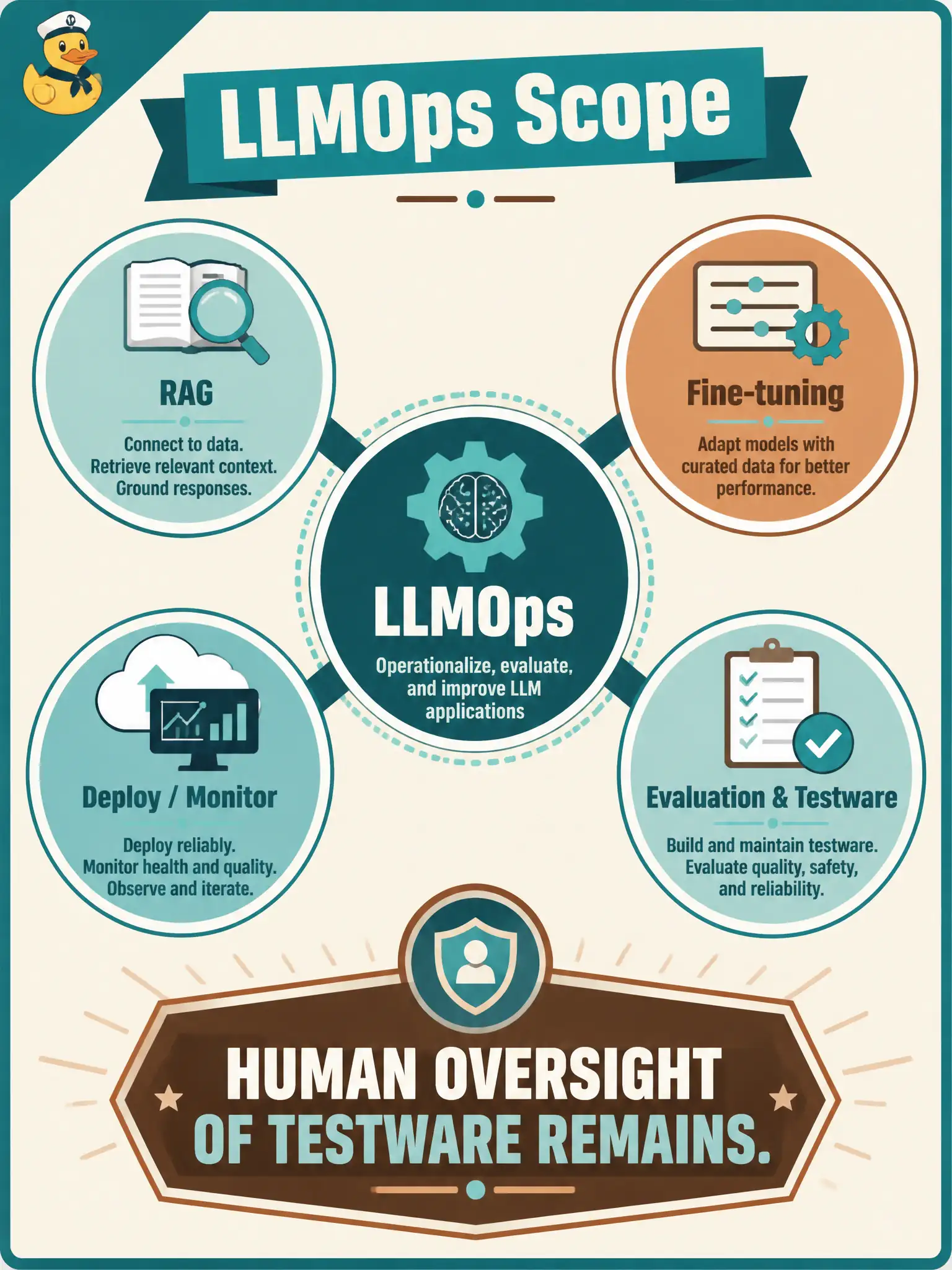
LLMOps is the operating plan — it can include RAG and fine-tuning, and it still expects people to oversee testware. It is not a license to skip review or a ban on those techniques. Think management across use, not autopilot without humans.
Full Explanation
LLMOps can incorporate techniques such as RAG and fine-tuning within its operating paths, and its purpose is managing LLMs across development, deployment, and maintenance without aiming to eliminate human oversight of testware. A community sauna-booking lead who hears that LLMOps means the model runs itself without review, or that RAG and house fine-tunes cannot share a plan, should reject both claims. Forbidding RAG and fine-tuning in every production test setting under LLMOps contradicts how those techniques support grounded and specialized outputs. Claiming LLMOps exists to remove all human review of generated testware conflicts with quality gates and review skills elsewhere in Chapter 5. Restricting LLMOps only to chatbots and never to test tools or in-house models denies the three recognized approaches. Exam caveat: LLMOps is an operating umbrella, not a license for unattended acceptance of civic testware. Operational check: keep RAG or fine-tuning under the sauna shop’s LLMOps plan where useful, and retain human review of generated booking cases before they are relied upon. Keep civic testware subject to the same review discipline you would apply to human-authored packs. On the written exam, prefer syllabus terminology over vendor marketing language or lab choreography.