
A community makerspace laser-booking desk cannot host a large general model but can further train a smaller one on its safety-card cases. Why might the shop fine-tune an SLM?
Select an answer to reveal the explanation.
Short Explanation
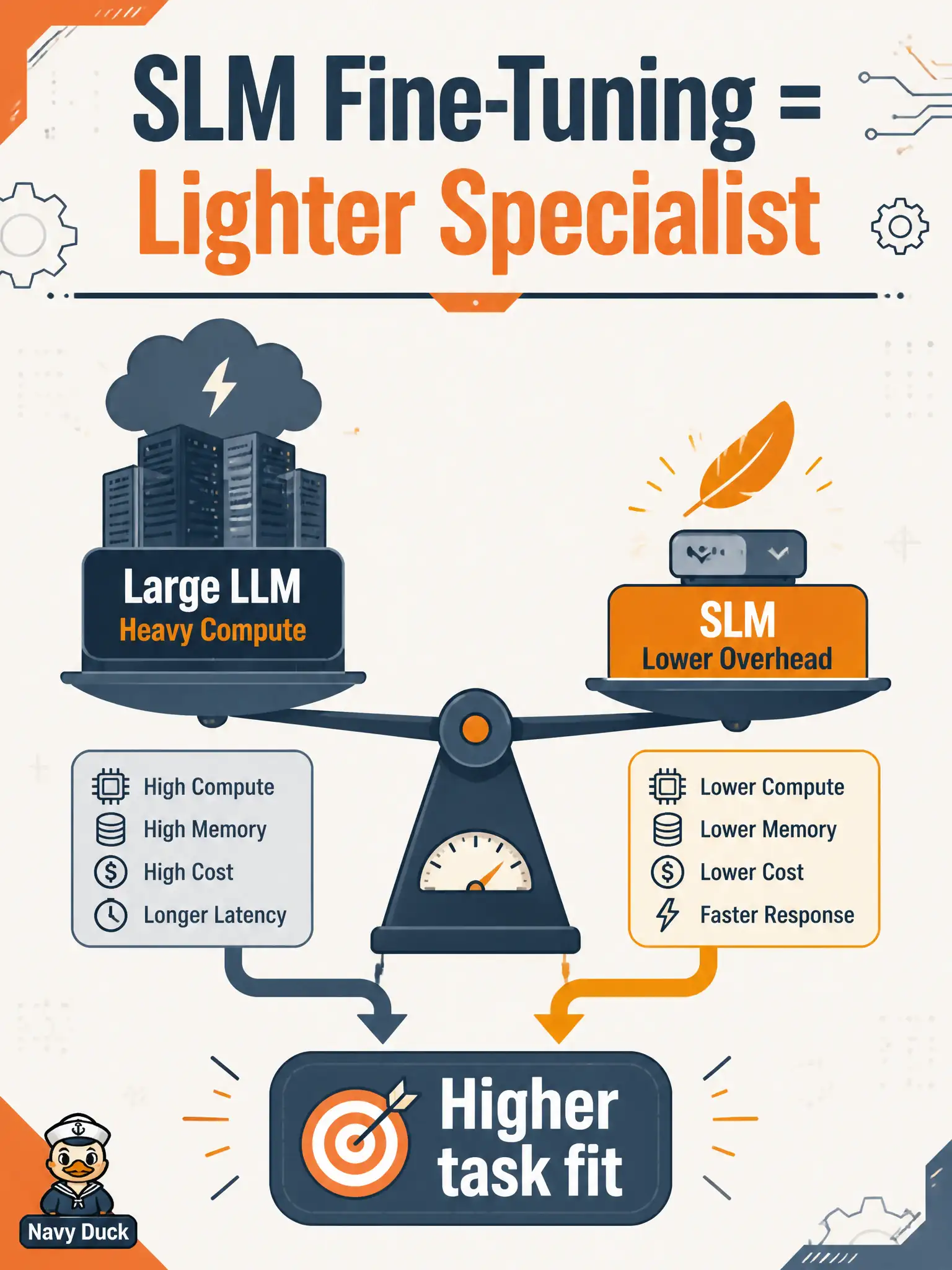
A smaller specialist can learn the safety cards without the power bill of a giant general model. Fine-tuning an SLM boosts task performance with less computational overhead. It is a lighter specialized option, not a license to skip review.
Full Explanation
Fine-tuning a small language model can improve specialized task performance while avoiding much of the computational overhead of fine-tuning a large LLM, which is why a community makerspace laser-booking desk that cannot host a large general model may further train a smaller one on its safety-card cases. The SLM path trades peak general capability for domain fit at a cost the civic shop can sustain without oversized infrastructure. Claiming only the largest LLM can ever learn safety-card terminology ignores SLM fine-tuning as a viable specialized path recognized for resource-constrained settings. Saying SLMs cannot be fine-tuned under any syllabus path contradicts that lighter specialized option. Asserting that SLM fine-tuning replaces the need for any human review forever confuses improved task fit with elimination of oversight and quality gates. Exam caveat: depth stays conceptual—no GPU-cluster sizing, token billing labs, or vendor SKU recall is required on the written exam. Operational check: when compute is limited but safety-card terminology matters, evaluate fine-tuning an SLM for task lift at lower overhead, then still review generated makerspace safety cases before they enter the booking suite.