
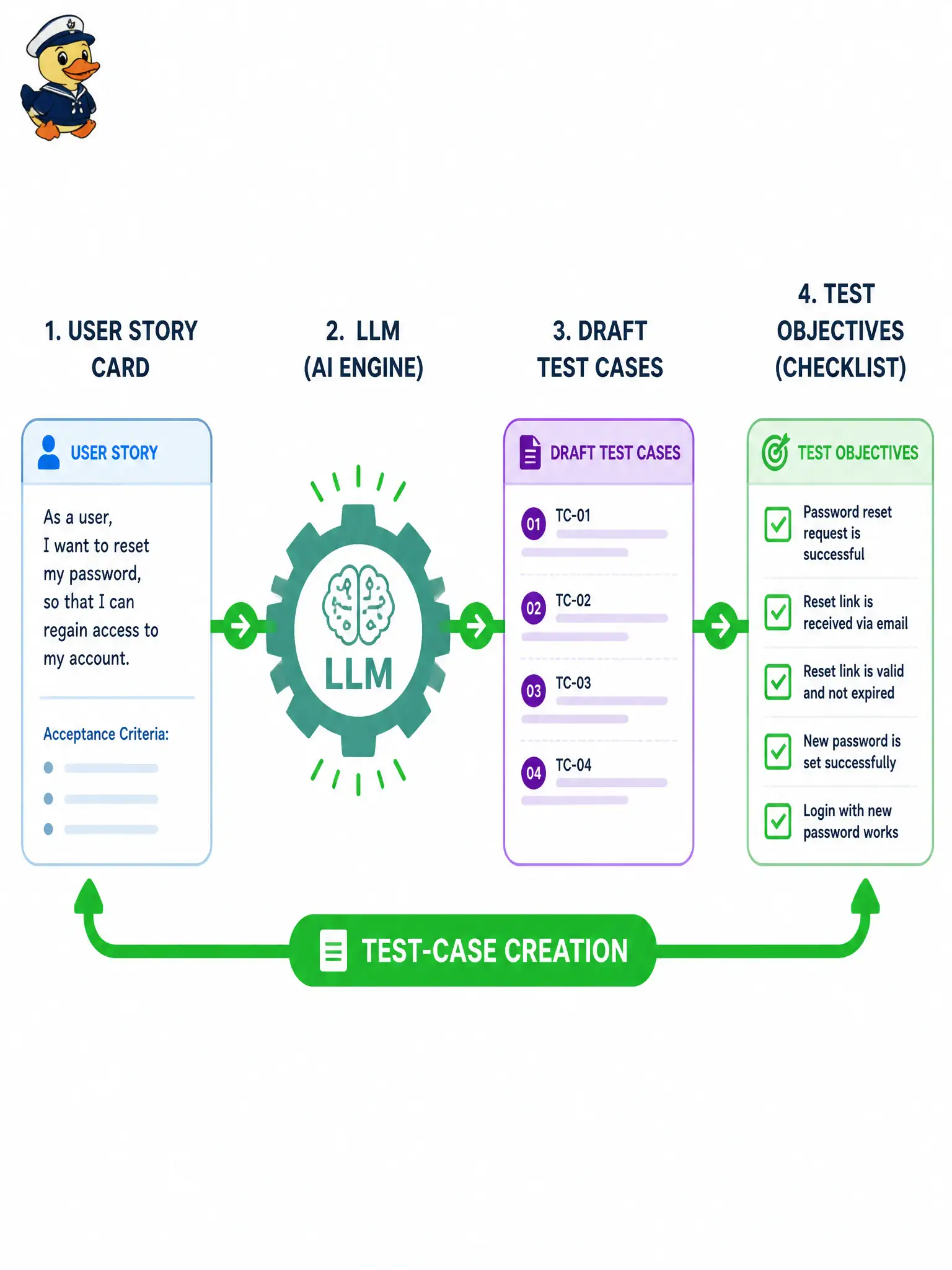
A library-hold user story is given to an LLM, which returns a draft set of cases and suggested test objectives. Which GenAI testing capability does this primarily illustrate?
Select an answer to reveal the explanation.
Short Explanation
Turning a story into draft cases and objectives is classic test-case creation help—like a junior teammate sketching scenarios from the brief. It is not the same as locking oracles, sorting logs, or poking model internals. Name the capability for what it is.
Full Explanation
Returning a draft set of cases and suggested test objectives from a library-hold user story primarily illustrates test-case creation support from the test basis. That GenAI-for-testing capability turns requirements into candidate scenarios and goals for civic library systems while leaving review, selection, prioritization, and risk ordering with the tester. Draft volume is not the same as suite readiness.
Calling the output test-oracle writing that locks expected results without further review overstates finality and confuses case creation with oracle support—objectives and cases are not sealed expected results. Result-log classification after a failed overnight run is a different capability: test-result analysis on execution evidence. Multimodal neuron-coverage measurement of the hold queue treats the model as the system under test and sits outside this capability’s meaning on CT-GenAI.
Exam caveat: name the capability by its artefact—cases and objectives derived from the basis—not by neighboring GenAI testing capabilities or model-as-SUT metrics.
Operational check: generate draft hold cases and objectives from the story; map each draft to a basis line; delete orphans and inventions; check accepted objectives into the municipal library test plan only after human review and lead acknowledgement.