
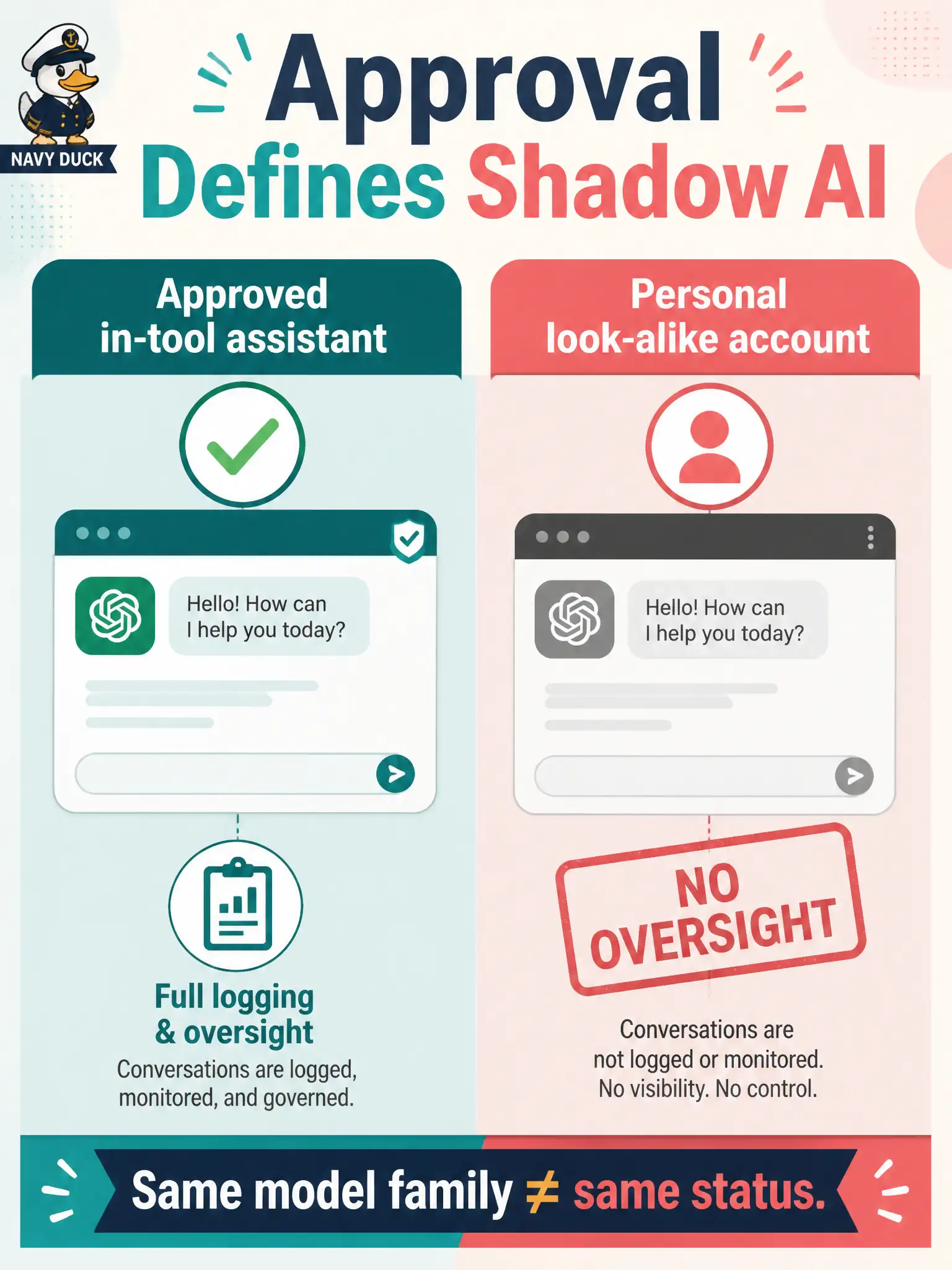
A municipal food-scraps drop shop already has an approved in-tool assistant, but a tester uses a look-alike personal account with no logging. What makes the personal-account use shadow AI?
Select an answer to reveal the explanation.
Short Explanation
Shadow AI is about the permission slip, not the logo on the box. A look-alike personal account with no logging is shadow AI because approval and oversight are missing. Model size, multimodal features, or benchmark scores do not define the label.
Full Explanation
Shadow AI is defined by absence of formal approval or organizational oversight. The same underlying model family can be approved in one channel and shadow in another if the personal path has no logging, policy, or authorization—as when a municipal food-scraps drop shop has an approved in-tool assistant but a tester uses a look-alike personal account with no logging. Parameter count relative to the approved tool does not decide shadow status. Inability to perform multimodal image analysis is a capability difference, not the approval criterion. Lack of a public software-test benchmark score is a selection or benchmarking concern, not what makes use shadow AI. Exam caveat: architecture details and benchmark scores are selection topics; they do not decide whether a use is shadow AI. Operational check: compare approval, logging, and oversight—not brand resemblance—before treating a personal look-alike account as equivalent to the approved food-scraps assistant. Keep civic testware subject to the same review discipline you would apply to human-authored packs. On the written exam, prefer syllabus terminology over vendor marketing language or lab choreography. Treat fluent output as a draft until organizational quality gates and data-handling rules are satisfied.