
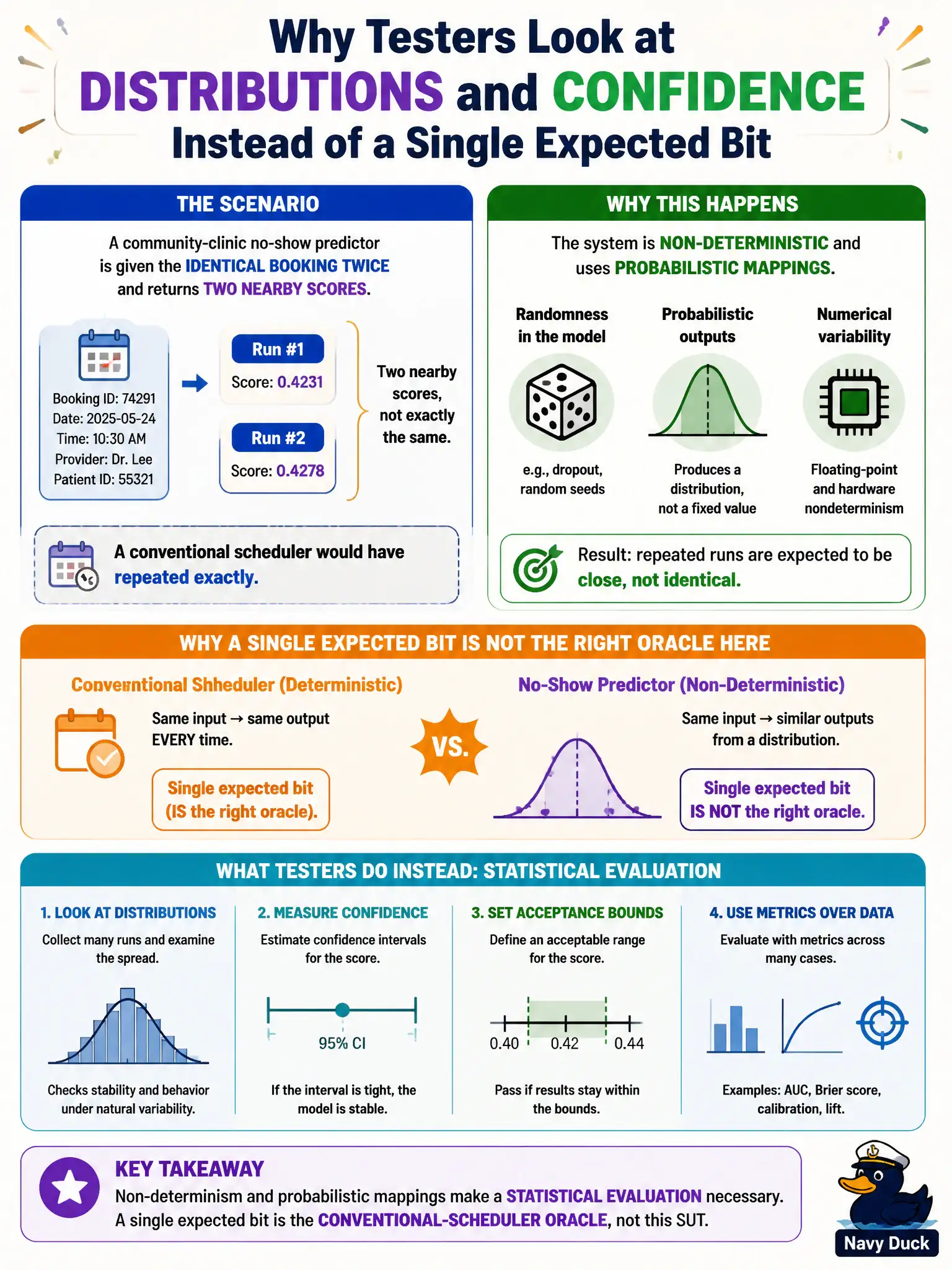
A community-clinic no-show predictor is given the identical booking twice and returns two nearby scores. A conventional scheduler would have repeated exactly. Why do testers look at distributions and confidence instead of a single expected bit?
Select an answer to reveal the explanation.
Short Explanation
The same booking twice, two nearby scores: that is non-determinism and a probabilistic mapping. Testers look at distributions and confidence, not a single expected bit. Nearby scores are not a one-shot defect, and a clinic predictor is not a conventional scheduler.
Full Explanation
Probabilistic, non-deterministic systems need statistical evaluation, not a single expected bit. Treating nearby scores as a one-shot fail, demanding a conventional oracle, or moving the item to Chapter 6 misses that need.