
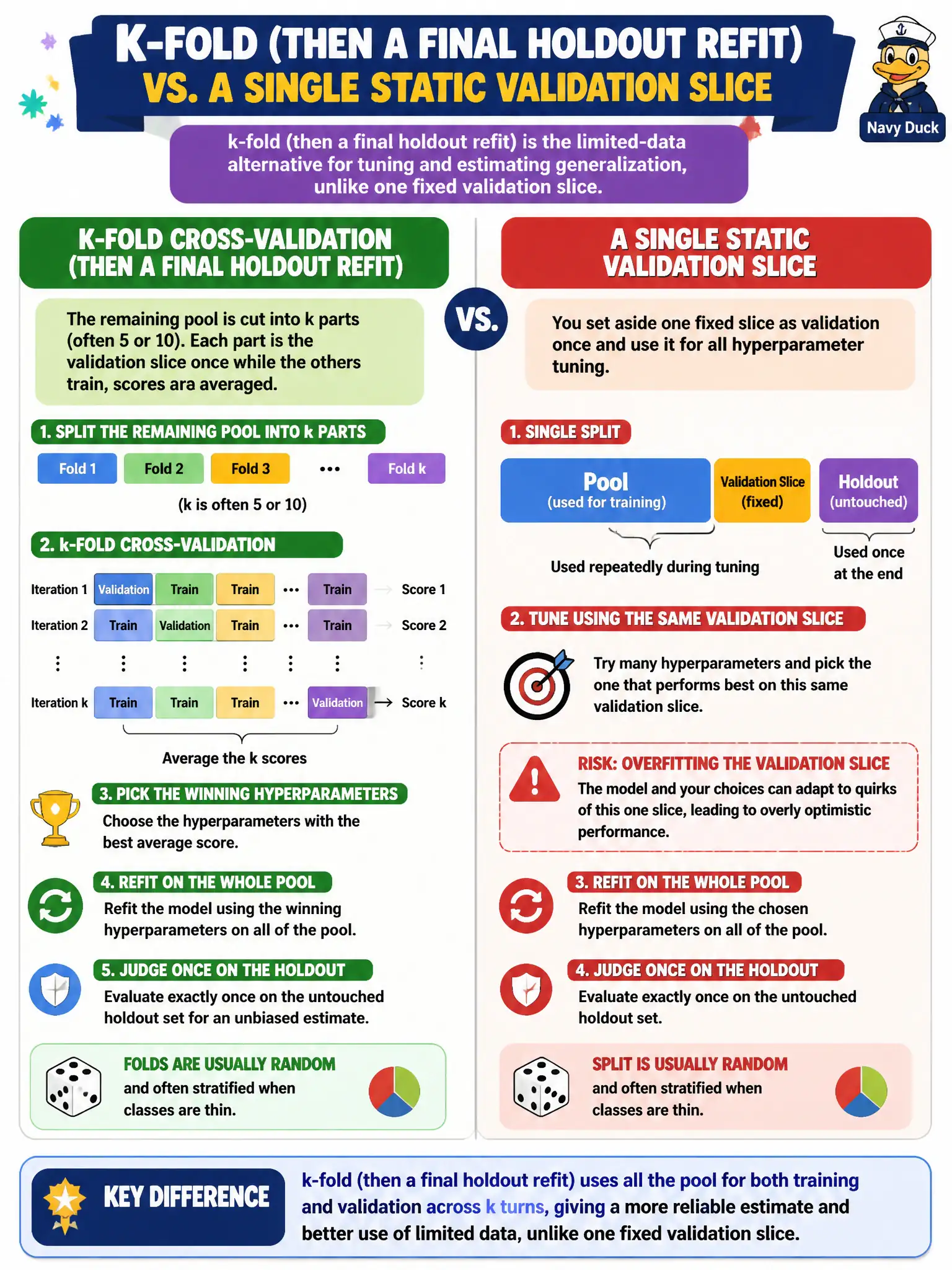
The remaining pool is cut into k parts (often 5 or 10). Each part is the validation slice once while the others train; scores are averaged; the winning hyperparameters then refit on the whole pool and are judged once on the holdout. Folds are usually random and often stratified when classes are thin. How does that differ from a single static validation slice?
Select an answer to reveal the explanation.
Short Explanation
Cut the remaining pool into k parts, each part the validation slice once, average the scores, then refit the winning hyperparameters on the whole pool and judge once on the holdout. That k-fold plus final holdout is the limited-data alternative. It does not replace the holdout.
Full Explanation
k-fold shares scarce rows for tuning, then one last holdout judges the refit. It does not erase the holdout, is not the same as one static slice, and is not an implementation task.