
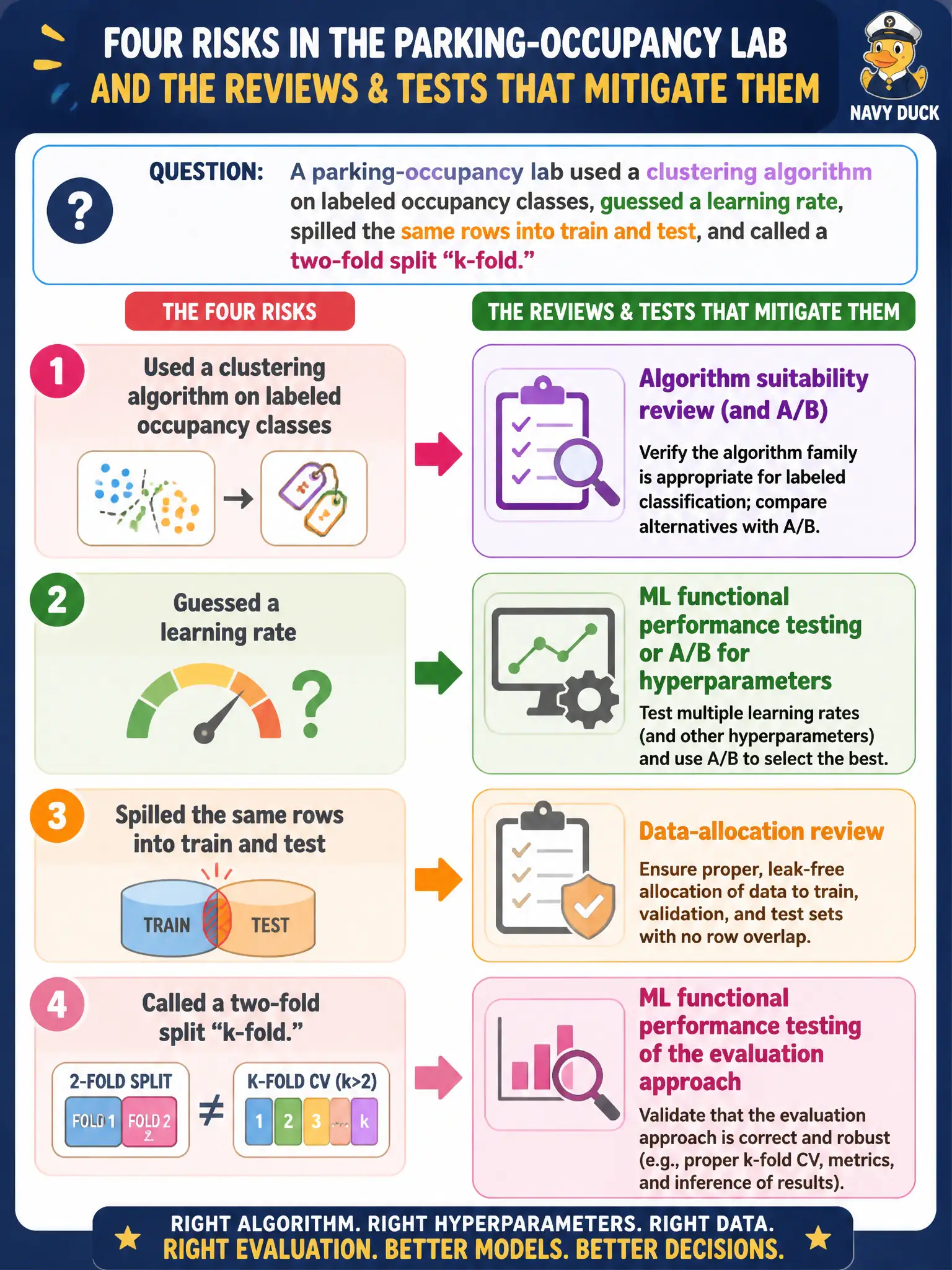
A parking-occupancy lab used a clustering algorithm on labeled occupancy classes, guessed a learning rate, spilled the same rows into train and test, and called a two-fold split “k-fold.” Which named reviews and tests mitigate those four risks?
Select an answer to reveal the explanation.
Short Explanation
Clustering on labeled occupancy classes, a guessed learning rate, spilled train and test rows, and a two-fold split called “k-fold” are four named risks. Match them with an algorithm suitability review (and A/B), ML functional performance testing or A/B for hyperparameters, a data-allocation review, and ML functional performance testing of the evaluation approach. Four adversarial passes, canaries, or Chapter 5 uniqueness checks miss that map.
Full Explanation
Algorithm choice, hyperparameter choice, train/validation/test allocation, and evaluation-approach (including k-fold) risk have named reviews and tests. Adversarial passes, canaries, and Chapter 5 uniqueness checks miss that mapping.