
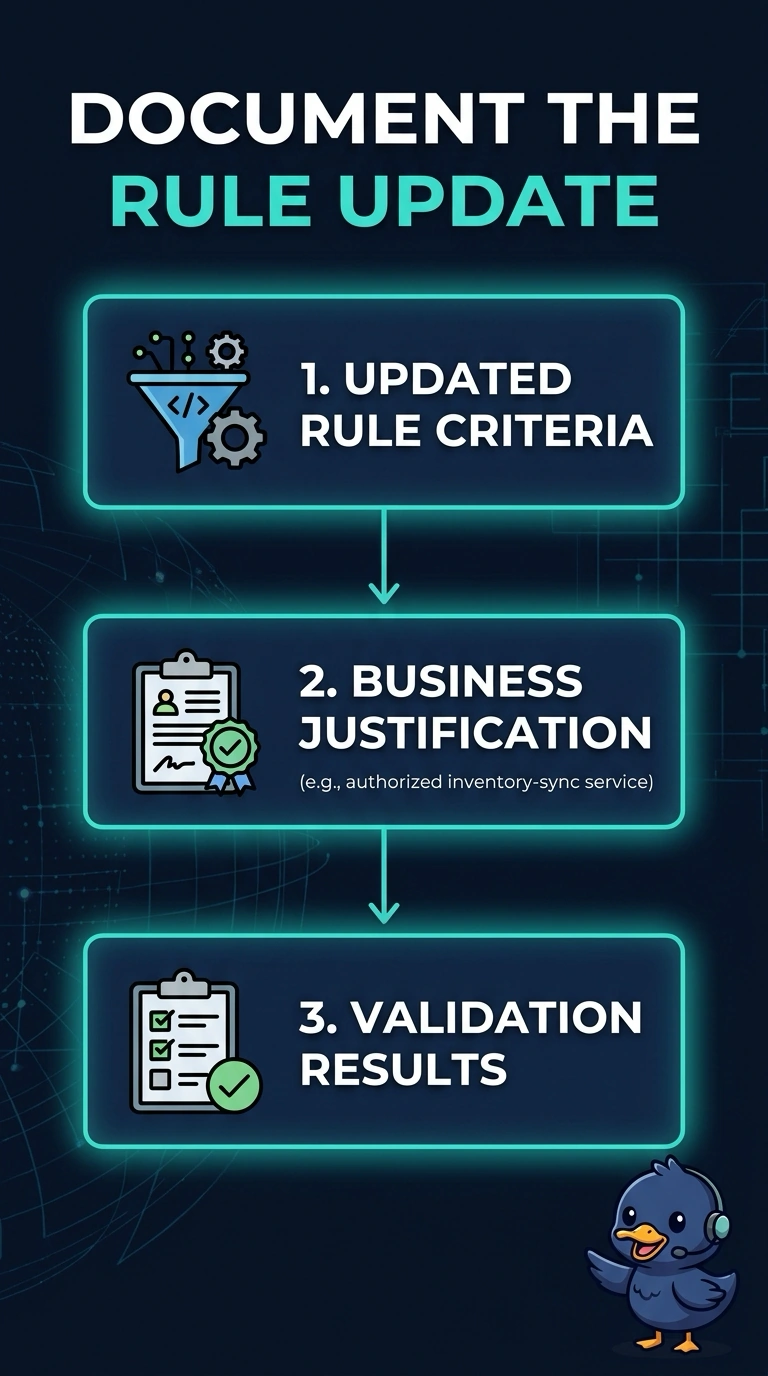
A logistics company SOC analyst closes a recurring false-positive case after updating a correlation rule's exclusion list to filter out an authorized inventory-sync service. What should the analyst record in the case documentation?
Select an answer to reveal the explanation.
Short Explanation
Tuning a detection rule without writing down what you changed is like adjusting a thermostat and throwing away the note for the next shift. Recording the exact exclusion and why it is safe keeps your team from guessing later. The trap is closing a tuned false positive with bare status labels and no audit trail.
Full Explanation
Recording The updated rule criteria, business justification, and validation results gives future analysts, rule authors, and auditors a clear record of why alert volume changed and what boundaries were verified. Without that context, another analyst investigating a missed detection later cannot tell whether an exclusion was intentional, temporary, or overly broad. Entering Only a single-word closed status without referencing the rule change leaves no traceable link between the false-positive investigation and the detection-logic modification. Pasting The full raw binary contents of every unrelated executable on the server adds massive irrelevant noise to the case file while omitting the actual tuning decision. Adding A recommendation to disable all SIEM correlation rules during shift changes would introduce severe blind spots rather than documenting a targeted, verified improvement. As a caveat, any exclusion tied to a temporary project or vendor tool should also include a scheduled review date. As an operational check, attach the exact rule name, the specific excluded attributes, the approving ticket or owner, and a summary of historical test results showing benign noise dropped without hiding true positives.
Prefer to study offline? Printable PDF study book + test engine ($7.50, unofficial). These questions stay free here.