
A logistics SOC analyst queries a 1:00 PM to 2:00 PM window for a remote warehouse firewall that batches and forwards logs two hours late, and finds the 1:30 PM events missing from the expected window. The parser failed to extract the source timestamp, so @timestamp fell back to the 3:30 PM ingestion time. Which timestamp distinction explains this?
Select an answer to reveal the explanation.
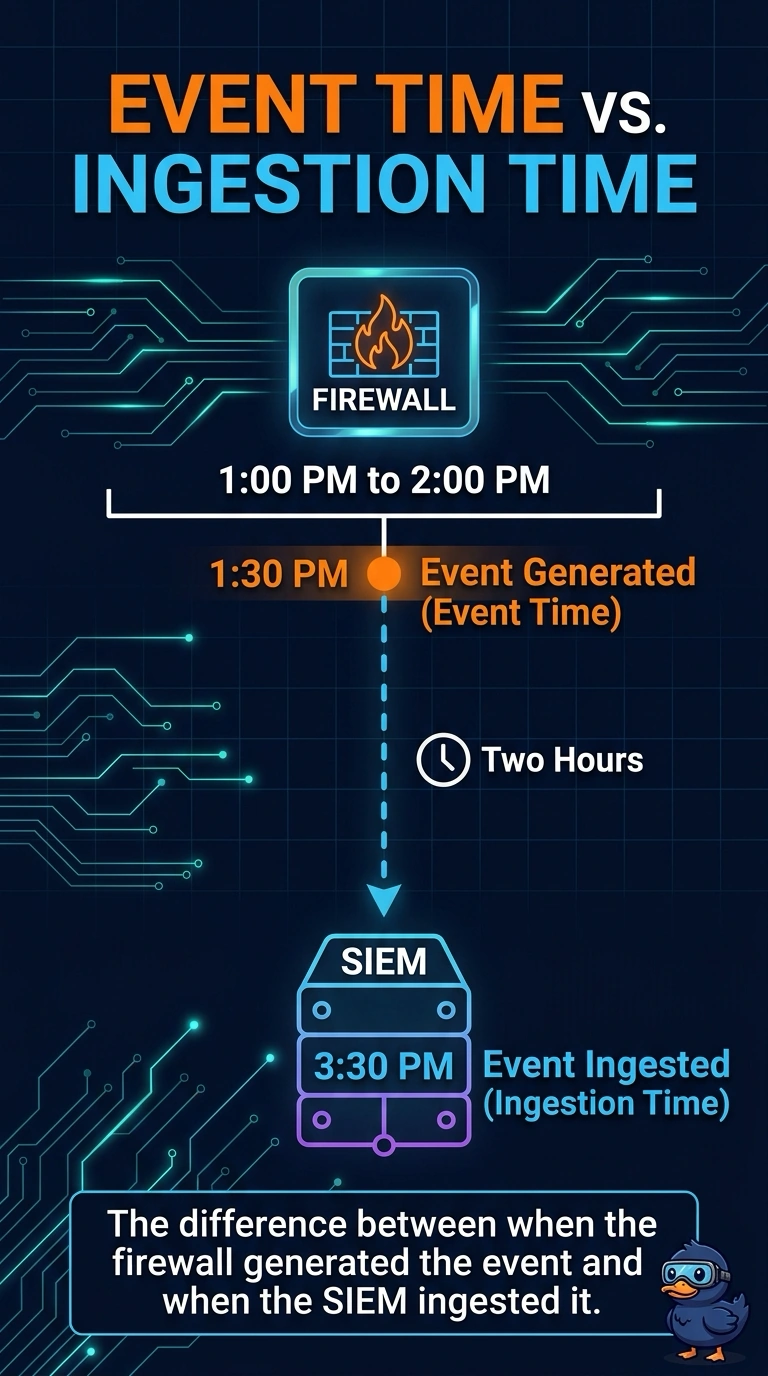
Short Explanation
You are missing the 1:30 PM events because @timestamp fell back to the 3:30 PM ingestion time when extraction failed. Remember LogScale normally searches parsed event time; late delivery alone does not move a correctly parsed 1:30 event into a later event-time window, so compare @timestamp and @ingesttimestamp and verify extraction/timezone.
Full Explanation
The missing 1:30 PM events are explained by The difference between when the firewall generated the event and when the SIEM ingested it. The firewall generated the event at 1:30 PM but forwarded it two hours late, and because the parser failed to extract the source timestamp, @timestamp fell back to the 3:30 PM ingestion time, so a 1:00 PM to 2:00 PM query misses those records. LogScale normally searches parsed event time; late delivery alone does not move a correctly parsed 1:30 event into a later event-time window. Compare @timestamp and @ingesttimestamp and verify extraction/timezone to confirm the failure and correct the parser. Attributing the gap to The difference between a correlation-rule detection origin and a third-party passthrough alert confuses how alerts are generated with how raw log timestamps are indexed and searched. Pointing to The difference between a SOAR containment workflow and an ad-hoc dashboard panel compares automation and visualization features rather than timestamp semantics in CQL. Relying on The difference between a MITRE ATT&CK tactic label and a CPS normalized hostname field mixes threat classification with field naming and does not explain why delayed events fall outside a time filter. As a caveat, clock skew or misconfigured timezone offsets on the source device can also shift event-generation timestamps relative to ingest time.
Prefer to study offline? Printable PDF study book + test engine ($7.50, unofficial). These questions stay free here.