
A retail DevSecOps team pushes a release-candidate container image to its integrated registry, where Falcon Cloud Security assesses it. Later, the pipeline applies a new release tag to the exact same immutable image digest without rebuilding. Why do the pre-runtime package vulnerability findings remain unchanged at that moment?
Select an answer to reveal the explanation.
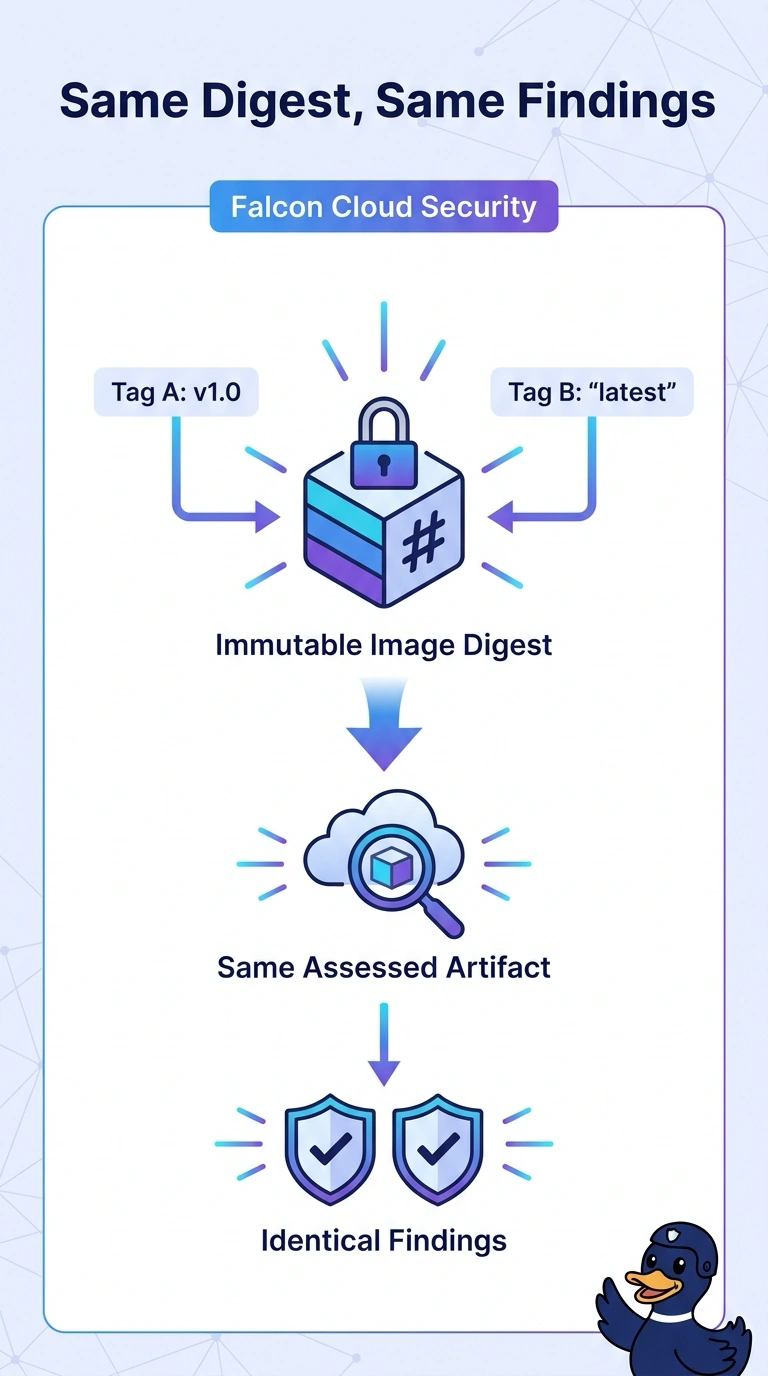
Short Explanation
Think of an image tag like a sticky note on a sealed shipping crate—changing the label does not change what is packed inside. You will see the exact same vulnerability findings because Falcon Cloud Security assesses the underlying immutable digest, not the mutable tag name. The trap is assuming that applying a new tag strips out vulnerable packages or causes registry assessment to ignore versioned release tags.
Full Explanation
Image assessment evaluates the immutable image digest and its layers, so adding another tag to the same digest references the same assessed artifact. Because container tags are mutable pointers to a content-addressed manifest, re-tagging an existing digest neither adds nor removes operating system packages or application libraries. Registry integrations only assess images that carry a latest tag and ignore versioned release tags. fails because registry-based image assessment evaluates images across configured repositories regardless of whether they use versioned or release tags. Adding a second tag automatically strips out vulnerable OS packages from the underlying image layers. fails because tagging is purely a metadata operation in the registry and never modifies image layers. Pre-runtime image assessment only evaluates containers after a Kubernetes cluster pulls and starts them. fails because pre-runtime assessment inspects static images in pipelines or registries before deployment. As an important caveat, findings on an unchanged digest can still increase later when newly published vulnerability advisories match existing packages. For a concrete operational check, verify the image digest in the registry assessment view and confirm whether the pipeline pushed a newly built digest or merely added a tag.
Prefer to study offline? Printable PDF study book + test engine ($7.50, unofficial). These questions stay free here.