
A software company integrates its private container registry with Falcon Cloud Security, but notices that temporary intermediate build-cache repositories generate thousands of duplicate vulnerability findings. Why should the team exclude those build-cache repositories from registry assessment while keeping release repositories in scope?
Select an answer to reveal the explanation.
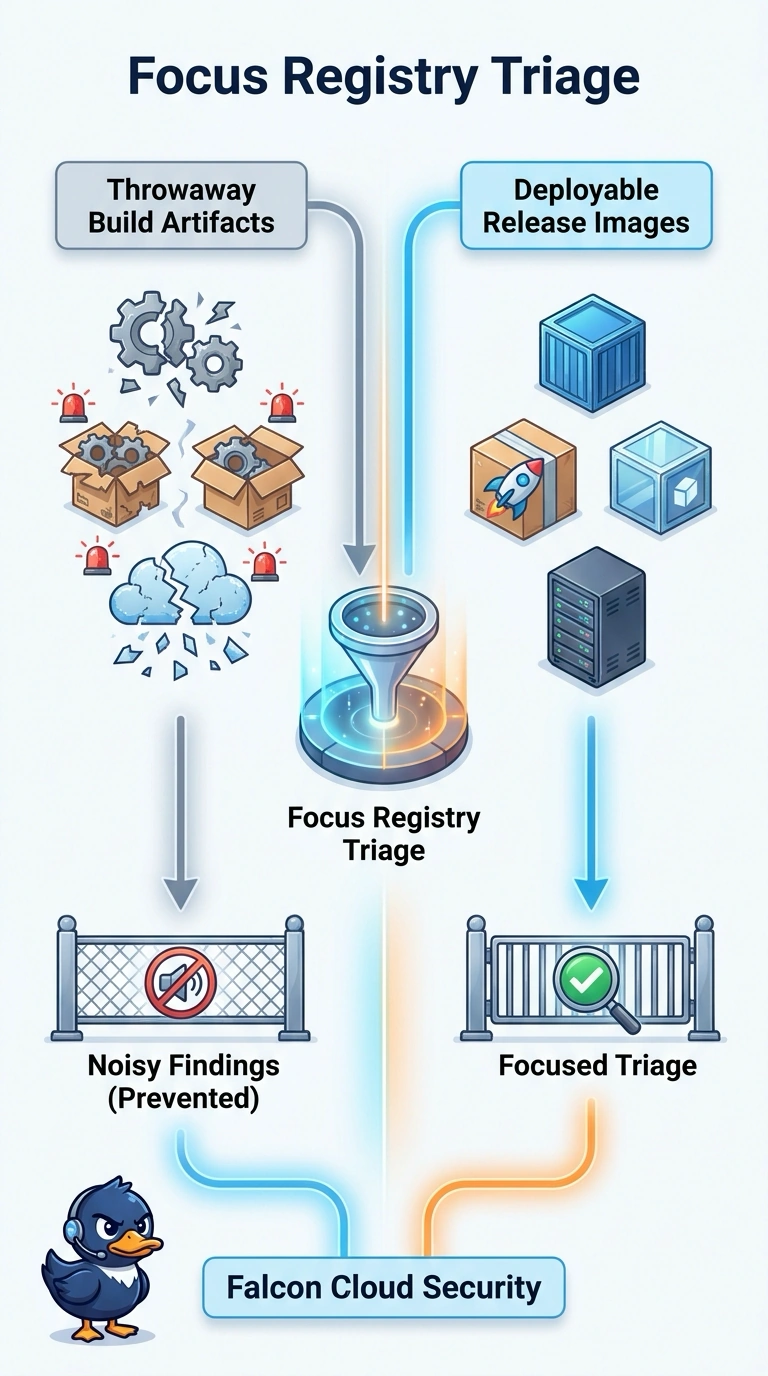
Short Explanation
Sweeping sawdust off the workshop floor makes sense, but you do not catalog every wood shaving as finished furniture. Excluding throwaway build-cache repositories keeps your pre-runtime assessment queue focused on actual deployable release images. The trap is thinking registry exclusions patch code or weaken runtime protection.
Full Explanation
It prevents noisy findings on throwaway build artifacts and focuses triage on deployable release images. Build-cache repositories store transient intermediate layers that are never deployed to Kubernetes clusters, so scanning them wastes triage effort without improving production security. It automatically patches vulnerable packages inside intermediate build layers before they reach the release repository. fails because registry assessment is a read-and-evaluate inspection process that does not rewrite or patch container layers. It forces the Kubernetes admission controller to allow unassessed images from any external public registry. fails because admission policies are configured independently and can still block unassessed or unapproved registries. It disables runtime Falcon sensor monitoring on Kubernetes worker nodes that pull images from the release repository. fails because node-level runtime sensors operate continuously on worker nodes regardless of registry scan filters. As a caveat, verify that no deployment pipeline pulls directly from a repository marked as a cache before excluding it. For a concrete operational check, audit your cluster deployment manifests and registry inclusion rules to confirm every deployable repository remains in scope for continuous assessment.
Prefer to study offline? Printable PDF study book + test engine ($7.50, unofficial). These questions stay free here.