
A manufacturing DevSecOps team configures an image assessment policy with strict vulnerability rules, but forgets to assign the policy to a policy group covering its production container registries. What is the operational result?
Select an answer to reveal the explanation.
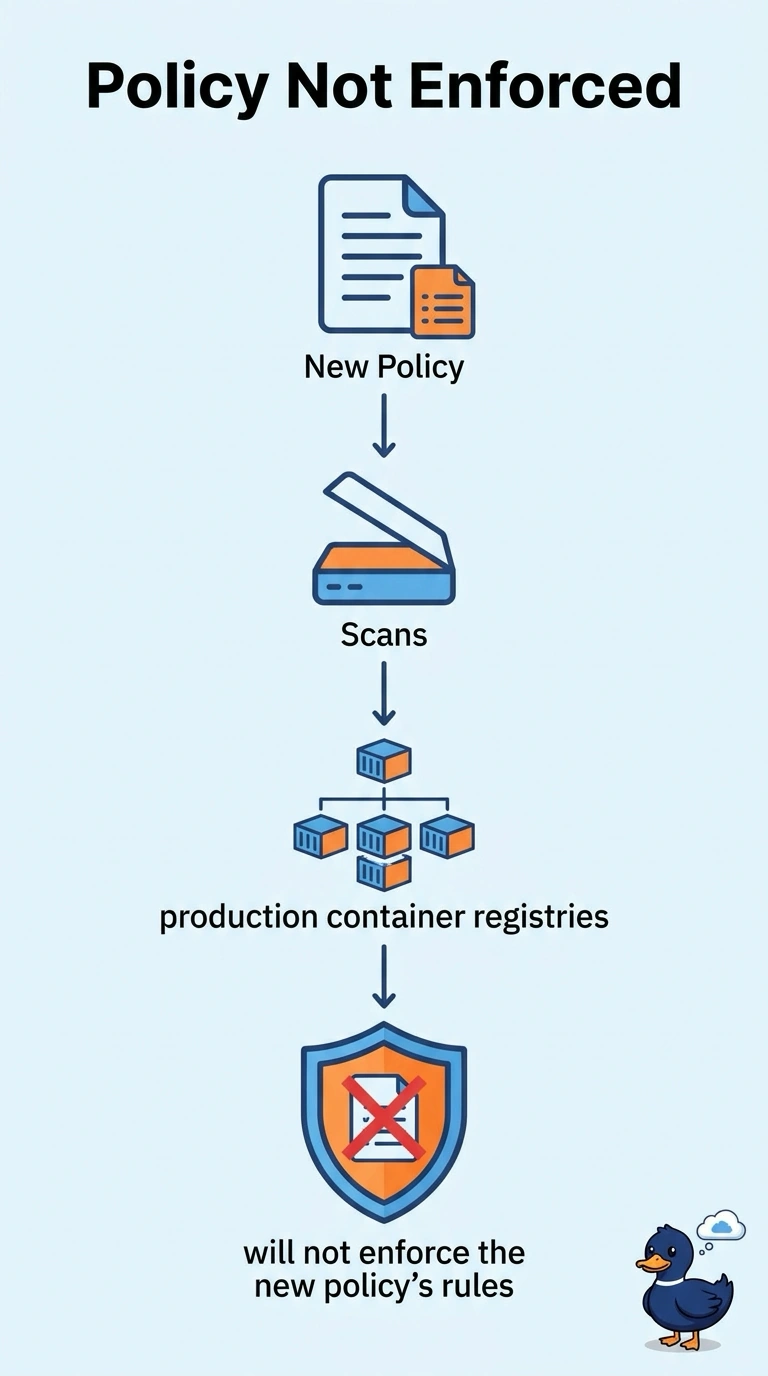
Short Explanation
Writing a strict rulebook does nothing if you leave it sitting in a desk drawer instead of handing it to the inspectors. The trap is assuming a newly created policy automatically applies everywhere when it actually needs an explicit policy group assignment.
Full Explanation
When a policy is created without being linked to a target scope, Scans against those production registries will not enforce the new policy's rules because image assessment policies only take effect on the registries or pipelines associated with their assigned policy group. Expecting that Falcon Cloud Security automatically applies the policy to every registered cloud account confuses scoped image assessment policies with global defaults and ignores the separation between cloud account posture and container registry targets. Assuming The Kubernetes admission controller immediately blocks all running pods in the cluster is wrong on two counts: an unassigned image policy does not trigger admission denials, and admission policies only evaluate new deployment requests rather than terminating already-running pods. Believing Fusion SOAR automatically disables the policy and deletes the associated registry credentials invents an automatic destructive action that does not occur simply because a policy lacks a group assignment. Keep in mind as a caveat that an unassigned policy can still appear active in the policy list while quietly having zero enforcement impact. As an operational check, confirm the new policy is enabled and explicitly bound to the policy group covering your production registries.
Prefer to study offline? Printable PDF study book + test engine ($7.50, unofficial). These questions stay free here.