
A manufacturing security team enables a stricter cloud posture policy in Falcon Cloud Security requiring an AWS S3 company requirement for a designated customer-managed SSE-KMS default, while buckets retain automatic SSE-S3. Why did the buckets not automatically apply the required KMS configuration?
Select an answer to reveal the explanation.
Short Explanation
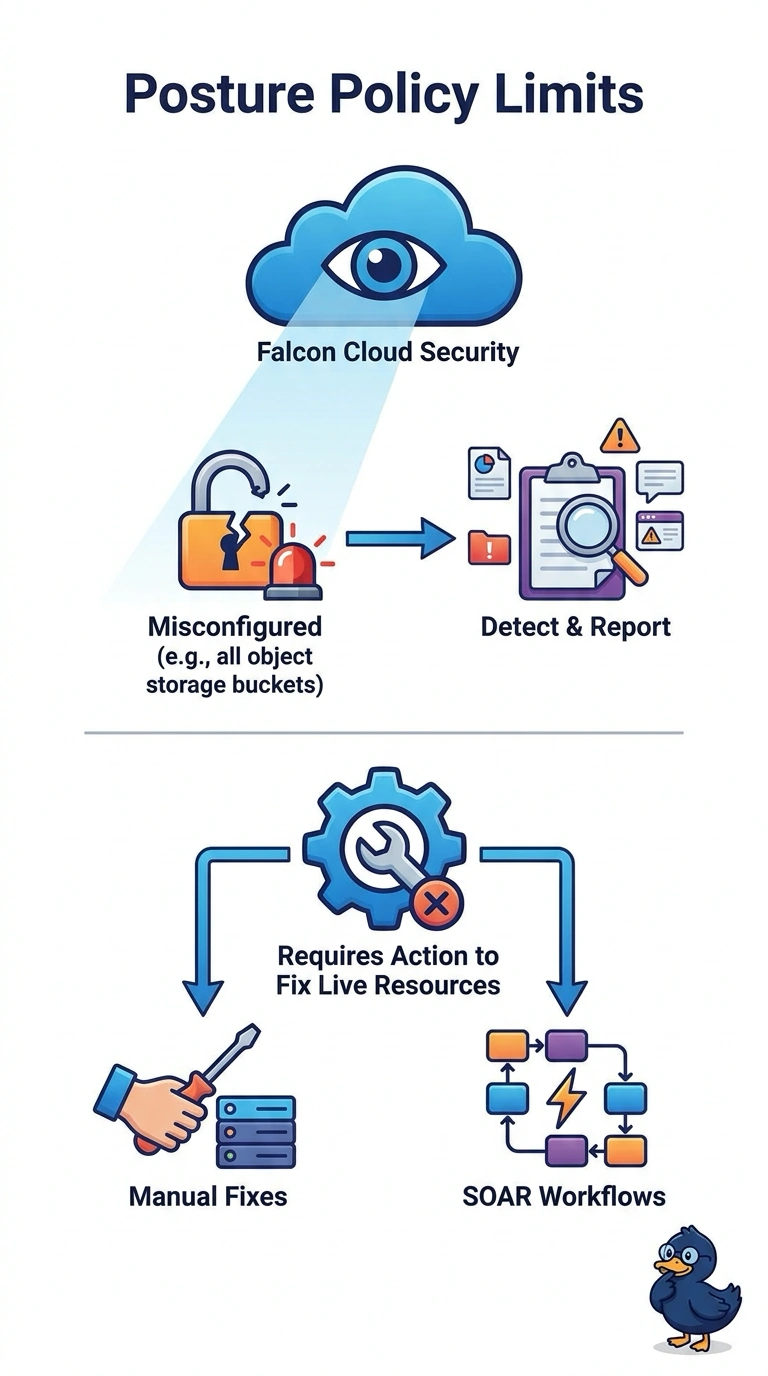
You turned on a stricter detector, but you still have to apply the fix yourself. A detection policy does not apply the required KMS configuration; use approved IaC/manual/Fusion action with its actual write identity. The S3 baseline encrypts new uploads already, and a changed default does not re-encrypt old objects.
Full Explanation
A detection policy does not apply the required KMS configuration; use approved IaC/manual/Fusion action with its actual write identity. The S3 baseline encrypts new uploads already, and a changed default does not re-encrypt old objects. Cloud posture policies detect and report misconfigurations, whereas changing live resources requires manual fixes or SOAR workflows, so enabling a stricter rule only creates findings for buckets still on automatic SSE-S3 instead of the designated customer-managed SSE-KMS default. Posture evaluation remains read-only audit, and remediation happens when engineers update the bucket default manually, update Infrastructure-as-Code templates, or run an explicitly configured Fusion SOAR workflow with appropriate write permissions on the onboarded cloud role. The idea that cloud posture policies only inspect Kubernetes pod manifests rather than cloud storage settings is incorrect because admission policies govern pod specifications while cloud posture policies audit cloud control-plane resources like S3 bucket encryption configuration. The idea that posture rules require a Falcon sensor DaemonSet on every storage bucket before evaluating fails because cloud posture assessment is agentless via cloud APIs without host sensors. The idea that new posture policies only apply to container images pushed to a registry after the rule is saved confuses continuous cloud posture auditing with pre-runtime image assessment policies.
Prefer to study offline? Printable PDF study book + test engine ($7.50, unofficial). These questions stay free here.