
A school district platform team already enforces a runtime protection policy on its Kubernetes cluster to block suspicious container processes, and now wants to reject any new deployment manifest that requests host-network access before pods are scheduled. Why must the team add an admission policy rather than modifying the runtime protection policy?
Select an answer to reveal the explanation.
Short Explanation
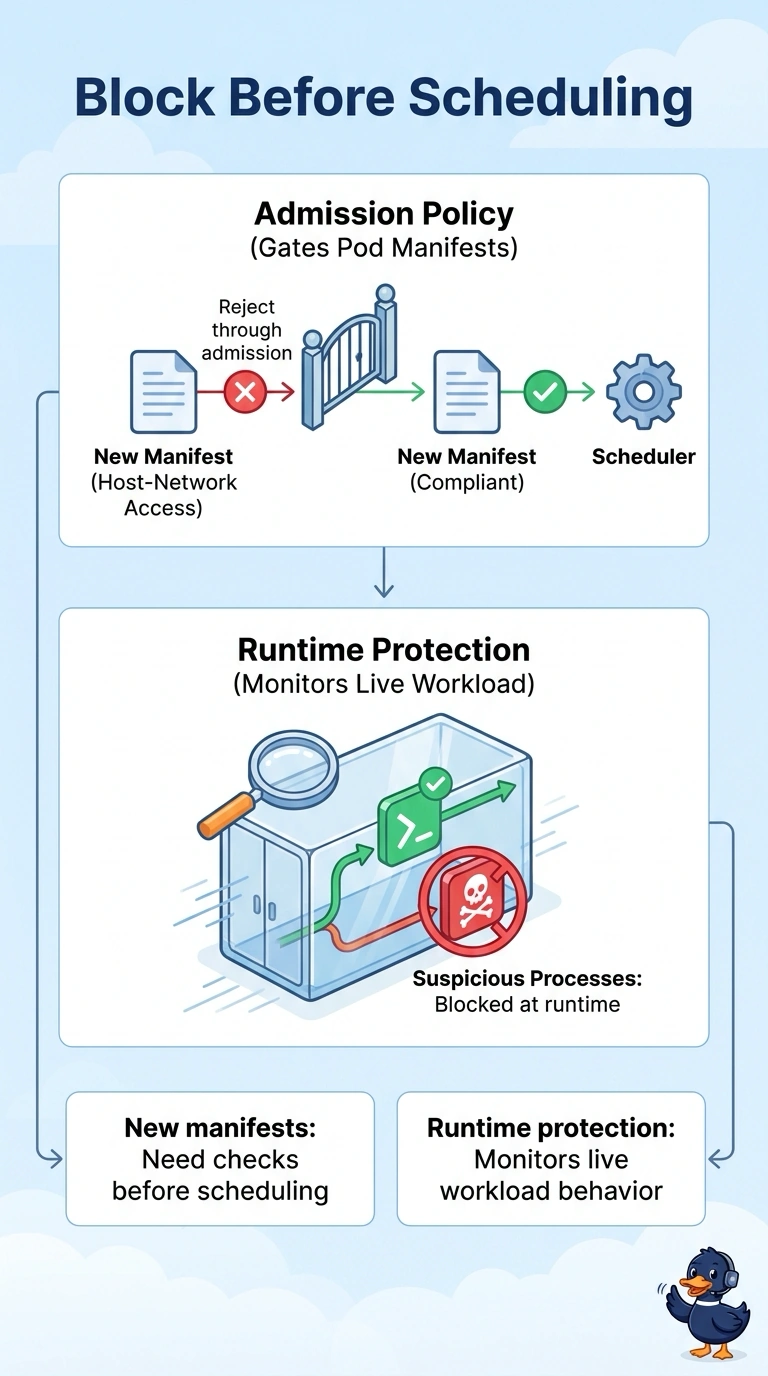
Think of a runtime protection policy as a security guard inside the building, while an admission policy is the bouncer checking IDs at the door. Because you want to stop risky pod specifications before they ever enter the cluster, only an admission policy can gate deployments prior to scheduling. The trap is assuming one container policy covers both pre-deployment admission checks and post-startup execution.
Full Explanation
In Falcon Cloud Security, each policy type governs a distinct stage of the cloud and container lifecycle. Runtime protection policies monitor live workload behavior rather than gating pod manifests before scheduling. When the Falcon sensor runs on Kubernetes worker nodes, a runtime policy evaluates process execution, file activity, and network behavior inside active containers, whereas a Kubernetes admission policy inspects deployment requests to reject risky pod specifications such as host-network access before pods start. It is inaccurate to claim that Runtime protection policies only scan static container image layers in registries and cannot observe running Kubernetes workloads. That description applies to pre-runtime image assessment instead. Likewise, it is incorrect to state that Runtime protection policies only audit cloud-provider control-plane settings and cannot evaluate activity on cluster worker nodes. Nor is it true that Runtime protection policies evaluate cloud storage and identity configurations rather than inspecting container processes or pods. Both of those statements describe cloud posture management rather than node-level workload protection. As a caveat, a blocking admission policy only stops future non-compliant deployment requests and does not terminate pods already running. As an operational check, verify the cluster scope of the admission policy and validate it in alert mode before enforcing blocks.
Prefer to study offline? Printable PDF study book + test engine ($7.50, unofficial). These questions stay free here.