
A distributed office cloud team previously registered its cloud accounts for periodic posture assessment and now wants Falcon Cloud Security to detect suspicious control-plane API activity in near real time. What must the team configure in its account registration?
Select an answer to reveal the explanation.
Short Explanation
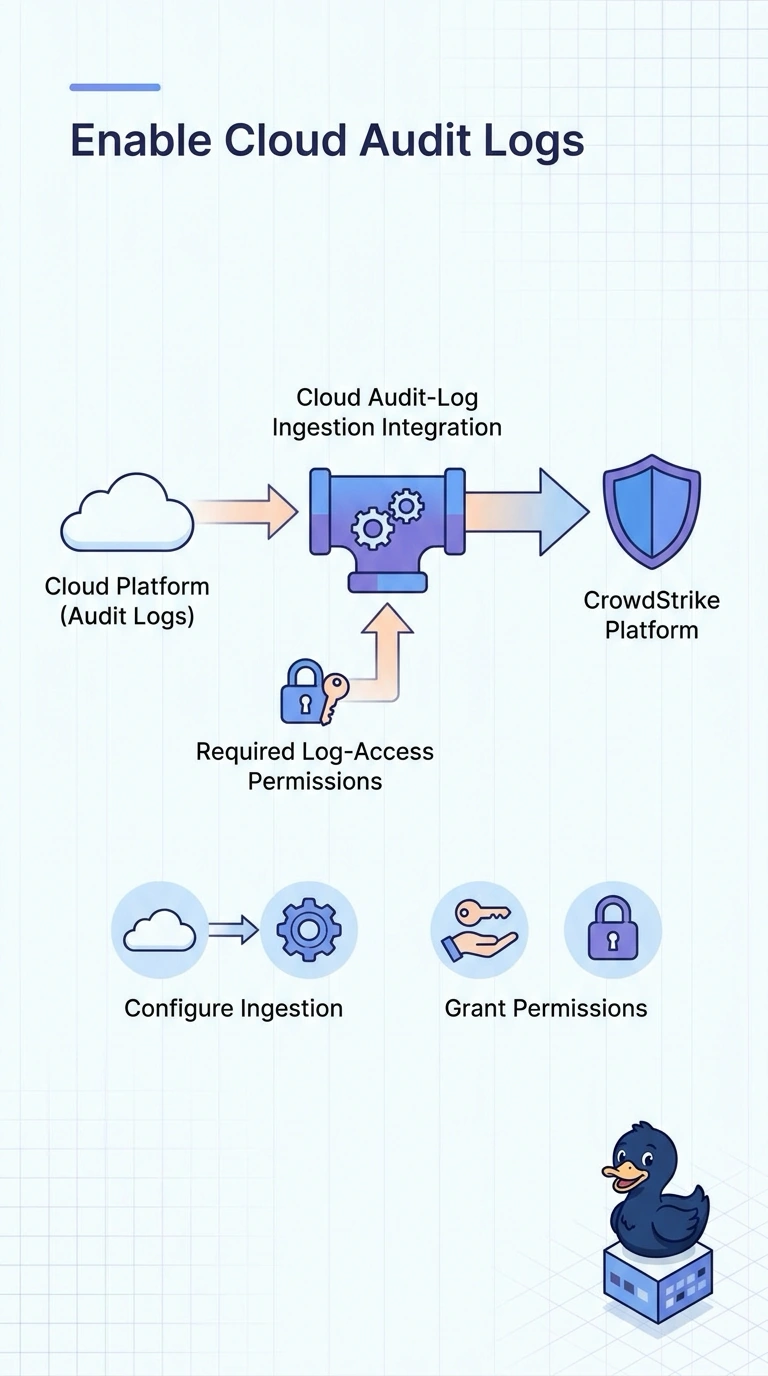
Think of periodic posture snapshots as checking your store’s locks, while audit-log ingestion is the live camera showing who turns the knob. To detect suspicious control-plane API activity near real time, you need cloud audit-log integration and the permissions to read those logs.
Full Explanation
Cloud audit-log ingestion integration and the required log-access permissions are needed because near-real-time control-plane threat detection depends on ingesting cloud provider audit logs, not relying on periodic configuration snapshots. Those logs can reveal anomalous API calls, such as disabled logging or unauthorized key creation. A Kubernetes admission controller webhook on the cluster control plane evaluates Kubernetes pod creation requests within a cluster; it does not provide visibility into cloud provider IAM or management APIs. A private container registry credential for continuous image scanning enables inspection of stored images for vulnerabilities and secrets, not monitoring of live cloud control-plane API events. A scan exclusion rule for ephemeral developer sandbox resources suppresses posture scanning for selected assets; it does not enable event-driven API monitoring. One caveat is that audit-log ingestion may require updating the onboarding template or IAM role so Falcon Cloud Security can read the provider’s log stream without authorization errors. As a practical check, verify the account registration health status for log ingestion and confirm that control-plane events are flowing.
Prefer to study offline? Printable PDF study book + test engine ($7.50, unofficial). These questions stay free here.