
A distributed enterprise wants to group its regional retail cloud accounts for filtering and ownership context, without omitting any production resources from security evaluation. Which construct should the administrator use?
Select an answer to reveal the explanation.
Short Explanation
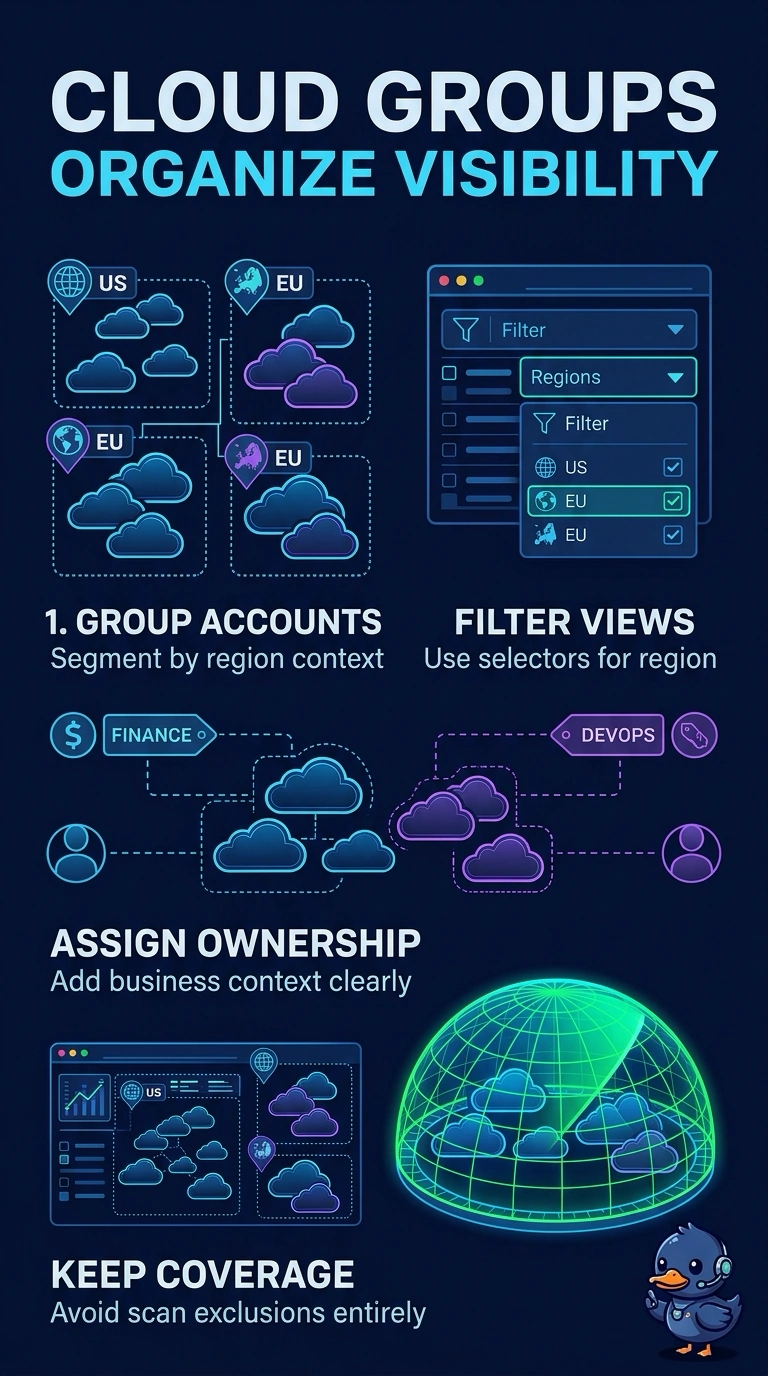
Cloud groups are like filing folders that help you filter regional accounts and assign ownership context without hiding anything from inspection. The trap is reaching for scan exclusions, which blind your posture engine instead of organizing it. Use cloud groups to keep full visibility with clean grouping.
Full Explanation
Account grouping in Falcon Cloud Security lets administrators segment registered cloud accounts by region, business unit, or environment, making "Cloud groups to organize accounts for filtering and ownership scope while keeping full scan coverage" the right construct. Selectors and group membership support filtering views by regional accounts and assigning ownership/business context, plus scoping risk filtering and suppressions, while maintaining complete visibility across all production assets. The remaining options create blind spots or operational errors. Using "Scan exclusions to remove all regional production accounts from continuous posture evaluation" would stop assessing production resources altogether, violating the requirement to keep full evaluation coverage. Choosing "Kubernetes admission policies to automatically block cloud account registration across regional teams" misapplies a cluster workload gate to cloud account onboarding. Creating "Separate Falcon tenant subscriptions for every individual virtual machine in the retail regions" is operationally unmanageable and fragments centralized security visibility. As a caveat, ensure newly onboarded regional accounts are assigned to the proper cloud group so filtering and ownership remain accurate. For an operational check, review each cloud group's member list and verify selectors show the expected regional accounts.
Prefer to study offline? Printable PDF study book + test engine ($7.50, unofficial). These questions stay free here.