
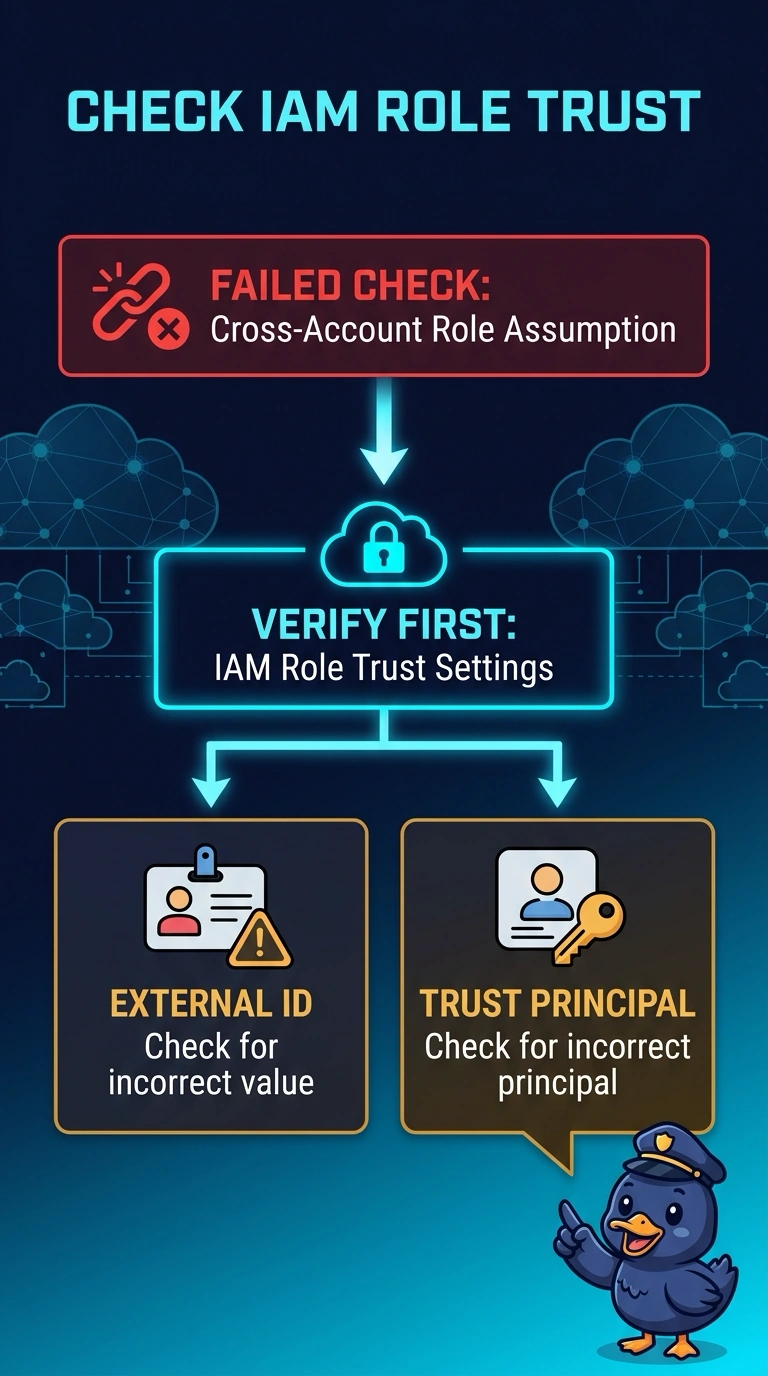
A retail cloud engineer attempts to register a new AWS account in Falcon Cloud Security for posture assessment, but the onboarding check fails to assume the cross-account role. Which issue should the engineer verify first?
Select an answer to reveal the explanation.
Short Explanation
Registering a cloud account works like handing over a keycard that only opens specific doors. If you get an assume-role failure during onboarding, the trap is blaming workload sensors when the real culprit is usually the IAM trust relationship.
Full Explanation
During cloud account registration, Falcon Cloud Security assumes a cross-account IAM role to read cloud resource metadata for posture assessment. An incorrect external ID or trust principal in the IAM role prevents the security platform from authenticating through STS AssumeRole, causing the onboarding validation step to fail immediately. A missing runtime Falcon sensor on the cloud control plane is not a valid requirement because cloud providers manage their own control planes and posture registration is agentless. An unconfigured Kubernetes admission webhook on the cluster affects container deployment gating inside Kubernetes rather than cloud account API registration. A disabled scheduled report in the Fusion SOAR workflow engine impacts automated reporting or notifications after data is already collected, not initial account onboarding. As a scope caveat, fixing the trust policy enables read-only posture discovery but does not automatically deploy runtime sensors to compute instances. For an operational check, inspect the IAM role trust policy document to confirm the trusted AWS principal ARN and external ID match the onboarding template, then re-run the account connectivity test.
Prefer to study offline? Printable PDF study book + test engine ($7.50, unofficial). These questions stay free here.