
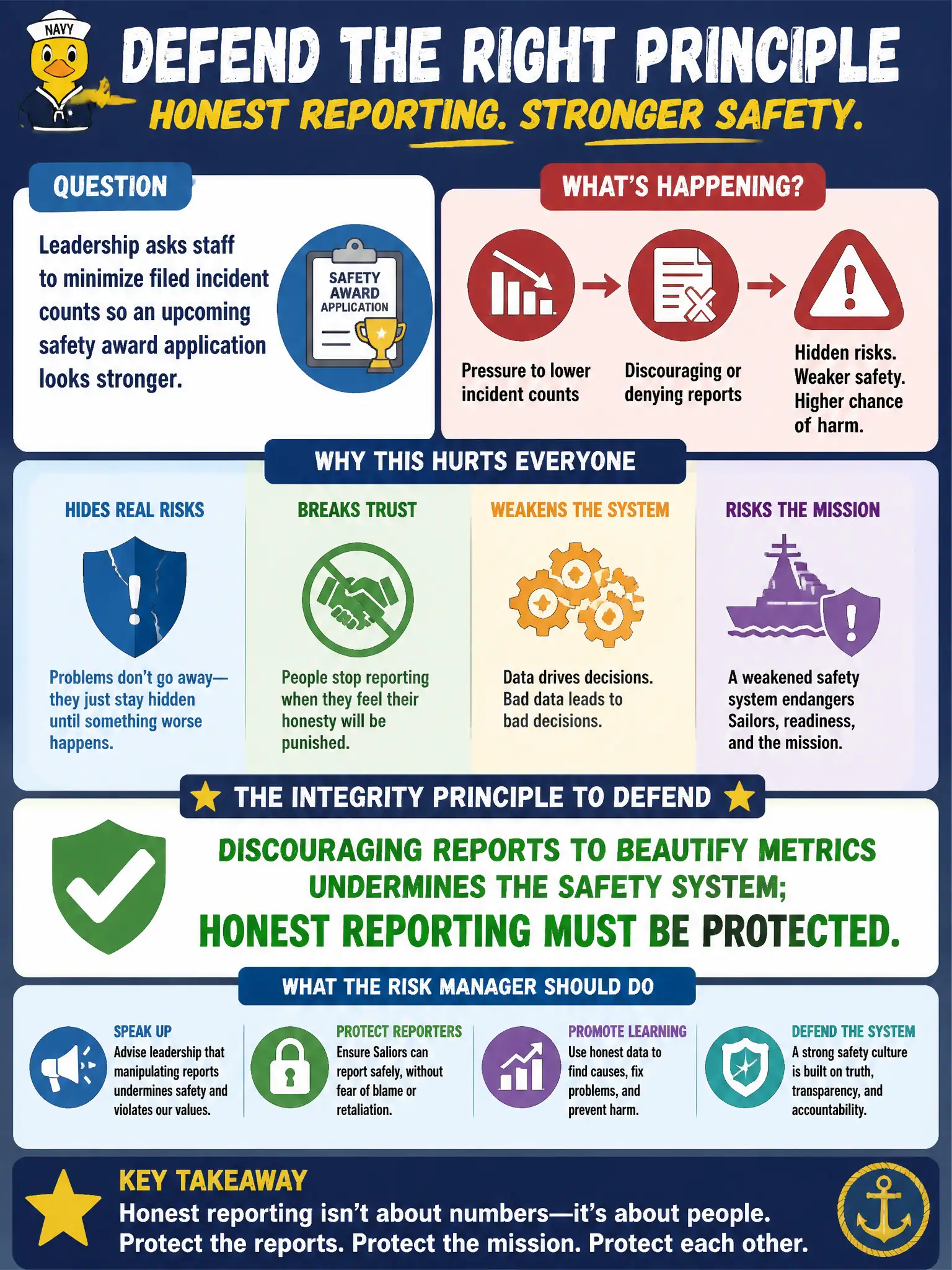
Leadership asks staff to minimize filed incident counts so an upcoming safety award application looks stronger. What integrity principle should the risk manager defend?
Select an answer to reveal the explanation.
Short Explanation
Cooking the incident numbers for a trophy is how you win a plaque and lose the plot. Awards mean nothing if people are scared to report. Protect the pipeline of honest filings—even when the dashboard looks less shiny.
Full Explanation
Discouraging reports to beautify metrics undermines the safety system; honest reporting must be protected because leadership pressure to minimize filed counts for a safety award corrupts the learning engine. Awards built on suppressed incidents are false assurance. Civic risk managers defend reporting integrity even when optics suffer in the short term.
Justifying suppression of near-misses and minor injuries until after the submission date fails by concept because temporary non-reporting still hides hazards and teaches staff that silence is rewarded. Editing incident totals downward by finance before external applications fails because falsifying counts is integrity fraud, not analysis. Claiming safety awards require zero incidents so non-reporting is an accepted control fails because zero achieved by silence is not risk control—it is concealment.
Exam caveat: CRMC reporting integrity prioritizes truthful incident capture over award cosmetics. Metric pressure that suppresses reports is a cultural and control failure on the exam.
Operational check: Issue a leadership note that reporting is non-punitive and required; remove award criteria that incentivize under-reporting; audit for sudden count drops before award deadlines and investigate suppression signals.