
A utilities manager claims hazards and risks are the same because both can hurt people. Which distinction should the risk manager reinforce?
Select an answer to reveal the explanation.
Short Explanation
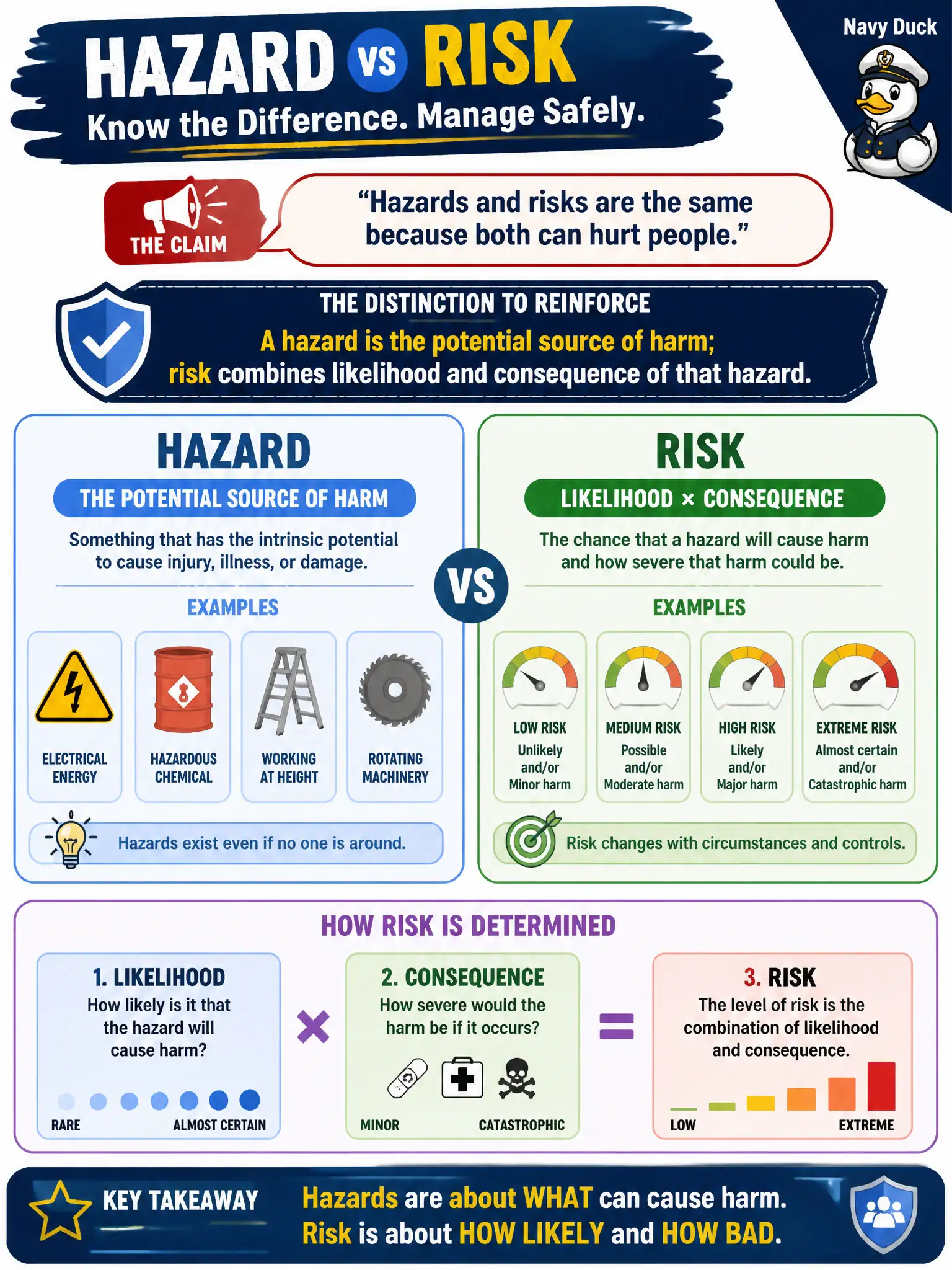
A frayed cable is the hazard — the thing that can hurt you. Risk is how likely that cable sparks trouble and how bad the fallout would be for your goals. Same neighborhood, different addresses; calling them identical muddies the assessment.
Full Explanation
A hazard is the potential source of harm—for utilities, a frayed cable, an unguarded vault, or similar condition. Risk combines the likelihood that the hazard produces an unwanted event with the consequence for people, service continuity, and objectives. Saying hazards and risks are the same because both can hurt people collapses source and scored uncertainty, which breaks matrices, treatment selection, and residual-risk conversation with the city manager. Treating the terms as identical in all formal assessments is therefore wrong. Claiming risk exists only after injury and hazards only before work begins reverses timeline logic and erases proactive assessment. Assigning hazards only to equipment and risk only to budget variances splits the concepts by department silo rather than by definition. Exam caveat: expect stem language that rewards "source versus likelihood×consequence" and punishes synonym or post-injury-only definitions. Operational check: photograph or log one utilities hazard, then complete a two-line register entry that separates the source description from a likelihood band and a consequence band tied to outage or injury objectives. Walk the crew through why mopping, guarding, or de-energizing treats the risk arising from that hazard rather than renaming the hazard itself.