
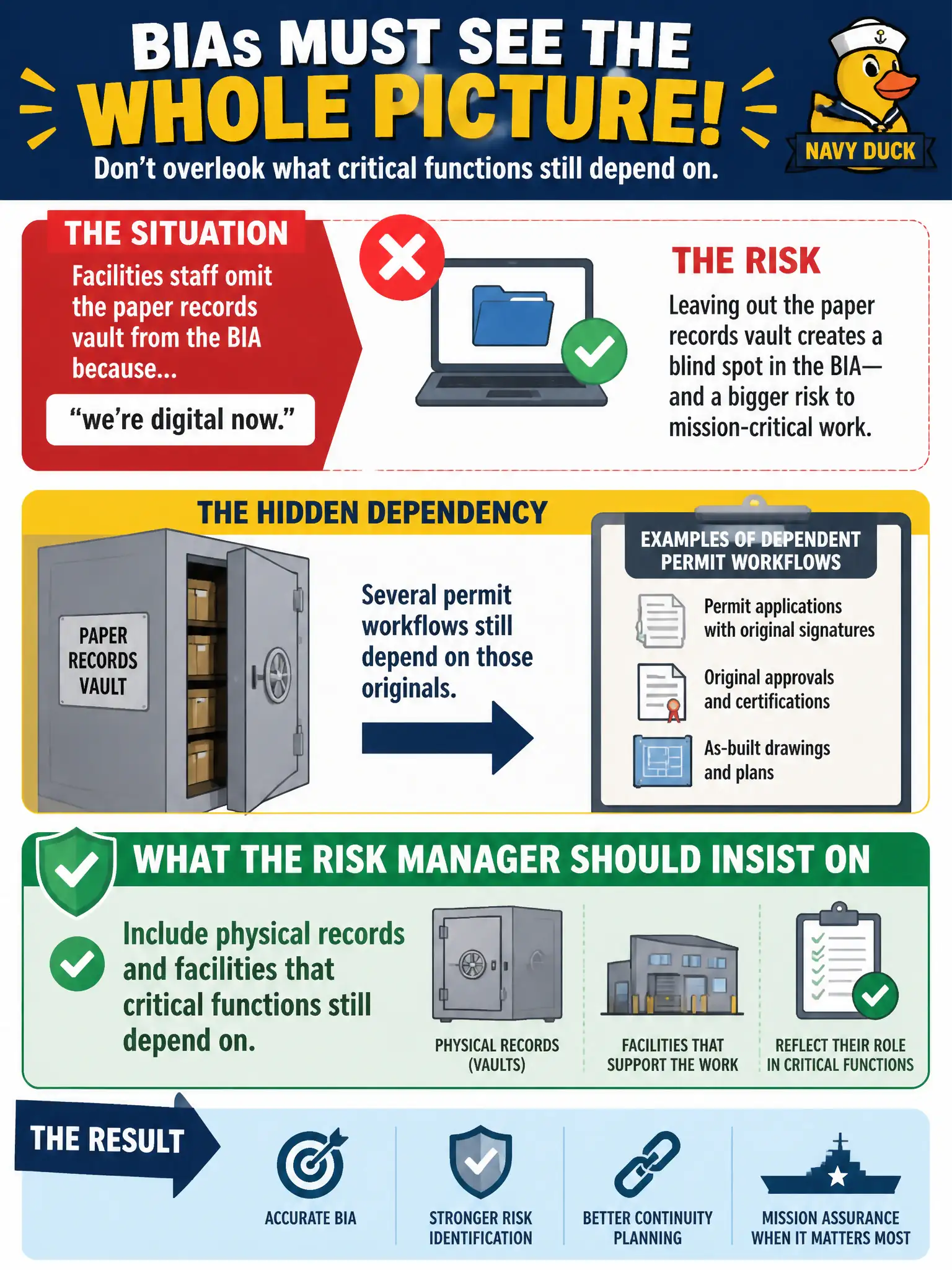
Facilities staff omit the paper records vault from the BIA because 'we're digital now,' yet several permit workflows still depend on those originals. What should the risk manager insist on?
Select an answer to reveal the explanation.
Short Explanation
Going 'digital' on paper while the clerk still digs in a vault is like retiring the spare tire before the new one is mounted. If permits still need those originals, the vault is a critical dependency. Keep non-IT assets in the BIA until the process truly no longer needs them.
Full Explanation
Critical civic functions often still depend on physical records, specialized spaces, and other non-IT assets even when much of the enterprise has digitized. If permit workflows still require originals from a paper vault, omitting that vault from the BIA produces incomplete dependency and recovery analysis. Risk managers should insist that physical records and facilities that critical functions still depend on remain in scope until those dependencies are truly retired.
Excluding all physical assets once any digitization project has started treats aspiration as completion and blinds planners to residual paper paths. Scoring only cloud applications so paper dependencies cannot affect priorities invents an IT-only BIA that fails the business process. Destroying vault contents immediately to force a fully digital model is an operational and legal hazard, not a BIA correction.
Exam caveat: digitization progress does not automatically remove physical dependencies from BIA scope. CRMC continuity items test whether candidates follow the process, not the slogan.
Operational check: walk each critical permit workflow end to end; list any required paper, vault access, scanners, or specialized rooms; add those assets to the BIA dependency map; assign recovery owners until digital substitutes are verified in production.