
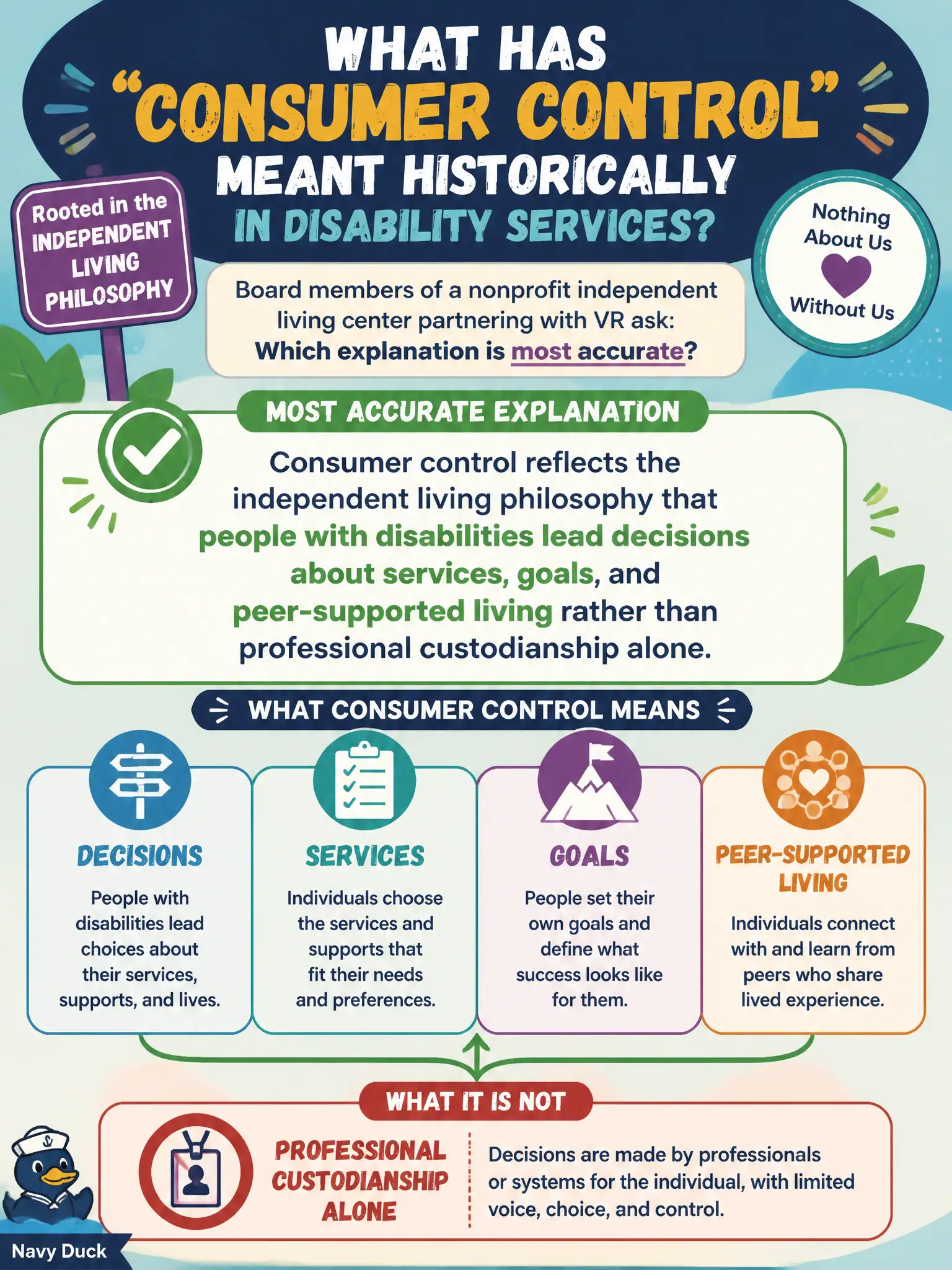
Board members of a nonprofit independent living center partnering with VR ask what 'consumer control' has meant historically in disability services. Which explanation is most accurate?
Select an answer to reveal the explanation.
Short Explanation
Picture someone else packing your suitcase and telling you where you're going — that's custodial service. Independent living flipped the script: the traveler picks the destination and the supports. Consumer control is that leadership by people with disabilities over goals and services, not staff or doctors steering every choice.
Full Explanation
Nonprofit independent living centers partnering with VR often ask board members what “consumer control” has meant historically. Consumer control reflects the independent living philosophy that people with disabilities lead decisions about services, goals, and peer-supported living rather than living under professional custodianship alone. It is a civic civil-rights corrective to medical and custodial models that treated professionals as final decision-makers.
Defining consumer control as physicians approving every IL goal fails by concept because that recenters medical custodianship the IL movement challenged. Equating it with sheltered workshops deciding work assignments fails because workshop control is historically opposite of consumer-directed living. Saying funding agencies write IL plans without consumer input for uniformity fails as bureaucratic control, not consumer control.
Exam caveat: consumer control coexists with funding rules and safety requirements; it means leadership in decisions, not absence of all structure. Operational check: review IL center governance and service planning for meaningful consumer majorities or leadership roles, peer support pathways, and documentation that goals originate with the consumer rather than staff convenience.