
A client asks whether public VR, a for-profit disability-insurer rehab unit, or a nonprofit community rehabilitation program is "better." What comparison should the counselor offer?
Select an answer to reveal the explanation.
Short Explanation
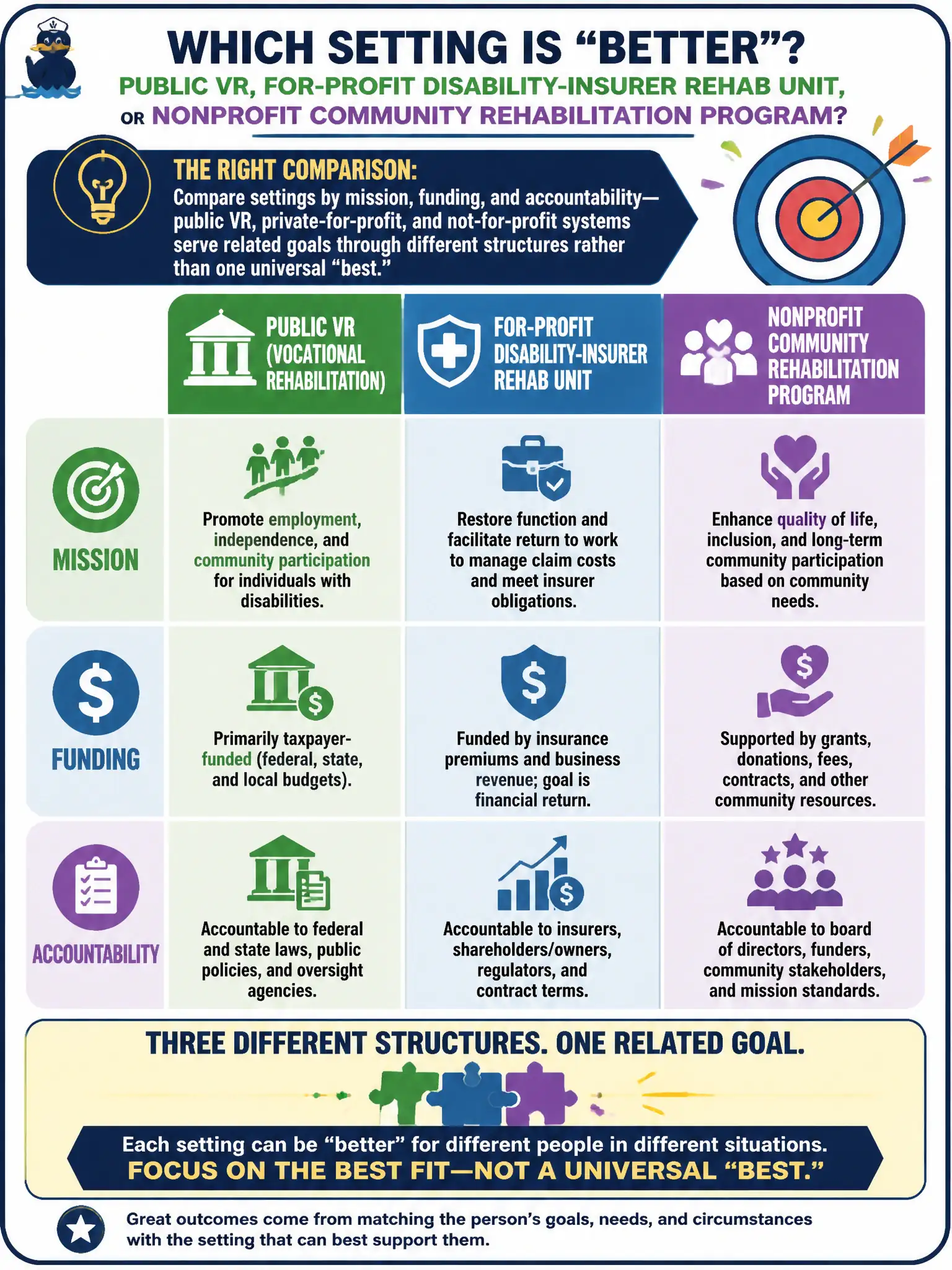
Public VR, insurer rehab shops, and nonprofit CRPs are different vehicles — mission, money, and accountability shift. Help the client compare fit instead of crowning one universal winner.
Full Explanation
Clients comparing public VR, for-profit disability-insurer rehab units, and nonprofit community rehabilitation programs need a structural comparison by mission, funding, and accountability—not a slogan that one sector is universally “best.” Civic counselors help consumers understand how public entitlement systems, insurer-driven disability management, and nonprofit CRP missions differ while serving related disability employment goals.
Declaring for-profit insurer units always superior because profit proves quality fails by concept: profit is not a validity criterion for rehab quality or consumer protection. Saying nonprofit CRPs are illegal alternatives to public VR in every state fails as a false legal generalization. Insisting all three are structurally identical in funding and oversight fails because funding streams, oversight bodies, and dual-customer pressures differ in ways that affect services.
Exam caveat: quality varies within each sector; teach structures without demonizing an entire setting type. Operational check: when counseling setting choice, map who the payer/customer is, what success metrics drive the agency, what appeal rights exist, and how those factors may shape the client’s experience and goals.