
A newly hired client with autism needs coaching on break-room norms and supervisor communication. Which counseling focus best fits workplace socialization skills?
Select an answer to reveal the explanation.
Short Explanation
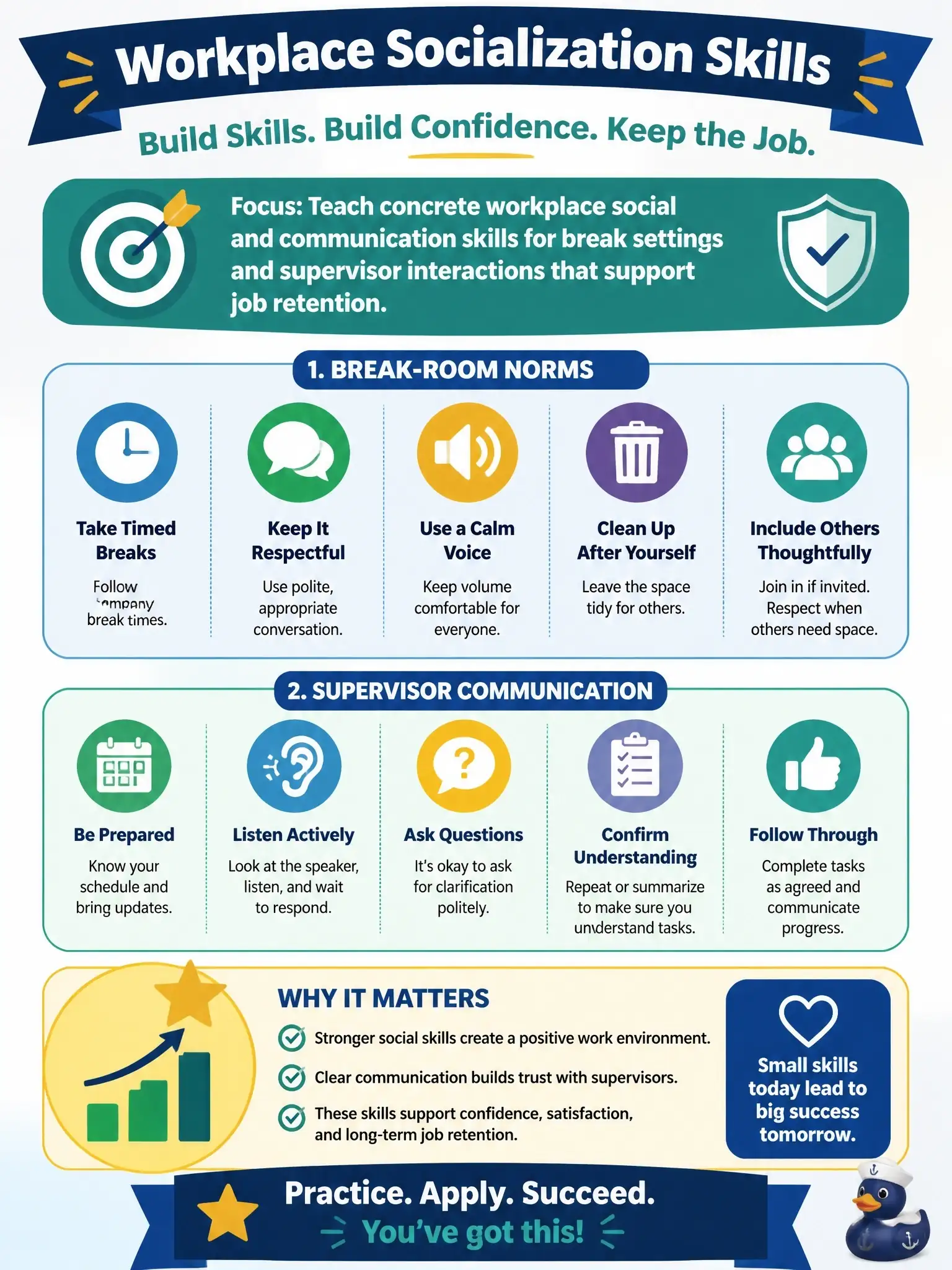
Jobs aren't only task lists—break rooms and supervisor check-ins have unwritten rules. You need to coach concrete workplace social and communication skills for those settings so the client can keep the job without guessing.
Full Explanation
Workplace socialization skills counseling for a newly hired client with autism should focus on teaching concrete social and communication skills for break-room settings and supervisor interactions to support job retention. Civic employment success often hinges on informal norms that are rarely written in job descriptions, yet those norms are learnable through explicit instruction, modeling, and on-the-job supports. The approach that removes the client from all coworker contact as the only retention strategy fails because it over-isolates the client and may not match essential job functions. The approach that assumes social norms are innate and provides no coaching after hire fails because many clients need explicit instruction after hire rather than trial-and-error stigma. The approach that limits counseling to resume fonts and ignores on-the-job social demands fails because retention barriers after hire are interpersonal as well as documentary. Exam caveat: coaching should respect neurodiversity and client goals—teach workable strategies without demanding neurotypical performance for its own sake. Operational check: task-analyze break-room and supervisor interactions, role-play scripts, arrange natural supports or job coaching on site, gather employer feedback with consent, and fade prompts as competence and comfort grow.