
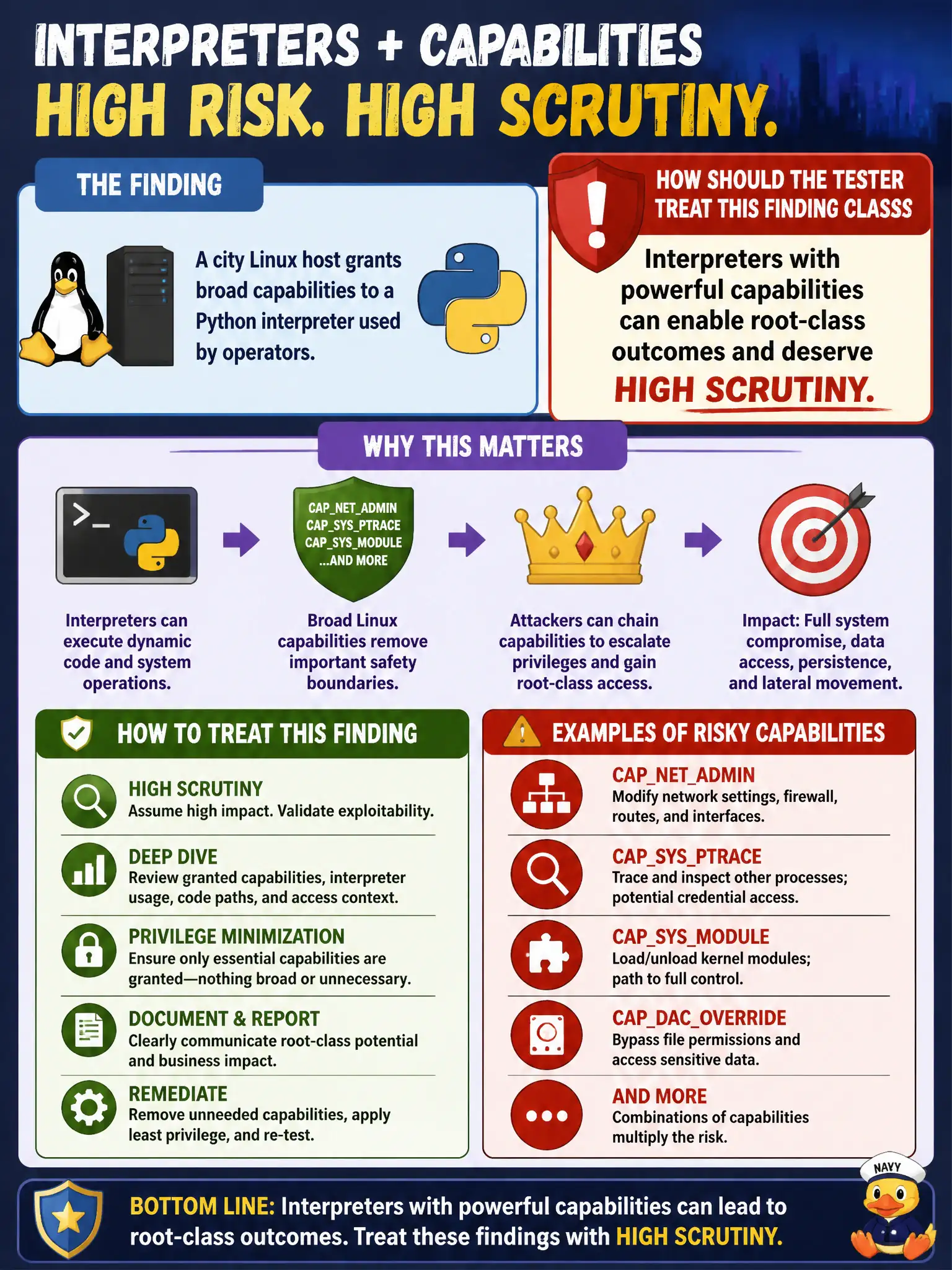
A city Linux host grants broad capabilities to a Python interpreter used by operators. How should the tester treat this finding class?
Select an answer to reveal the explanation.
Short Explanation
Handing a full-power capability set to Python is like giving a Swiss Army knife that also opens the vault. Scripting languages plus dangerous capabilities often equal a short path to high privilege.
Full Explanation
Broad capabilities granted to a Python interpreter used by city operators are a high-scrutiny finding class: interpreters with powerful capabilities can enable root-class outcomes similar to other living-off-the-land escalation paths. Treat capability-bearing scripting runtimes as privileged tools.
Capabilities on interpreters are not cosmetic. Capability bits cannot be ignored merely because setuid binaries also exist—both matter. Python capabilities remain relevant even when SELinux is not in enforcing mode.
Exam caveat: identify which capabilities are assigned and whether operators need them for legitimate civic tasks.
Operational check: inspect capabilities on the interpreter binary and running processes, document privilege boundary impact, and recommend dropping capabilities or wrapping needed tasks in narrower privileged helpers for the city. In municipal operations, record the rationale in the engagement notes so future assessors know which control was chosen and which failure modes the rejected options would create for city services. Re-validate after the next maintenance window that the same finding class still applies under the estate's current patch and configuration baseline.