
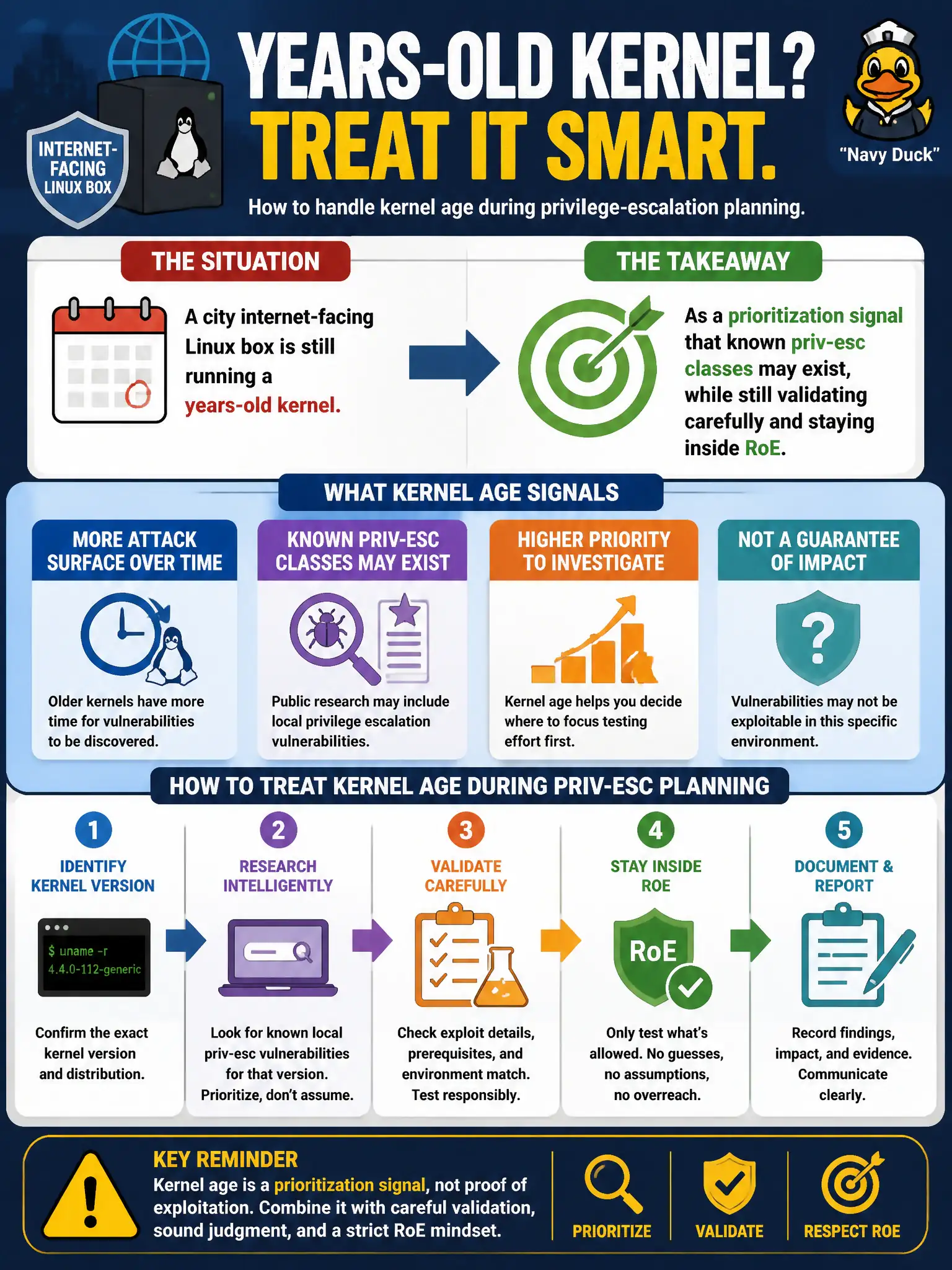
A city internet-facing Linux box is still running a years-old kernel. How should the tester treat that kernel age during privilege-escalation planning?
Select an answer to reveal the explanation.
Short Explanation
An ancient kernel is like a rusty lock on the front door—it screams "check this," but you still do not kick every door with a battering ram. Age raises the chance of known local privilege classes, yet RoE and careful validation still rule. Enumerate, prioritize, then only use approved techniques.
Full Explanation
A city internet-facing Linux box running a years-old kernel is a prioritization signal during privilege-escalation planning: known local privilege-escalation classes may exist, but testers must still validate carefully, match exploits to the exact build, and stay inside RoE—especially on production civic systems.
Kernel age is not automatic permission to run every public exploit online without checks. Age does not imply immunity through mysterious hardening. It is not a reason to skip local enumeration and jump straight to Active Directory attacks when Linux LPE remains in scope.
Exam caveat: many engagements favor misconfig paths over risky public kernel exploits on fragile municipal hosts.
Operational check: record kernel version and patch posture, compare against known issue classes at a high level, seek approval where RoE requires it, and prefer safer misconfiguration proofs when available. Note internet exposure when scoring impact for the city. In municipal operations, record the rationale in the engagement notes so future assessors know which control was chosen and which failure modes the rejected options would create for city services. Re-validate after the next maintenance window that the same finding class still applies under the estate's current patch and configuration baseline.