
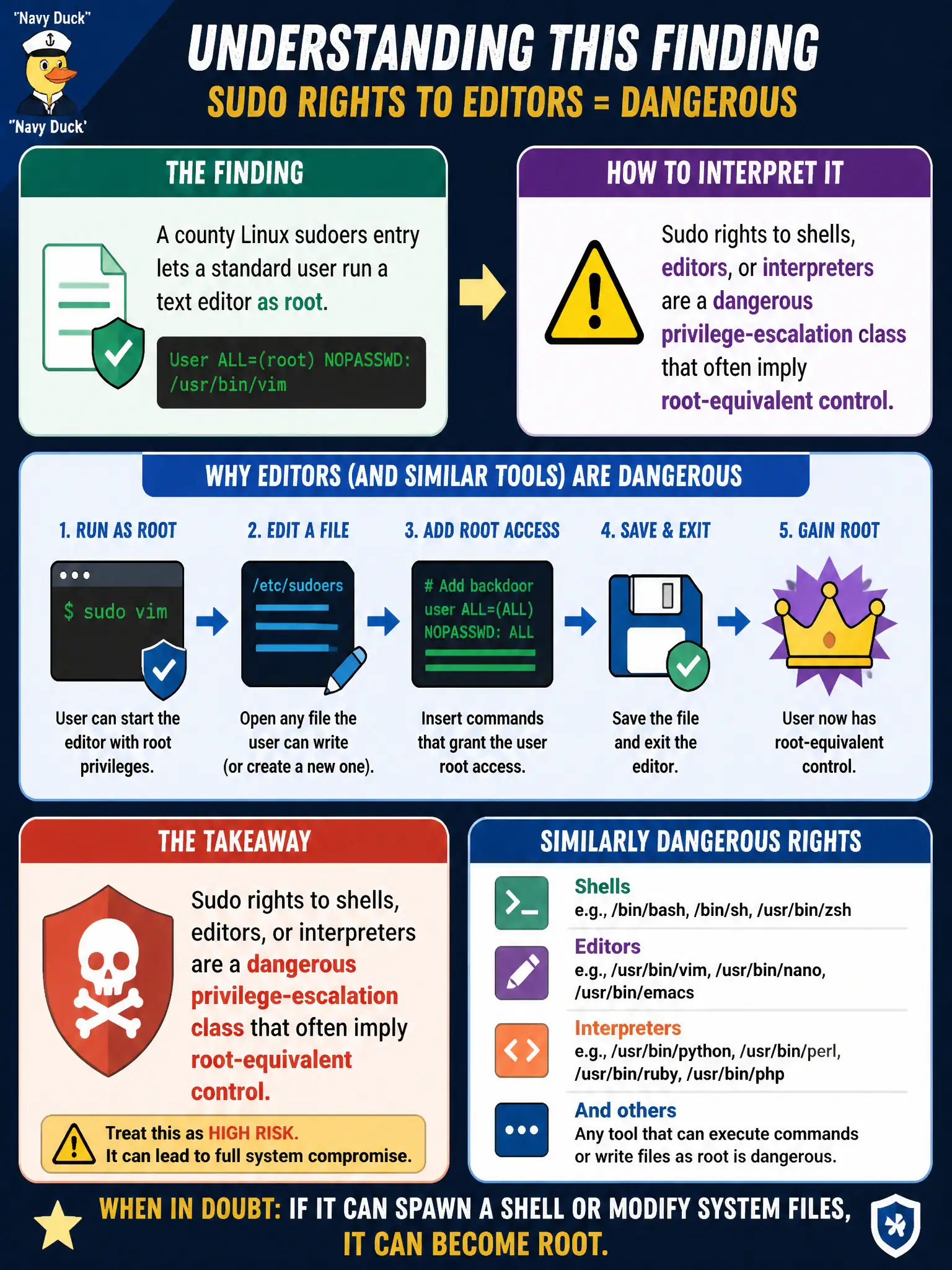
A county Linux sudoers entry lets a standard user run a text editor as root. How should the tester interpret this class of finding?
Select an answer to reveal the explanation.
Short Explanation
Handing someone root's notepad is basically handing them root's keys. Sudo to editors, shells, or interpreters is a classic dangerous sudoers class — conceptually root-equivalent. Bash as the login shell does not make that safe.
Full Explanation
A county Linux sudoers entry allowing a standard user to run a text editor as root is a dangerous privilege-escalation class: editors, shells, and interpreters run via sudo commonly yield root-equivalent control through file writes, shell escapes, or command execution features.
Editors via sudo are not confined to read-only spellcheck. Sudo rights matter for more than package managers—editors and interpreters are classic escalation primitives. A bash login shell does not make a root-editor sudo entry safe.
Exam caveat: discuss GTFOBins-class awareness conceptually; avoid publishing step-by-step abuse recipes in exam-style answers when judgment about risk class is the point.
Operational check: review sudoers for civic operators, flag shell/editor/interpreter escalations, and recommend least-privilege command lists or privileged access workflows that do not grant unconstrained root editors. Capture evidence of the sudo rule without destructive testing. In municipal operations, record the rationale in the engagement notes so future assessors know which control was chosen and which failure modes the rejected options would create for city services. Re-validate after the next maintenance window that the same finding class still applies under the estate's current patch and configuration baseline.