
A city security lead asks how adding layer-3 routes on a compromised foothold differs from using application-layer tunnels for reachability. What conceptual contrast should the tester emphasize?
Select an answer to reveal the explanation.
Short Explanation
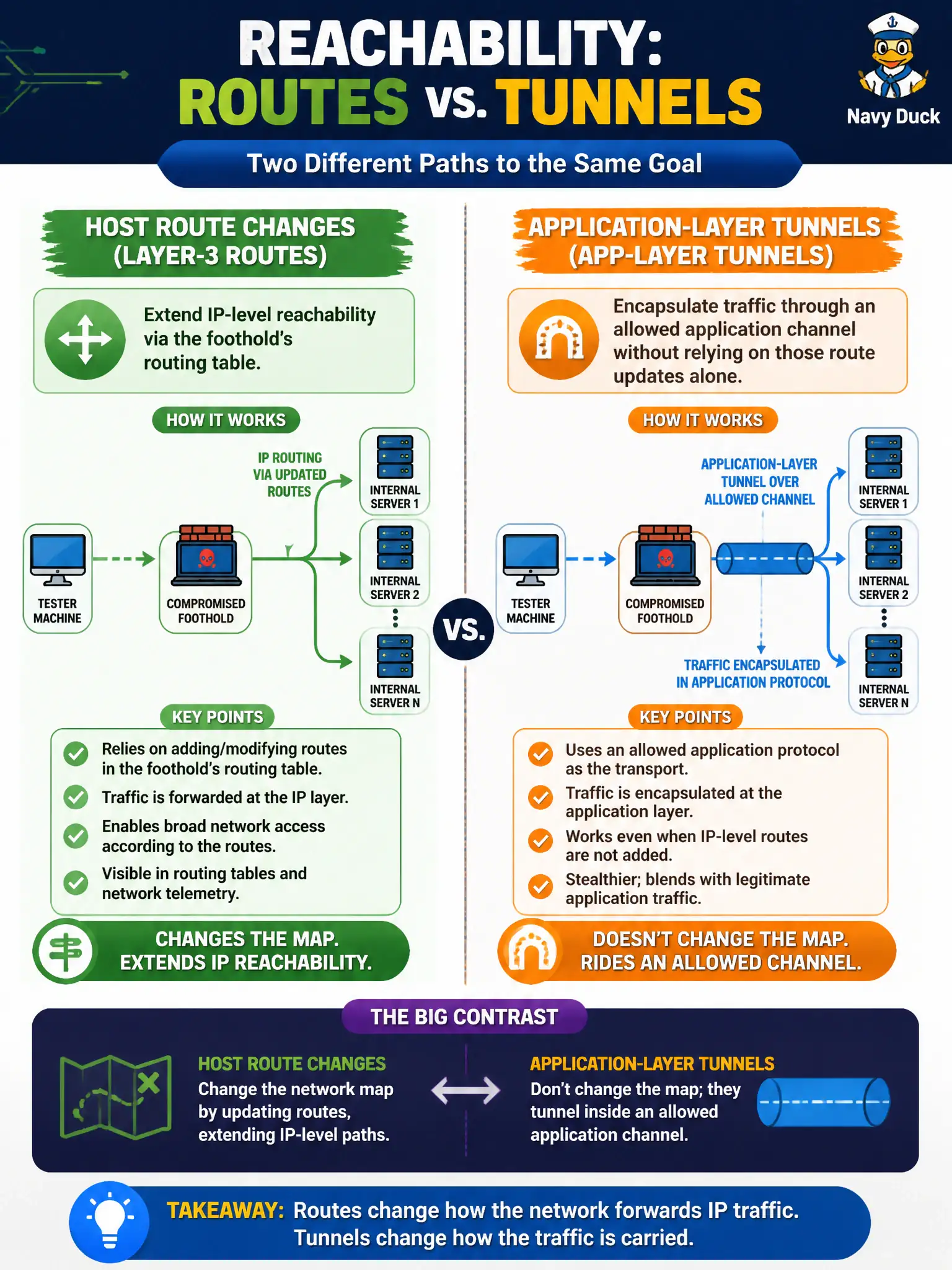
Think of host routes like adding a new road on the foothold's map, and app-layer tunnels like shipping boxes through a mail slot that is already allowed. Same goal — get somewhere — different plumbing. One leans on routing; the other rides an application path.
Full Explanation
When a city security lead asks how adding layer-3 routes on a compromised foothold differs from application-layer tunnels, emphasize that host route changes extend IP-level reachability via the foothold’s routing table, whereas application-layer tunnels encapsulate traffic through an allowed application channel without relying on those route updates alone. The approaches do not permanently rewrite every firewall ACL, so the labels are not interchangeable. It is false that app-layer tunnels only work on Windows while host routes only work on Linux. They are also not identical techniques that always require a new kernel module. Exam caveat: exams test conceptual contrast—routing-table reachability versus encapsulated app channels—not vendor CLI memorization. Operational check: pick the pattern that matches municipal egress/firewall reality, document whether you changed routes or stood up a tunnel, and restore any host routing edits at closeout. In municipal operations, record the rationale in the engagement notes so future testers and city defenders understand which approach was chosen and which failure modes the rejected options would create for civic services. Re-validate the same judgment after the next change window so the control still holds under the city’s current tooling, identity posture, and RoE amendments.