
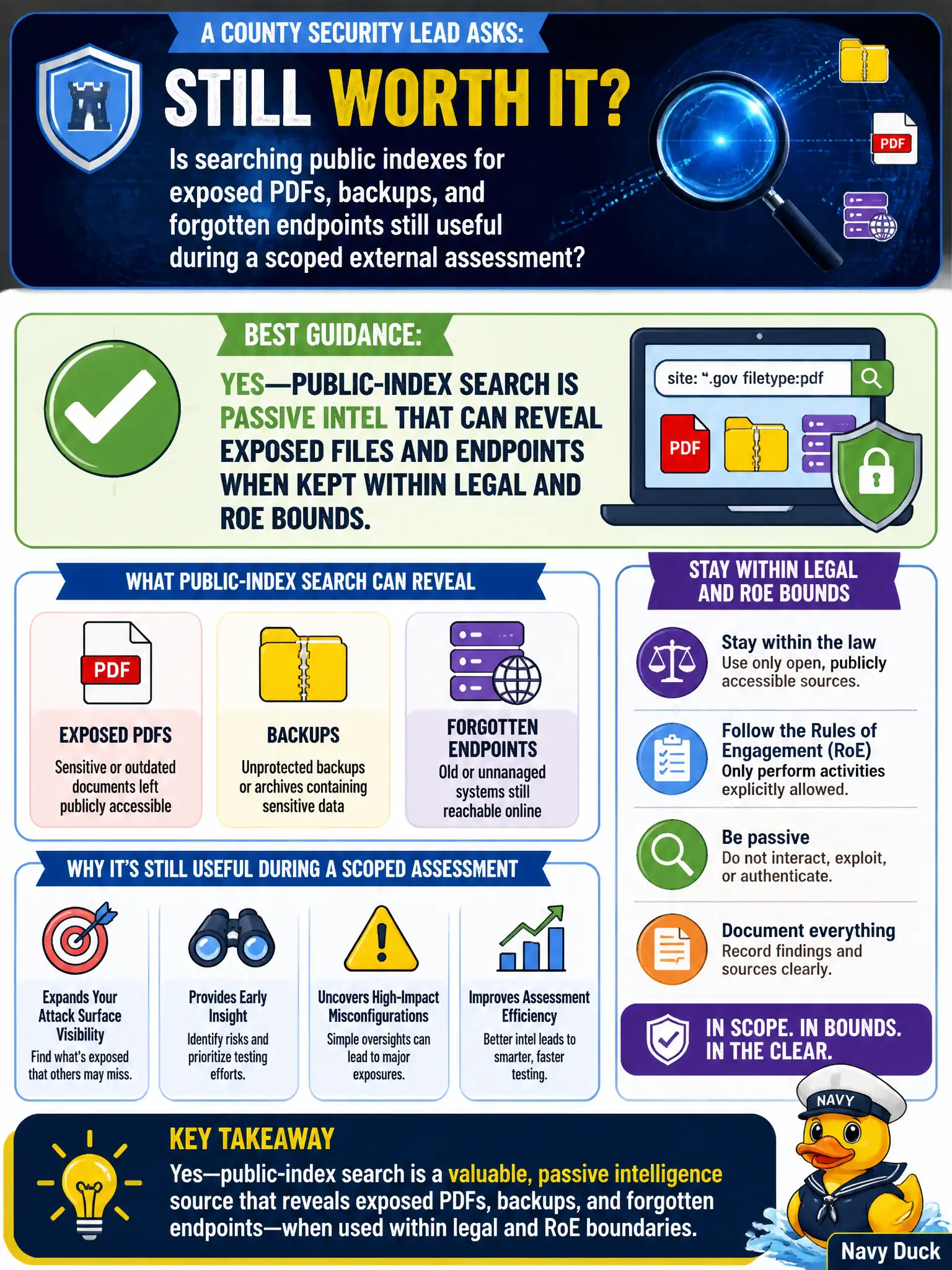
A county security lead asks whether searching public indexes for exposed PDFs, backups, and forgotten endpoints is still useful during a scoped external assessment. What is the best guidance?
Select an answer to reveal the explanation.
Short Explanation
Public search is like checking the community bulletin board before you knock on doors—lots of stuff gets posted that nobody meant to leave up. When the RoE allows it, those indexed crumbs are fair, quiet intel.
Full Explanation
Searching public indexes for exposed PDFs, backups, and forgotten endpoints remains useful during a scoped external county assessment: public-index search is passive intel that can reveal exposed files and endpoints when kept within legal and RoE bounds. Public search engines are not obsolete for municipal asset discovery. This work need not wait until after a foothold; it is classic early recon. Disabling robots.txt is not a prerequisite for thoughtful public search of already indexed content. Exam caveat: do not download or redistribute sensitive resident data beyond minimal proof, and follow notification rules if exposures appear. Operational check: run targeted queries for county domains and file types, validate hits still resolve, capture evidence with least data necessary, and report exposed backups or endpoints promptly. Document the rationale in the municipal engagement notes so later civic responders know which boundary was honored and which failure modes the rejected options would create for public services. Document the rationale in the municipal engagement notes so later civic responders know which boundary was honored and which failure modes the rejected options would create for public services.