
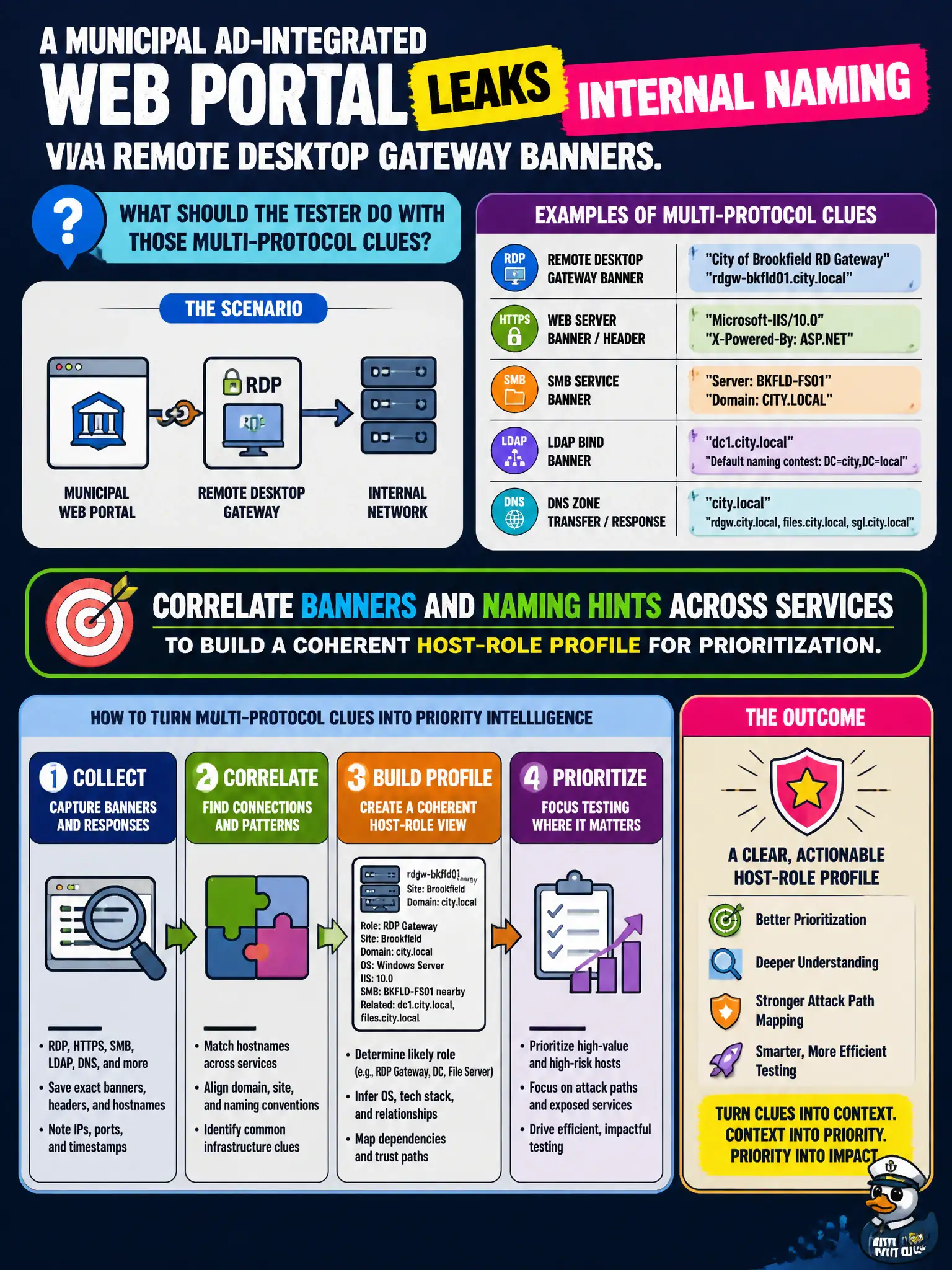
A municipal AD-integrated web portal leaks internal naming via remote desktop gateway banners. What should the tester do with those multi-protocol clues?
Select an answer to reveal the explanation.
Short Explanation
Clues from the web portal and the gateway are puzzle pieces from the same box. Snap the naming hints together and the host's role gets clearer. That profile guides where to spend the next hour — it is not instant domain admin.
Full Explanation
When a municipal AD-integrated web portal leaks internal naming via remote desktop gateway banners, correlate banners and naming hints across services to build a coherent host-role profile for prioritization. Protocol banners are not isolated trivia; multi-protocol clues refine targeting. Gateway banners are valid recon evidence alongside cookies and other web artifacts. Internal naming leaks do not by themselves prove domain admin compromise has already occurred. Exam caveat: keep correlation notes clear so the city sees how non-web services informed web-app risk. Operational check: collect RDG and web banners, extract naming patterns, map likely roles and trusts, and use that profile to guide authorized deeper tests without over-claiming compromise. Document the rationale in the municipal engagement notes so later civic responders know which boundary was honored and which failure modes the rejected options would create for public services. Document the rationale in the municipal engagement notes so later civic responders know which boundary was honored and which failure modes the rejected options would create for public services. Document the rationale in the municipal engagement notes so later civic responders know which boundary was honored and which failure modes the rejected options would create for public services.