
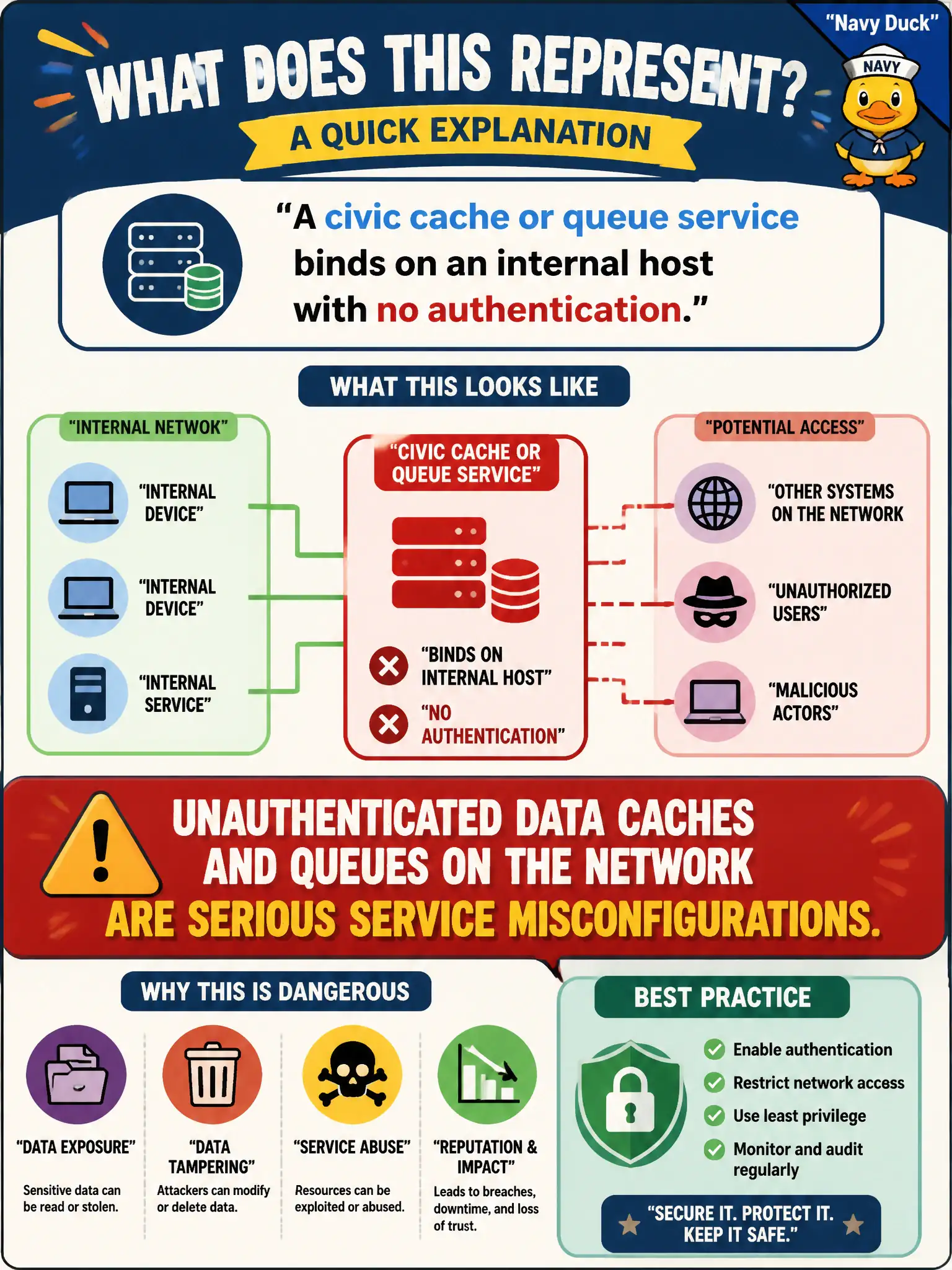
A civic cache or queue service binds on an internal host with no authentication. What does that represent?
Select an answer to reveal the explanation.
Short Explanation
A cache or queue with no login is an open notebook on the conference table—anyone on that network can read or scribble. Internal doesn’t mean trusted forever. Put auth on it and limit who can connect.
Full Explanation
A civic cache or queue service bound on an internal host with no authentication represents an unauthenticated data service misconfiguration that can expose or alter application data once any network path reaches it. Internal placement alone does not make no-auth services safe; pivots and insider paths routinely reach “internal only” listeners in city environments. Missing authentication is not merely a performance metrics issue—it is an access-control failure on data in motion and at rest in the broker. Preferring queues without auth so microservices never need credentials optimizes developer convenience over municipal data protection. Exam caveat: classify by exposure and sensitivity of queued data, not by whether the service is trendy infrastructure. Operational check: show unauthenticated connect/read or write capability from the approved segment under RoE, identify data classes present, recommend authn/authz, network restriction to app tiers, and TLS where supported before production use continues. In municipal operations, record the rationale in the engagement notes so future testers and city defenders understand which approach was chosen and which failure modes the rejected options would create for civic services.