
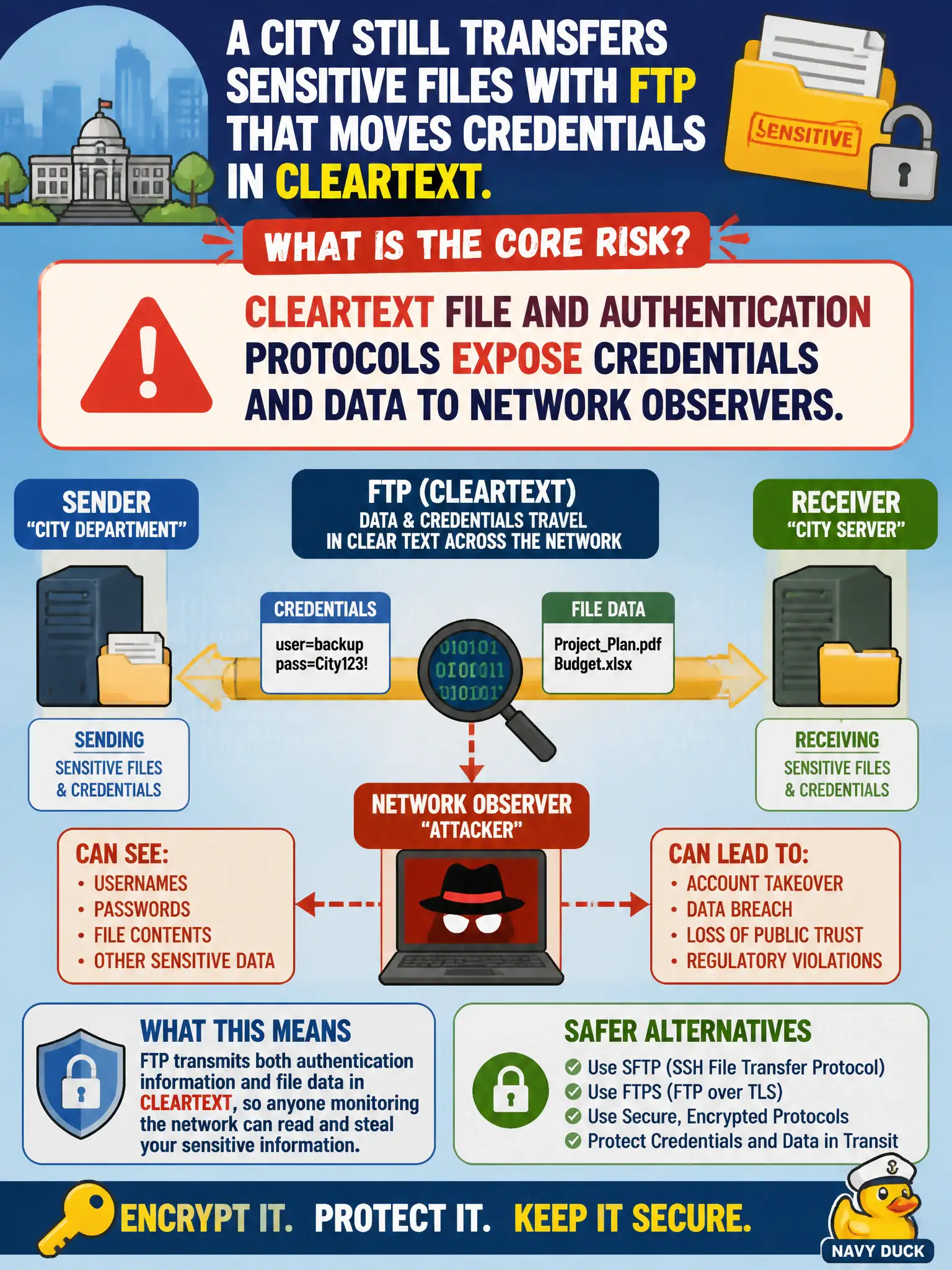
A city still transfers sensitive files with FTP that moves credentials in cleartext. What is the core risk?
Select an answer to reveal the explanation.
Short Explanation
FTP is the postcard of file transfer—anyone along the path can read it, including the login. Sensitive city data deserves sealed envelopes like SFTP or HTTPS. If credentials ride in the clear, treat that as a real finding.
Full Explanation
When a city still transfers sensitive files with FTP that moves credentials in cleartext, the core risk is that cleartext file and authentication protocols expose credentials and data to network observers—including anyone who can see transit on shared civic segments. FTP is not “safe on internal networks” merely because it is not on the public internet; insider and pivot paths still observe cleartext. Hiding the FTP banner does not encrypt the channel and is not a substitute for a protected protocol. Limiting FTP risk discussion to client laptop disk encryption misses the in-flight credential and data exposure that network attackers exploit. Exam caveat: cleartext protocol findings stand even when the server is patched and the banner is muted. Operational check: capture authorized evidence of cleartext auth or file transfer under RoE, map which municipal data classes traverse the service, and recommend SFTP/FTPS or another encrypted channel with credential migration and decommission of plain FTP. In municipal operations, record the rationale in the engagement notes so future testers and city defenders understand which approach was chosen and which failure modes the rejected options would create for civic services.