
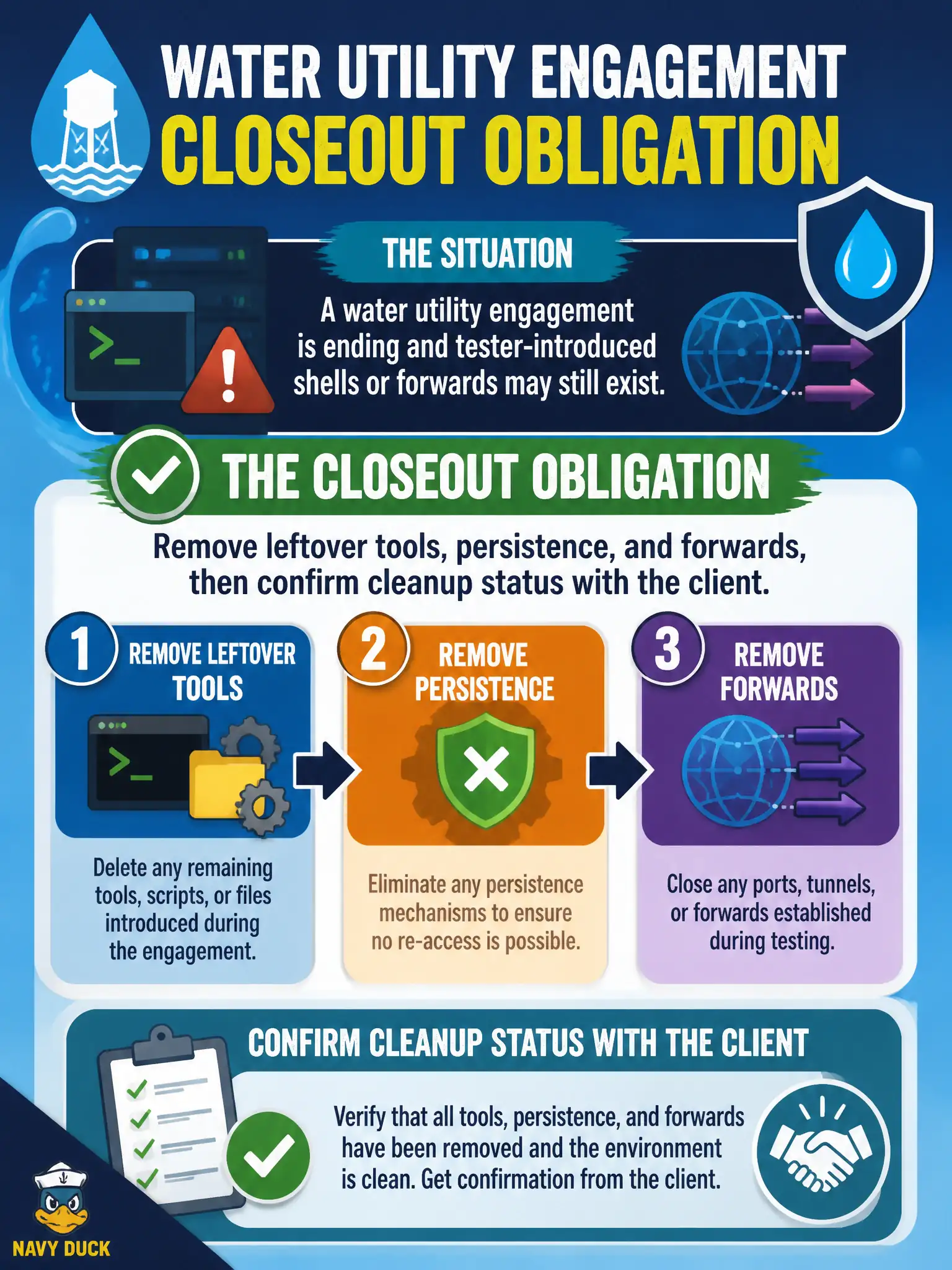
A water utility engagement is ending and tester-introduced shells or forwards may still exist. What closeout obligation applies?
Select an answer to reveal the explanation.
Short Explanation
Pack out what you packed in. Leftover shells on a water utility are not souvenirs—they are unfinished business you clean up and confirm.
Full Explanation
At the end of a water utility engagement, tester-introduced shells, persistence, or forwards must be removed, and cleanup status confirmed with the client. Leaving access artifacts in industrial or utility environments is a serious closeout failure.
Leaving persistence as a 'free monitoring gift' is unauthorized risk. Transferring shell ownership to an unknown third party is unethical. Documenting shells in the report while skipping removal does not satisfy cleanup obligations.
Exam caveat: if removal needs a maintenance window, obtain written acknowledgment of temporary residual access and a removal plan.
Operational check: inventory all implants and tunnels, remove them, verify with the utility contact, and attach cleanup attestation to the final delivery package. In municipal operations, record the rationale in the engagement notes so future assessors know which control was chosen and which failure modes the rejected options would create for city services. Re-validate after the next maintenance window that the same finding class still applies under the estate's current patch and configuration baseline. In municipal operations, record the rationale in the engagement notes so future assessors know which control was chosen and which failure modes the rejected options would create for city services.