
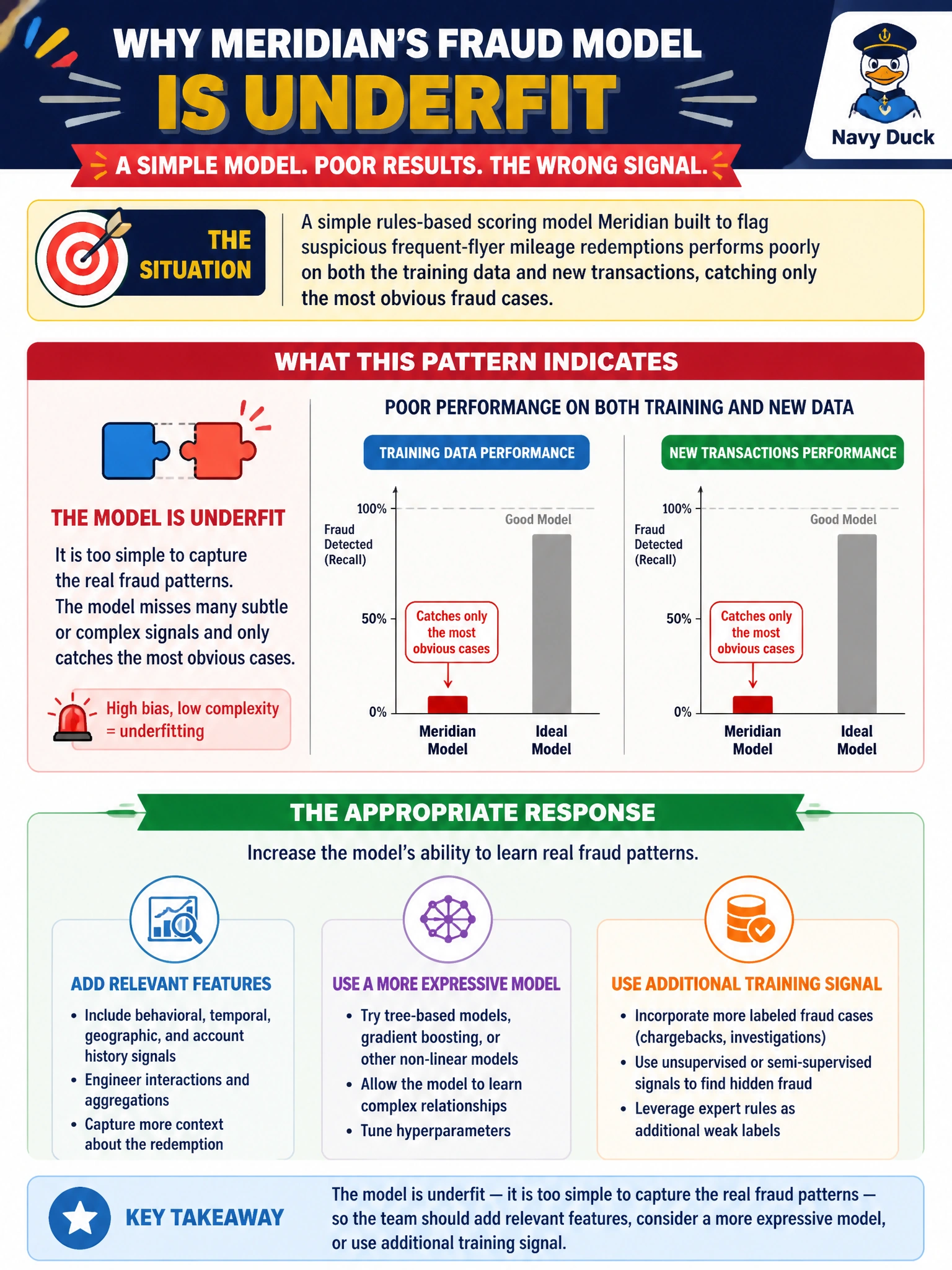
A simple rules-based scoring model Meridian built to flag suspicious frequent-flyer mileage redemptions performs poorly on both the training data and new transactions, catching only the most obvious fraud cases. What does this pattern indicate, and what is the appropriate response?
Select an answer to reveal the explanation.
Short Explanation
Underfitting is a model that never even learned the practice material — it does poorly whether you quiz it on old questions or new ones. The fix is the opposite of overfitting: give it more signal and more capacity, not less.
Full Explanation
Poor performance on both training and unseen data is the classic signature of underfitting: the model is too simplistic to represent the true relationship between transaction features and fraudulent behavior, so it fails everywhere rather than just on new data. The right move is to increase model expressiveness or add richer features (transaction velocity, account-history anomalies, device fingerprinting) and re-evaluate — the opposite direction from an overfitting fix. Overfitting produces the reverse pattern: strong training performance, weak generalization — not what is described here, so adding regularization would only make an already-too-simple model worse. Proceeding to production unchanged ignores that catching only obvious fraud defeats the point of the system; loyalty-program fraud detection exists precisely to catch the cases that are not obvious. Discarding the training data entirely is an overreaction — the data itself may be adequate; the diagnosis points to model capacity and feature richness as the fixable problem, not to abandoning the fraud-detection effort altogether.