
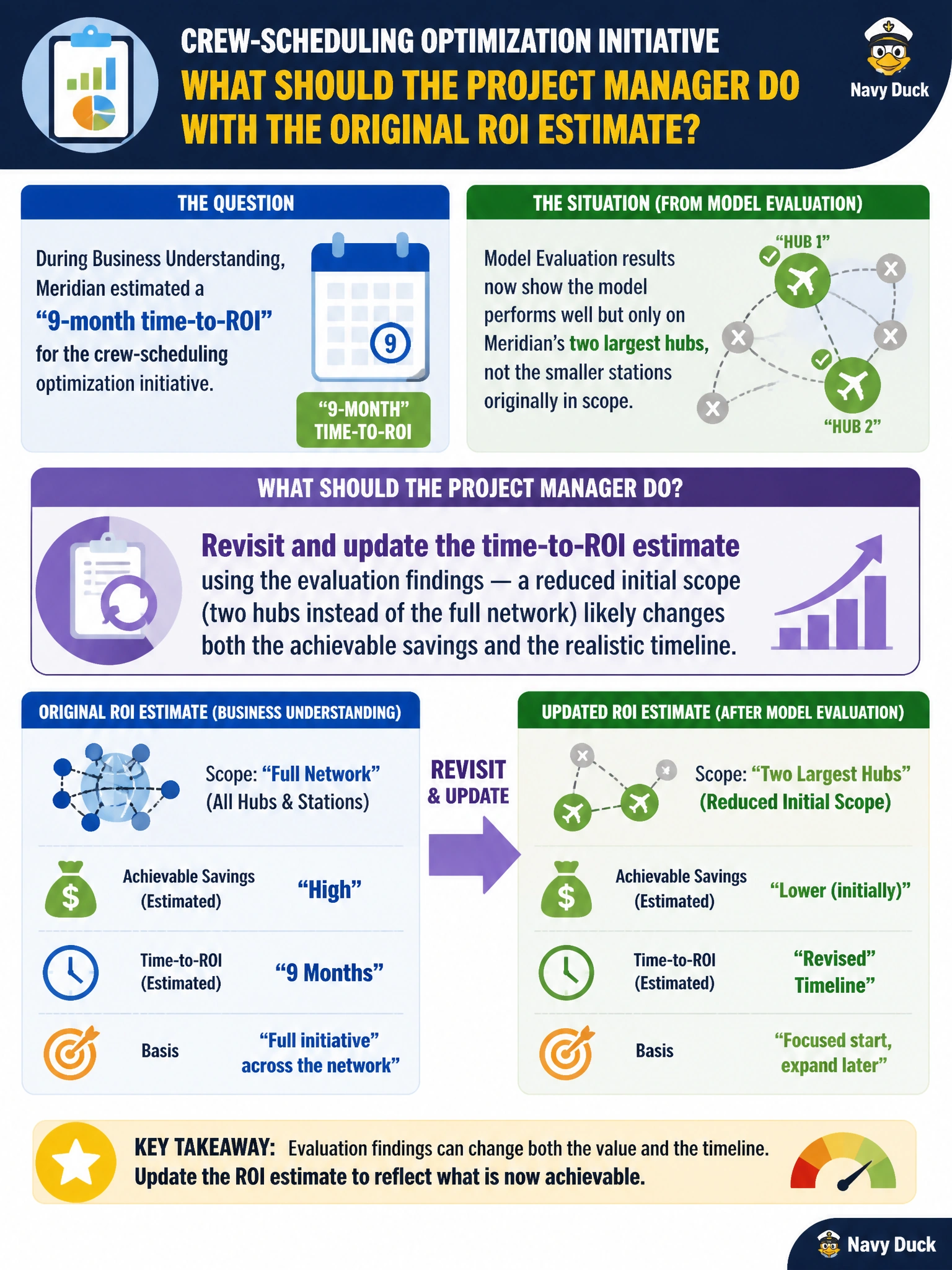
During Business Understanding, Meridian estimated a 9-month time-to-ROI for the crew-scheduling optimization initiative. Model Evaluation results now show the model performs well but only on Meridian's two largest hubs, not the smaller stations originally in scope. What should the project manager do with the original ROI estimate?
Select an answer to reveal the explanation.
Short Explanation
Reality just handed you new information — the model only really works at the two big hubs for now. That changes the math on both the payoff and the timeline, so the honest move is to go update the ROI estimate, not defend the old one.
Full Explanation
CPMAI's Business Understanding task calls for estimating time-to-ROI, but that estimate is a working projection, not a fixed commitment immune to later evidence — and Model Evaluation findings are exactly the kind of evidence that should feed back into it. Learning that the model performs well only at the two largest hubs, not across the full network as originally scoped, materially changes both the realistic savings (a smaller deployment footprint) and the timeline (smaller stations may need more data, more tuning, or a later rollout), so the honest and methodologically sound move is to revisit and update the ROI estimate using this new information. Leaving the original estimate untouched misleads finance and leadership about what the project will actually deliver and when. Discarding ROI estimation altogether overreacts to one revised number — CPMAI still expects ongoing ROI tracking, just recalibrated with better information as the project matures. Assuming smaller stations will 'catch up automatically' without evidence or a plan is an unfounded assumption that ignores the actual evaluation finding (that scope is currently narrower than planned) and risks repeating the overpromising problem CPMAI explicitly warns against. The exam point: ROI estimation is a living project artifact revisited across phases, not a one-time Business Understanding deliverable set in stone.