
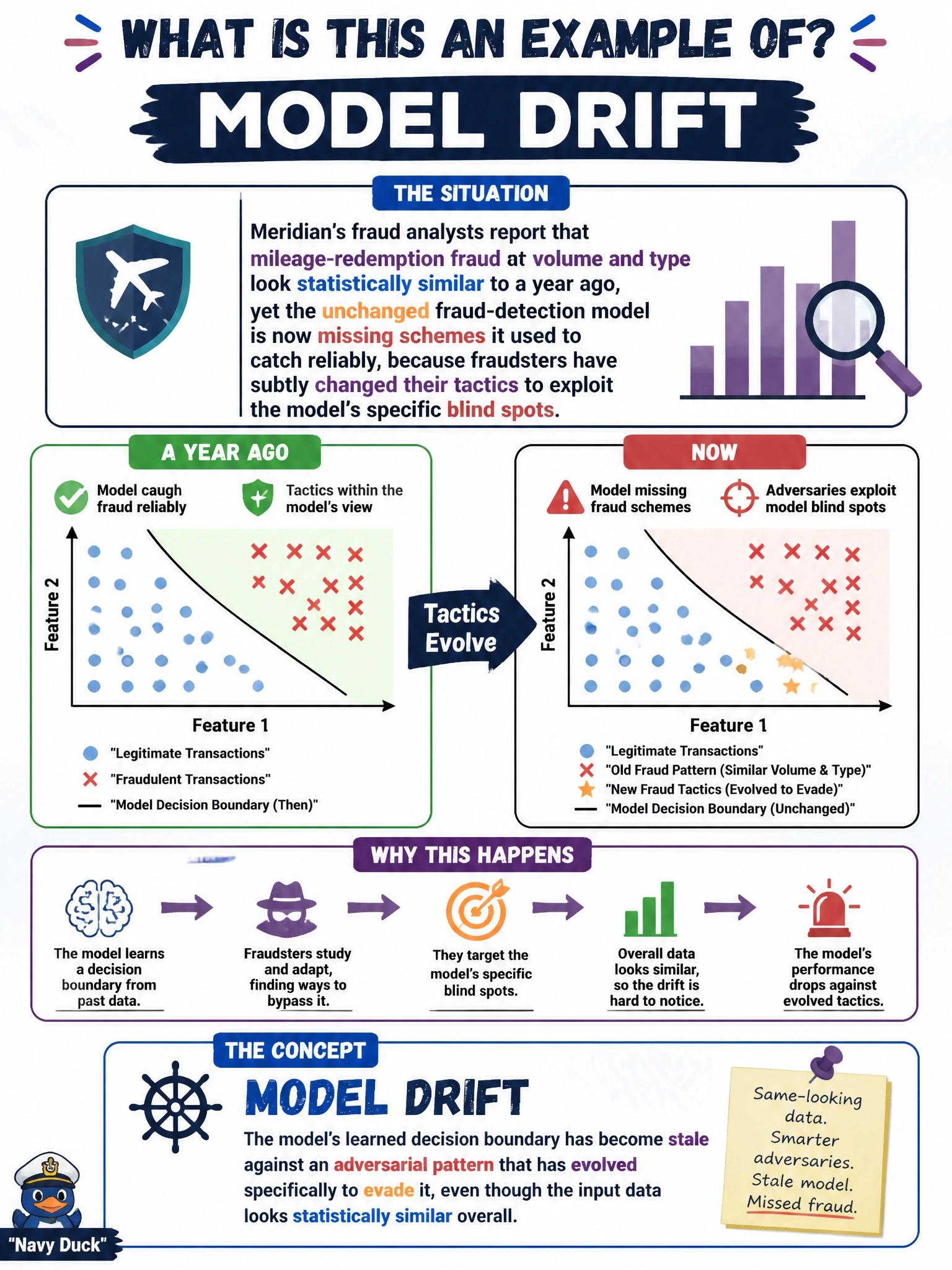
Meridian's fraud analysts report that mileage-redemption fraud volume and type look statistically similar to a year ago, yet the unchanged fraud-detection model is now missing schemes it used to catch reliably, because fraudsters have subtly changed their tactics to exploit the model's specific blind spots. What is this an example of?
Select an answer to reveal the explanation.
Short Explanation
The inputs look the same on paper, but fraudsters have learned exactly where the model's blind spots are and started aiming for them. That's model drift with an adversarial twist — the relationship the model learned has quietly stopped working.
Full Explanation
This is model drift, and specifically the adversarial flavor of it common in fraud detection: the overall input statistics look similar to a year ago, but the model's learned decision boundary is now stale because fraudsters have deliberately adapted their tactics to slip past this specific model's known blind spots. The relationship between inputs and correct fraud/not-fraud outputs has decayed even though the aggregate input distribution hasn't obviously shifted — that's the defining trait of model drift as distinct from data drift, and CPMAI's Model Evaluation and Maintenance task explicitly calls for monitoring both. Calling this data drift is a near-miss but wrong: the stem states the incoming transaction data looks statistically similar overall, not visibly changed, which points away from a data-drift diagnosis. A one-time Data Preparation defect would have caused poor performance from the start of deployment, not a gradual decline after a year of reliable detection. Blaming the original Phase IV Go/No-Go is misplaced — that gate correctly certified a model that performed well when it was built; it can't be faulted for not anticipating future adversarial adaptation, which is precisely why ongoing evaluation and iteration exist after deployment. The exam point: fraud and security use cases are classic settings for model drift, since bad actors actively adapt to evade a known, unchanging model.