
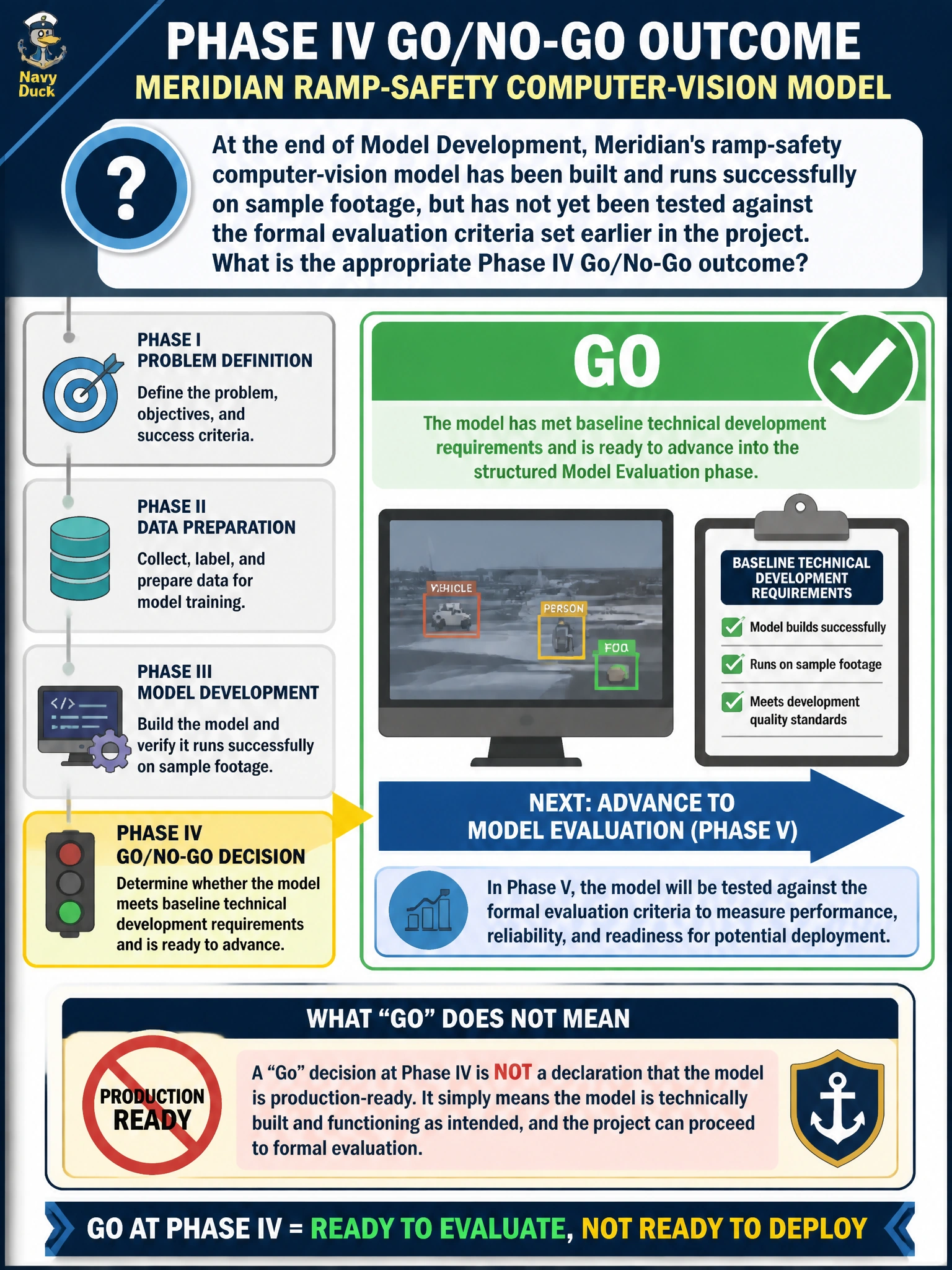
At the end of Model Development, Meridian's ramp-safety computer-vision model has been built and runs successfully on sample footage, but has not yet been tested against the formal evaluation criteria set earlier in the project. What is the appropriate Phase IV Go/No-Go outcome?
Select an answer to reveal the explanation.
Short Explanation
A Phase IV 'Go' just means 'good enough to formally test' — not 'ready to run on a live ramp.' That's what Phase V, Model Evaluation, is for. Don't confuse clearing one gate with clearing all of them.
Full Explanation
A Phase IV (Model Development) Go/No-Go is scoped to that phase's purpose: confirming the model has reached a baseline of technical functionality and is ready to move forward into the structured, criteria-based testing of Model Evaluation. Running successfully on sample footage without yet being measured against the formal evaluation criteria is exactly the state a Go decision at this checkpoint describes — the model has cleared development, not evaluation. Declaring a No-Go simply because formal evaluation hasn't happened yet misunderstands the phase order — evaluation against business criteria is Phase V's job, not a prerequisite for passing Phase IV. Treating a Phase IV Go as approval for full production deployment skips two entire phases (Model Evaluation and Operationalization readiness checks) and would put a computer-vision safety system on a live ramp without the criteria-based testing CPMAI requires for exactly this kind of safety-relevant use case — a serious methodology violation. Skipping the Phase IV Go/No-Go altogether removes CPMAI's built-in checkpoint discipline and lets an under-tested model drift forward without anyone formally confirming it's ready for the next stage. The exam point: each phase's Go/No-Go only certifies readiness for the next phase, never for production itself until Operationalization is actually reached.