
Meridian's PM is preparing two separate Go/No-Go checkpoints for the demand-forecasting initiative: one at the end of Model Development, one at the end of Model Evaluation. What is the key difference in what each checkpoint should confirm?
Select an answer to reveal the explanation.
Short Explanation
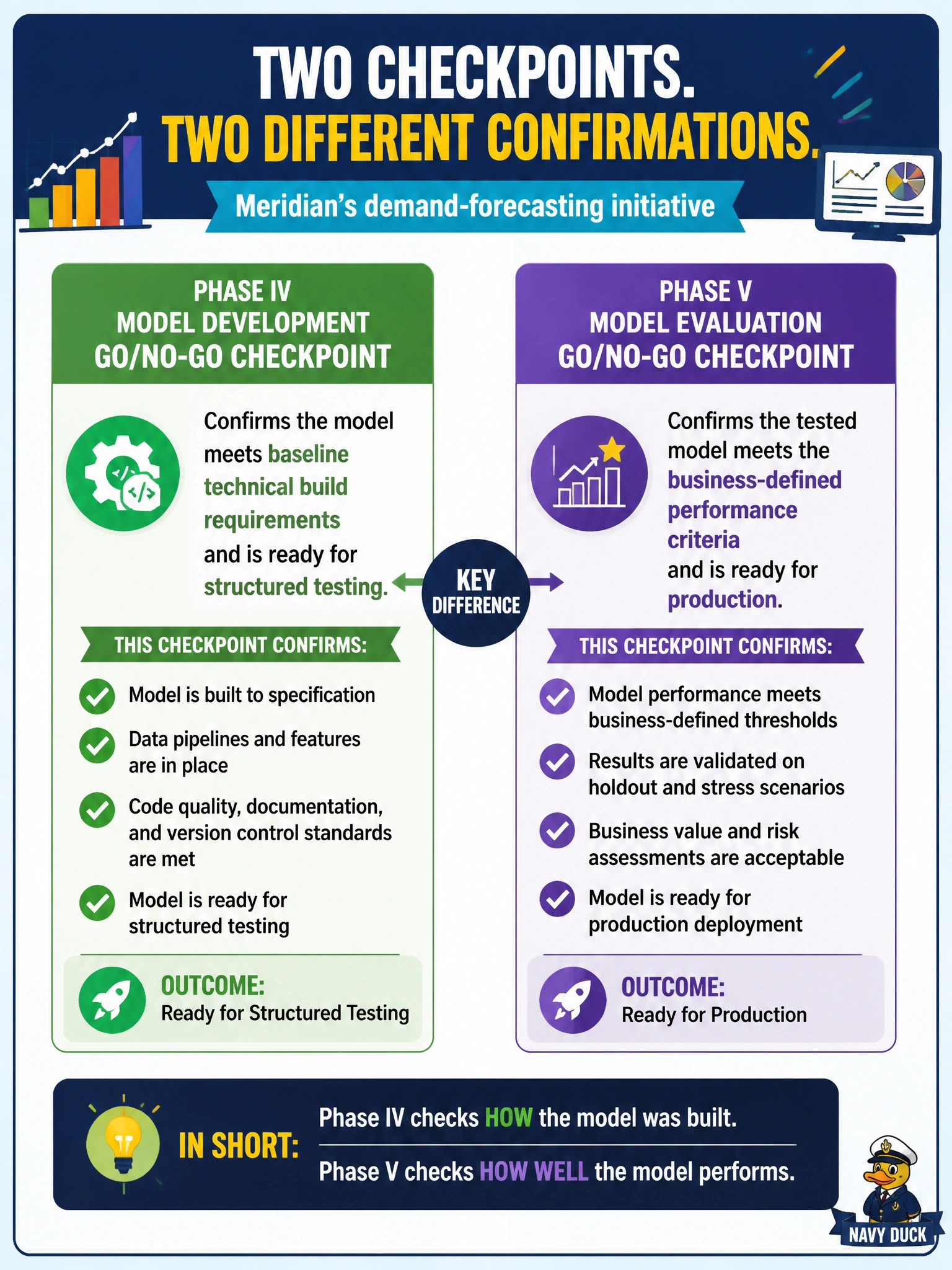
Think of it as two different questions asked in order: 'Did we build something worth testing?' (Phase IV), then 'Did the tested thing actually meet the bar we set for the business?' (Phase V). Mixing those up is a phase-order mistake.
Full Explanation
Each CPMAI phase ends with its own Go/No-Go assessment tied to that phase's specific purpose, and Phase IV and Phase V ask genuinely different questions even though both concern the same model. The Phase IV (Model Development) Go/No-Go confirms the model has been built to a baseline technical standard and is ready to move into structured, criteria-based testing — essentially, 'is there something worth formally evaluating?' The Phase V (Model Evaluation) Go/No-Go comes after that testing and confirms whether the model, now measured against the business-tied evaluation criteria established earlier, is actually ready for Operationalization. Treating the two as identical collapses a deliberate two-stage check into one, losing the distinct purpose of each gate. Framing Phase IV as purely budget and Phase V as purely technical mischaracterizes both — Go/No-Go assessments at every phase weigh technical readiness together with business fit, not one to the exclusion of the other. Reversing the order so evaluation precedes development is logically backwards: while evaluation criteria should indeed be defined early (ideally during Business Understanding), the evaluation of a built model can only happen after Model Development produces something to test. The exam point: know which phase's Go/No-Go answers which question, in the fixed six-phase order.